🎧 Listen to this story
Narrated by Schedar · 7,506 characters
When the Room Started Spinning, Kiwi Was Already There
Sarah Mendez had been living with panic disorder for six years before she got Kiwi, a four-year-old green-cheeked conure with a personality bigger than his four-inch body. She adopted him on a whim from a rescue shelter in Austin, Texas, never imagining that this tiny bird with a crooked tail feather would one day become her most important source of emotional support.
What happened over the following two years is the kind of story that makes you rethink what animals are truly capable of, and what connection between species can look like when it grows without being forced.
A Little Background: What Panic Attacks Actually Feel Like
For those who have never experienced a panic attack, it can be difficult to understand the sheer physical and emotional overwhelm involved. Sarah describes hers this way:
“It feels like the world is collapsing inward. My chest tightens, I can’t catch my breath, my hands go numb, and somewhere in the back of my mind a voice is screaming that something is terribly wrong, even when nothing is.”
Panic disorder affects roughly 2 to 3 percent of adults in the United States, according to the Anxiety and Depression Association of America. Many people manage it with therapy, medication, or both. But for Sarah, the unpredictability of her episodes made daily life a constant negotiation with fear.
She had coping tools. She had a therapist she trusted. What she didn’t have, until Kiwi, was someone who noticed the moment things started to go wrong.
The First Time Kiwi Noticed
It started about three months after she brought him home. Sarah was sitting at her kitchen table paying bills when a familiar wave of dread began to build in her chest. She hadn’t said anything out loud. She hadn’t moved dramatically. But Kiwi, who had been quietly preening on his play stand across the room, went still.
Then he flew directly to her shoulder.
“He pressed his whole body against my cheek,” Sarah recalls. “He started making this low, soft sound he had never made before. Not talking, not chirping. Just this steady little hum. And I started crying, but the panic didn’t take over the way it usually does.”
She didn’t think much of it at the time. Birds are curious. Maybe he had heard something. Maybe it was coincidence.
It happened again the following week. And the week after that.
A Pattern Nobody Taught Him
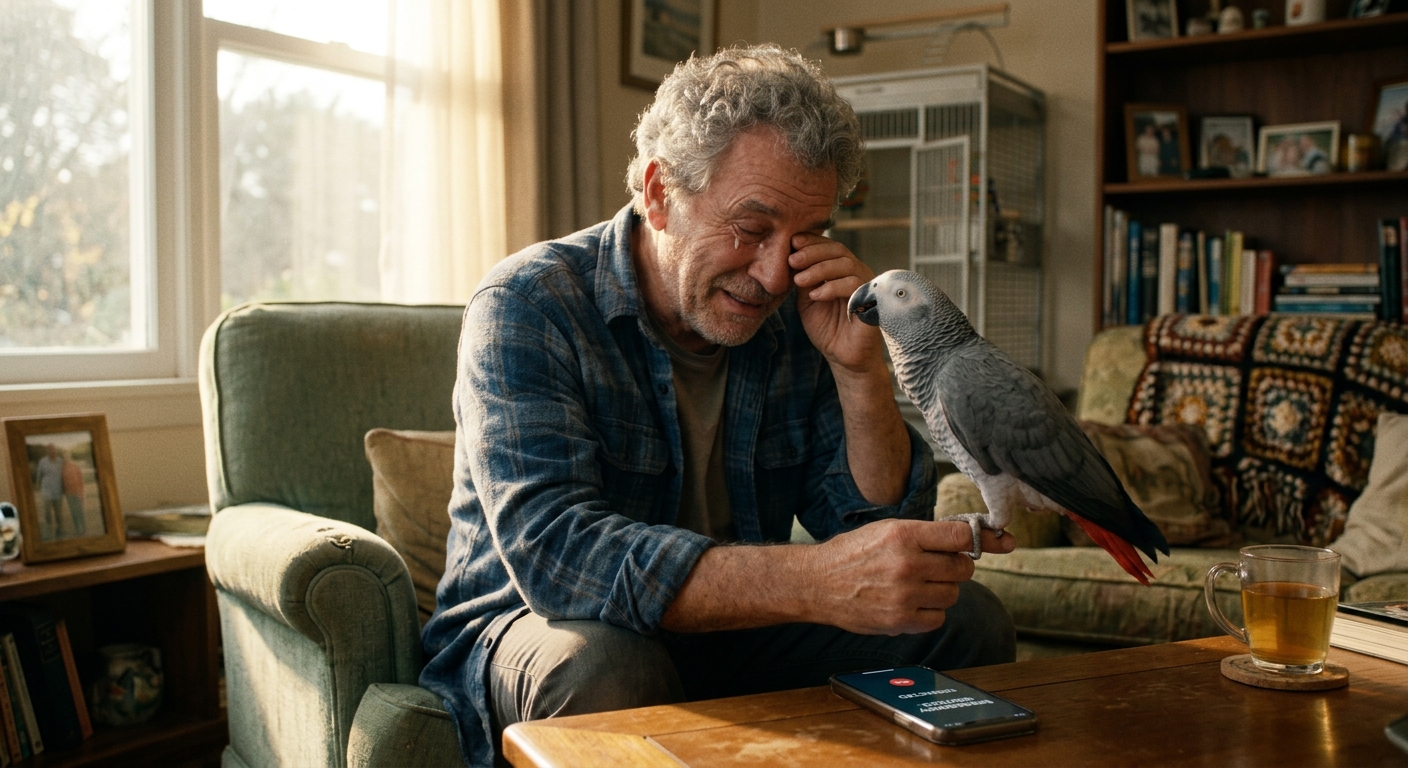
Over the next several months, a clear and undeniable pattern emerged. Kiwi would detect something, likely a shift in Sarah’s breathing, body language, or even scent, before the panic attack reached its peak. He would leave whatever he was doing, fly to her, and begin his signature comfort routine:
- Pressing his body firmly against her neck or cheek
- Vocalizing in a low, repetitive, soothing tone
- Gently tugging at her hair or earlobe, as if asking her to focus on him
- Staying put, sometimes for twenty minutes or more, until her breathing normalized
Sarah never trained him to do this. There was no treat reward system, no command he was responding to. Kiwi, it seemed, had simply decided on his own that this was his job.
What Does Science Say About Animal Emotional Intelligence?
While Kiwi’s behavior might sound extraordinary, animal behaviorists say it fits within what we know about parrots and emotional attunement. Dr. Irene Pepperberg, whose decades of research on African grey parrots reshaped our understanding of avian cognition, has long argued that parrots possess sophisticated social awareness.
Parrots are flock animals by nature. In the wild, they are constantly reading the emotional states of those around them, watching for signs of distress, danger, or illness. When a parrot lives with humans, we become the flock. And some birds, particularly those with strong bonds to their owners, appear to extend that vigilance to include human emotional states.
“Parrots are not just mimicking behavior,” explains one avian behavior consultant. “They are often responding to real, perceived need. They want the flock to be okay. That instinct doesn’t disappear in domestication. In some birds, it becomes even more focused.”
The Ripple Effect on Sarah’s Mental Health
Something shifted for Sarah once she recognized what Kiwi was doing. Not only did his physical presence during episodes help regulate her nervous system, but knowing he was watching, that she was not alone in her own home, reduced the anticipatory anxiety that often precedes panic attacks.
“I used to be terrified of being alone during an episode,” she says. “That fear would sometimes trigger the panic itself. But with Kiwi there, I stopped dreading it as much. He became my safety net in a way no human could quite replicate, because he’s just always there. No scheduling, no explanations needed.”
Her therapist took note. While Kiwi is not a certified emotional support animal, the documented impact on Sarah’s daily functioning led her care team to formally acknowledge him as part of her mental health support structure.
What Kiwi Taught Sarah About Asking for Help
There is a quieter lesson buried inside this story, one that Sarah only began to articulate recently.
“Kiwi never hesitates,” she says. “He doesn’t second-guess whether I actually need him. He doesn’t wonder if he’ll be a burden. He just comes. And watching him do that, over and over, made me realize how rarely I let people do that for me.”
She began, slowly, to let her friends in. To text someone when a bad episode was coming instead of white-knuckling it alone. To let her sister sit with her without explaining or minimizing. Kiwi, in a very real sense, modeled the kind of uncomplicated presence that human connection sometimes struggles to offer.
Three Things Kiwi’s Story Reminds Us
- Comfort doesn’t require language. Some of the most powerful support we receive is wordless, and that is not lesser. It is often more.
- Connection heals in ways we can’t always measure. Kiwi’s impact on Sarah isn’t captured in clinical data. It lives in the moments she didn’t spiral.
- Animals see us more clearly than we think. They don’t see our diagnoses or our fears about being too much. They just see us, and they show up.
A Note for Anyone Living With Anxiety
Sarah’s story is not a prescription. Not everyone needs a parrot, and not every parrot will become a Kiwi. But what her experience points to is something worth sitting with: healing rarely comes from a single source, and sometimes the most unexpected relationships carry the most transformative weight.
If you are managing panic disorder or anxiety, speak with a mental health professional about all your options, including the very real, growing field of animal-assisted therapy. The evidence base is expanding, and the stories are compelling.
And if you happen to share your home with a bird, a dog, a cat, or any creature who has ever pressed close to you on a hard day, consider this: they may know more about what you need than you have given them credit for.
Kiwi Today
As of the writing of this piece, Kiwi is six years old, still crooked-tailed, still opinionated about which vegetables he will accept, and still flying to Sarah’s shoulder at precisely the right moment. She calls him her “four-inch therapist” and laughs when she says it, but her eyes don’t laugh. They go soft and grateful in the way eyes do when you’re talking about something that genuinely saved you.
She didn’t rescue Kiwi, not really. They rescued each other. And maybe that’s always been how the best stories go.