🎧 Listen to this story
Narrated by Sulafat · 6,871 characters
The First Year Was an Accident. The Next 18 Were a Choice.
In 2005, Margaret Okafor had a 24-pound turkey, a dining room table that seated twelve, and exactly zero family members who could make it to her home in Columbus, Ohio for Thanksgiving. Her sister was stuck in Atlanta with a sick child. Her parents had passed years before. Her closest friends had all made other plans.
She could have cooked a smaller meal. She could have ordered takeout and watched movies. Instead, she called her neighbor, who mentioned a coworker who had no plans. That coworker mentioned a college student from Nigeria who had never experienced an American Thanksgiving. The college student mentioned two more friends. By the time the turkey came out of the oven, there were eleven people seated around her table, none of whom she had known at the start of that week.
“I didn’t plan to make it a tradition,” Margaret says, laughing from her kitchen where she is already scribbling a grocery list. “I just couldn’t stand the thought of all that food and all that quiet.”
Nineteen years later, Margaret has hosted over 400 guests at her Thanksgiving table. And she is just getting started.
How It Works: The Logistics Behind the Love
What started as one spontaneous dinner has grown into something that requires real planning, community support, and a whole lot of aluminum foil. Every October, Margaret posts a simple flyer at her local library, community center, laundromat, and church bulletin board. It reads: “No plans for Thanksgiving? You have one now. Everyone welcome.”
The response each year, she says, still surprises her.
She receives calls and messages from:
- International students spending their first Thanksgiving in a foreign country
- Elderly neighbors whose families live far away
- Newly divorced individuals navigating the holidays alone for the first time
- Veterans transitioning back into civilian life
- Immigrants and refugees unfamiliar with the holiday but curious about its meaning
- Single parents who could not afford a full holiday spread
- Young adults who had aged out of foster care with no family network
Over the years, neighbors and local businesses began pitching in. The bakery two blocks down donates pies. A local grocery store provides a gift card. A church group volunteers to help with setup and cleanup. What was once a one-woman operation has quietly become a community institution.
The Guests Who Changed Everything
Ask Margaret about a memorable guest and she will not give you just one. She will give you a dozen, each one told with the kind of warmth that makes you feel like you were there.
There was Samuel, a 72-year-old widower who came the first year and has returned every single year since. “He brings a bottle of sparkling grape juice every time,” she says. “Without fail.”
There was a young woman named Priya, a graduate student from India who had never eaten a slice of pumpkin pie and declared, after her first bite, that it was “scientifically the best thing she had ever tasted.” Priya now lives in Boston, but she sends Margaret a card every November.
One year, a man showed up who had just been released from a rehabilitation program two days before Thanksgiving. He stood at the door looking uncertain, the flyer folded in his hand. Margaret opened the door wider and told him the sweet potatoes needed someone to taste-test them. He sat at her table for four hours.
“People don’t just need food,” Margaret says quietly. “They need somewhere to put themselves.”
What 19 Years of Thanksgiving Has Taught Her
Margaret is not a philosopher. She will tell you that herself. But nineteen years of opening her door to strangers has given her a perspective that feels both hard-won and quietly profound. Here is what she has learned:
1. Loneliness Does Not Look the Way We Expect
Some of her most isolated guests have been surrounded by people all year long. Loneliness, she has found, is not just about being physically alone. It is about not having a place where you genuinely belong.
2. A Table Is More Powerful Than a Therapy Session
“People open up when they’re eating,” she says. “I don’t know what it is about passing the rolls, but walls come down.”
3. Generosity Is Contagious
The guests who came alone with nothing have returned in later years with casserole dishes and extra folding chairs. The act of being welcomed, she believes, teaches people how to welcome others.
4. You Don’t Have to Be Rich to Be Generous
In some of her leaner years, Margaret stretched her budget thin to make the dinner happen. She has learned that the quality of the welcome matters far more than the quality of the tablecloth.
5. Community Is Built on Small, Repeated Acts
One dinner does not change a neighborhood. But nineteen dinners, year after year, have made Margaret a quiet anchor in her community. People who have never met her know her name.
The Ripple Effect: Stories That Continued Past the Table
Journalism professor and community researcher Dr. Lisa Yamamoto, who studies the social impact of informal community gatherings, says that dinners like Margaret’s serve a function that organized charity often cannot replicate.
“There is something fundamentally different about being invited into someone’s home versus receiving a service,” Dr. Yamamoto explains. “It restores dignity. It signals that you are valued as a person, not as a recipient.”
That distinction has had measurable effects on some of Margaret’s guests. Two guests who met at her table in 2013 eventually got married. A college student she hosted in 2010 now runs his own community kitchen in Detroit. Multiple guests have credited the dinner as a turning point, a moment that interrupted a season of profound isolation.
“I’m not taking credit for any of that,” Margaret is quick to say. “People carry their own strength. I just gave them somewhere warm to sit.”
This Year’s Table
This November, Margaret expects between 30 and 40 guests. She has already begun coordinating with her neighbors, planning the menu, and responding to the messages that have started trickling in from people who found her flyer or heard about the dinner through word of mouth.
She is 61 years old now. Her knees bother her when she stands too long. She jokes that she may need to recruit a co-host someday. But when asked if she plans to stop, she looks genuinely puzzled by the question.
“Stop? Why would I stop? There are still people who don’t have anywhere to go.”
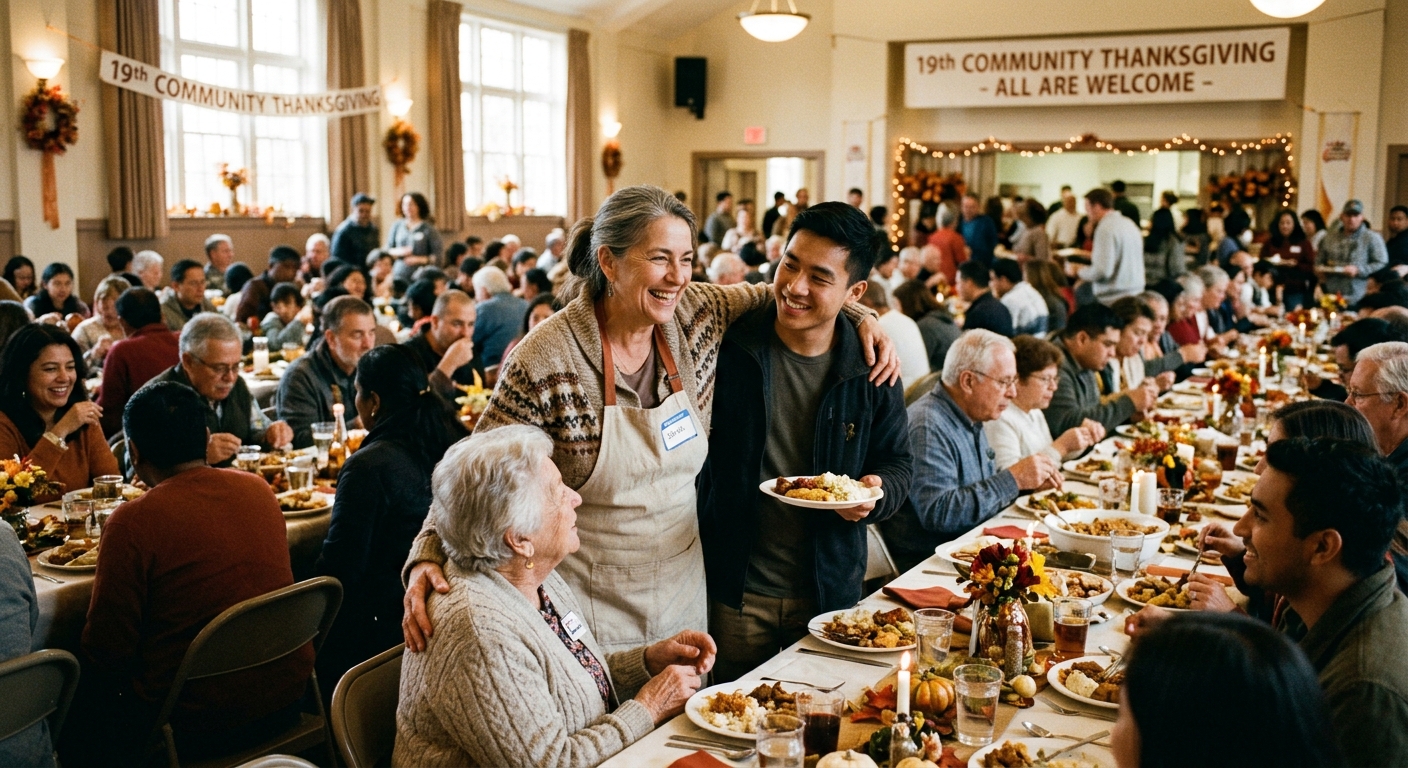
The turkey will be 24 pounds, same as the first year. The table will be crowded, noisy, and full of people who walked in as strangers and will leave as something harder to name but easier to feel.
And somewhere in the middle of all of it, Margaret Okafor will be refilling glasses and asking if anyone wants more stuffing, doing what she has done for nineteen years: making sure that on at least one day, nobody has to be alone.