🎧 Listen to this story
Narrated by Callirrhoe · 8,311 characters
The Diagnosis That Was Supposed to Be the End
In the spring of 2017, Maria Calloway sat in a beige office with fluorescent lighting and a doctor she had only met twice before. He slid a folder across the desk with the kind of quiet gravity that tells you everything before a single word is spoken. Stage four pancreatic cancer. Metastatic. The prognosis: six months, possibly less if she did not respond to treatment.
She was 44 years old. Her youngest daughter had just started kindergarten. Her oldest was about to sit her college entrance exams. Her husband of nineteen years reached across and held her hand so tightly she said later she thought her fingers might break. She let him hold on anyway.
That was seven years ago. Maria is now 51. She coaches a youth soccer team on Saturday mornings, grows tomatoes in her back garden, and laughs, often and loudly, at things that are not even that funny.
This is not a miracle story. Or rather, it is not only that. It is a story about what happens when a person refuses to organize their life around a deadline someone else set for them.
What the Statistics Do Not Tell You
Pancreatic cancer carries one of the lowest survival rates of any cancer diagnosis. The five-year survival rate for stage four cases hovers around three percent. Doctors are not being cruel when they give timelines. They are being honest, drawing on the best data available to help patients and families make informed decisions about treatment, finances, and time.
But statistics describe populations, not individuals. And Maria, as her oncologist Dr. Reeves would later admit in a filmed patient story for a regional cancer center, was “a population of one who refused to read the brochure.”
She did not ignore the data. She understood it. But she made a deliberate choice, one she describes as the most important decision of her life, to not let probability become identity.
“I Was Not Going to Decorate My House for Dying”
In the weeks after her diagnosis, Maria noticed something happening around her. People started speaking to her differently, more softly, with tilted heads and long pauses. Relatives she had not heard from in years began calling. Her sister flew in from across the country and reorganized her kitchen cupboards, which Maria says was both touching and quietly maddening.
“Everyone was grieving me,” she says. “And I understood it. I really did. But I was still there. I was still standing in my own kitchen, watching someone alphabetize my spices.”
She made a list. Not a bucket list, she is firm on that distinction. A living list. Things she wanted to keep doing, not things she needed to rush to complete before a buzzer went off. She wanted to keep coaching her daughter’s soccer team. She wanted to finish the novel she had been reading for three months. She wanted to argue with her husband about whose turn it was to take the bins out.
“I wanted the ordinary stuff,” she says. “The bucket list idea assumes your life was somehow not enough before. Mine was. I just wanted more of it.”
The Treatment, the Setbacks, and the Pivot Points
Maria’s survival is not purely a story of willpower and positive thinking, and she is the first to push back on that framing. She has had four major surgeries. She enrolled in a clinical trial in 2018 that left her bedridden for eleven weeks. She lost her hair twice. There were two occasions where her family was told to prepare for the worst.
She credits several concrete factors for where she is today:
- An aggressive and personalized treatment plan: Her oncologist pursued genomic testing early, which identified a specific mutation that made her eligible for a targeted therapy not typically offered to patients with her profile.
- A support network that showed up: Her husband took a leave of absence from work. A neighbor organized a meal train that ran for eight months. Her children, even at young ages, took on responsibilities that Maria says shaped them in ways she is still discovering.
- Mental health support: She began working with a therapist who specialized in chronic illness within weeks of her diagnosis, something she says was as important as any medication.
- Movement and nutrition, within her limits: Not as a cure, but as a way of feeling like an active participant in her own care rather than a passive recipient of it.
- Community: She joined an online forum for pancreatic cancer patients. She says the friendships she made there, some of whom are no longer alive, remain among the most meaningful of her life.
The People She Has Outlived
This is the part of Maria’s story that she does not shy away from, even though it is the hardest to tell. In the years since her diagnosis, she has watched friends from her cancer support group die. People who were younger than her, people who fought just as hard, people whose stories did not have seven-year follow-up chapters.
“Survivor guilt is real,” she says, leaning forward. “I do not think I am here because I wanted it more than they did, or because I was stronger, or because I prayed harder. That would be an insult to every single one of them. I am here because of science, because of luck, and because of timing. That combination does not work out the same way for everyone.”
She volunteers now with a palliative care organization, sitting with patients and families in the final stages of illness. It is, she says, a way of honoring the people she has lost while using the time she has been given in a way that feels purposeful.
What Seven Years of Borrowed Time Actually Looks Like
People often ask Maria if she lives differently now. If every day feels precious. If she wakes up grateful.
Her answer is refreshingly honest: “Some days, yes. Some days I wake up annoyed that the coffee maker is broken and I am tired and my back hurts and I do not want to be profound about any of it. And I think that is fine. That is actually the point. I am not performing gratitude. I am just living.”
Her youngest daughter is now twelve and has no memory of the months when her mother was first diagnosed. Her oldest graduated college last spring and dedicated her thesis to her mother, a fact that Maria mentions with the casual tone of someone who has cried about it so many times it has become a tender normal thing.
Her husband still holds her hand too tightly sometimes. She still lets him.
What We Can Take From This, Even Without a Diagnosis
Most of us will never sit in a beige office and receive the kind of news Maria received. But there are things in her story that translate across every kind of human experience:
1. Timelines are not destinies.
Whether it is a medical prognosis, a financial setback, or a relationship that everyone says will not last, external predictions about your future are data points, not verdicts. Treat them seriously, and then keep moving.
2. Ordinary life is the extraordinary thing.
Maria did not need to climb mountains or cross oceans. She needed her kitchen, her kids, her garden, and her Saturday mornings. Do not wait for a crisis to notice that you already have what matters.
3. Community is medical.
The research on social connection and health outcomes is not soft science. Human beings who feel supported, seen, and connected to others have measurably different health trajectories than those who are isolated. Showing up for someone is a form of medicine.
4. Grief and hope are not opposites.
Maria grieved. She grieved for the future she thought she had lost, for the friends who did not make it, for the version of herself that existed before that beige office. And she hoped. She held both at once. That capacity, to sit with grief without being consumed by it, may be the most transferable skill in her entire story.
Still Here
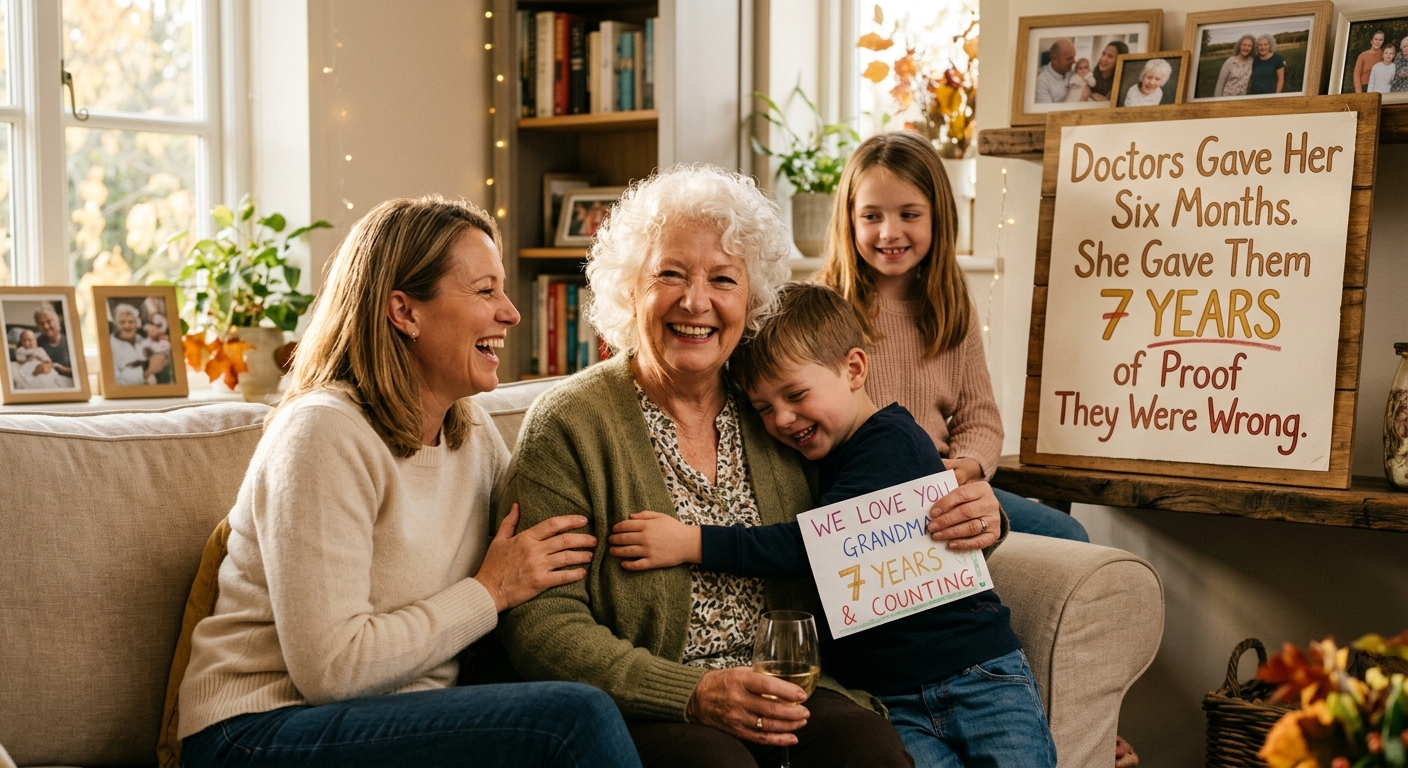
Last October, Maria celebrated what her family now calls her “Alive-iversary,” the seven-year mark since her diagnosis. Her husband made a cake. Her daughters came home. Her neighbor, the one who organized the meal train, brought wine. They sat in the garden until the light ran out.
Nobody made a speech. Nobody needed to.
She was told she had six months. She chose, with every tool available to her and every person willing to stand beside her, to use them differently. Seven years later, she is still choosing.
And the tomatoes, for the record, were excellent this year.