🎧 Listen to this story
Narrated by Iapetus · 8,303 characters
When the Researcher Becomes the Patient
Dr. Maren Sollis had spent fifteen years studying autoimmune disorders from the sterile comfort of a university laboratory. She knew the cellular pathways, the inflammatory markers, the clinical language that turned human suffering into manageable data points on a whiteboard. She thought she understood the disease. Then, at thirty-nine, the disease introduced itself to her personally.
It started with fatigue so heavy it felt like gravity had personally singled her out. Then came the joint pain, the brain fog so thick she once stood in her own kitchen for ten minutes unable to remember why she had walked in there. Finally, after months of dismissals from colleagues who probably should have known better, came the diagnosis: a severe form of lupus compounded by fibromyalgia.
“I remember sitting in the neurologist’s office and thinking, I have published papers about this,” she recalled in a recent interview. “And yet I had absolutely no idea what it actually felt like to live inside it. That gap between knowing and experiencing, that became the engine for everything that followed.”
The Cruelty and the Clarity of Being Sidelined
For the first eight months after her diagnosis, Dr. Sollis was largely bedridden. Her lab ran without her. Her graduate students sent careful, politely worded emails. Her research funding sat in a kind of suspended animation while her body waged war against itself.
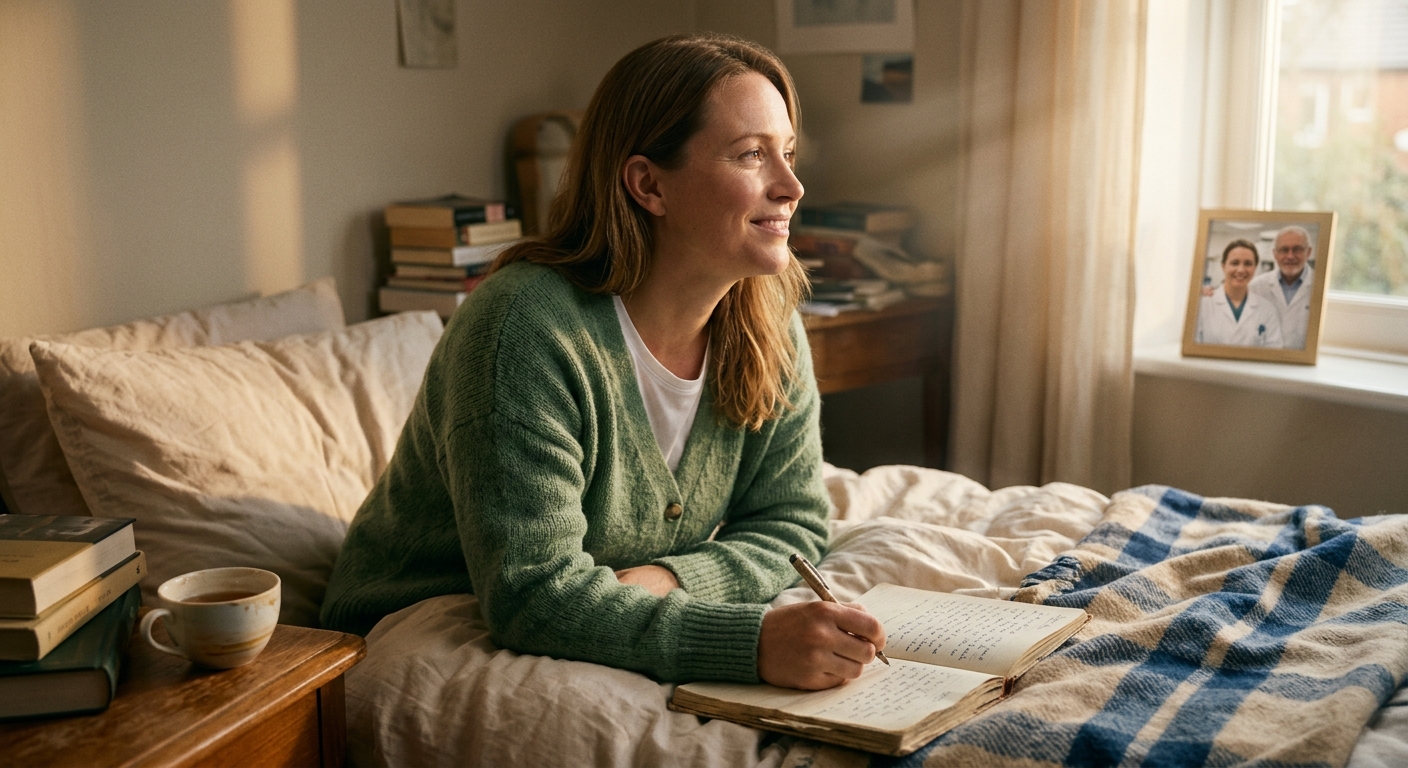
But something unexpected happened in the stillness. Stripped of the frantic pace of academic research, she started observing her own symptoms with the same meticulous attention she had always given to her lab work. She kept detailed journals, not just of pain levels and flare patterns, but of what she ate, how she slept, what emotional states seemed to precede or follow physical episodes.
“When you are too sick to do anything else, you either spiral or you focus,” she said. “I chose to focus. My body became my research subject.”
Patterns That No One Had Connected
Over the following months, Dr. Sollis began noticing correlations in her own data that she had never seen explored in existing literature. Specifically, she observed a consistent relationship between disruptions in her circadian rhythm and the severity of her immune flares. The connection was not entirely new in concept, but the specificity of what she was tracking, and the way she was tracking it, was different.
“Most research on lupus and circadian rhythm looked at sleep duration,” she explained. “But I was tracking the timing of cortisol response alongside dietary intake windows and microbiome activity. The picture that emerged was much more granular than anything I had seen published.”
Using a combination of wearable health monitors, continuous glucose tracking, and a custom journaling framework she designed herself, she accumulated eighteen months of detailed personal data. Then, still managing her illness from home, she began writing. Not a journal article. A hypothesis. A new research framework she would eventually call Chrono-Immune Mapping.
From Bedridden to Breakthrough
When Dr. Sollis finally returned to her lab part-time, she brought her personal dataset with her. Her team was initially skeptical. Personal anecdote, no matter how detailed, is not clinical proof. But the framework she had developed was rigorous enough to design a proper study around, and that is exactly what they did.
The pilot study enrolled forty-two participants with varying autoimmune diagnoses. Each participant used a modified version of the tracking protocol Dr. Sollis had developed during her own illness. The results, published eighteen months later in a peer-reviewed immunology journal, were striking. They found that individualized circadian disruption patterns could predict immune flare onset with significantly higher accuracy than any existing marker alone.
The implications were significant for several reasons:
- Personalized timing of medication could dramatically improve efficacy for existing treatments.
- Dietary and sleep interventions timed to individual biological rhythms showed measurable reduction in inflammation markers.
- Patient-generated data, long dismissed as too subjective, was validated as a legitimate and valuable research input.
- Cost of implementation was low, meaning this approach could potentially reach underserved patient populations.
“We are not claiming we cured anything,” Dr. Sollis was careful to note. “But we may have found a way to give patients significantly more control over their own flares. For someone living with a chronic illness, that is not a small thing. That is life-changing.”
What Living It Taught Her That Studying It Never Could
There is a dimension of this story that goes beyond the science, and Dr. Sollis is the first to acknowledge it. Her experience as a patient fundamentally changed how she practices as a researcher and how she treats the people who participate in her studies.
“I used to think of patients as data sources,” she admitted with disarming honesty. “That sounds terrible, but it is how a lot of research culture operates. You extract the information you need and you analyze it. The person attached to the data is almost incidental.”
Now, her lab operates differently. Patient advisors are formally included in study design. Participant feedback is treated as research input, not just courtesy. Her graduate students are required to engage in extended conversations with participants before a single data point is collected.
“Science loses so much when it forgets that the subject of the research is a human being who knows things we don’t,” she said. “My illness taught me that. I wish I had learned it sooner, but I am grateful I learned it at all.”
The Unlikely Gift Hidden Inside the Hardest Years
It would be dishonest to romanticize chronic illness. Dr. Sollis is clear about that. She still has bad days. She still cancels plans, misses conferences, and navigates the particular loneliness of a body that cannot always be trusted. The discovery she made does not exempt her from the reality of her diagnosis.
But she describes a shift in her relationship with her illness that she does not have a purely clinical word for.
“It stopped being the enemy and started being information,” she said. “Every flare tells me something. Every difficult stretch teaches me something. I do not like it, but I have learned to listen to it. And listening to it changed everything, not just for my research, but for how I move through my own life.”
Lessons from the Lab, and from the Bed
The story of Dr. Maren Sollis is not a story about suffering leading neatly to triumph. It is messier and more honest than that. It is a story about a scientist who was forced to become a student again, this time of her own body, and who had the discipline and the courage to take what she learned seriously.
There are things her story quietly teaches the rest of us, whether we work in a laboratory or not:
- Expertise has limits. No matter how much you know about something, direct experience adds a layer of understanding that cannot be replicated from the outside.
- Stillness can be generative. Slowing down is not the same as stopping. Sometimes the most important ideas arrive when the noise does.
- Vulnerability is data. The things that humble us can also sharpen us, if we are paying attention.
- The person in the problem is often the best guide to the solution. This is true in medicine. It is also true in leadership, in parenting, in community work.
- Recovery is not linear, and neither is discovery. Some of the most important breakthroughs come not from smooth progress but from being knocked sideways and finding a new angle.
Dr. Sollis is currently expanding her Chrono-Immune Mapping framework into a larger multi-site clinical trial. She is also working on a book, written for patients rather than researchers, that she hopes will help people with chronic illness become better advocates for their own care.
When asked what she would say to someone newly diagnosed with a serious chronic illness, she paused for a long moment before answering.
“Pay attention,” she said. “Not just to your symptoms. To everything. Your body is trying to tell you something. And you might be the only one who can hear it.”