
🎧 Listen to this story
Narrated by Gacrux · 7,891 characters
The Dress That Started It All
It was a Tuesday afternoon in early spring when Linda Hargrove first noticed the girl sitting alone in the school hallway, scrolling through prom photos on her phone with a look that was equal parts longing and resignation. Linda, then a part-time school counselor in Columbus, Ohio, stopped and asked if she was going to prom that year.
The girl shrugged. ‘Probably not,’ she said quietly. ‘We can’t really afford it.’
That exchange, brief and almost forgettable to an outsider, lodged itself somewhere deep in Linda’s chest. She went home that evening and did what many people do when a problem bothers them: she talked about it at dinner. But unlike most dinner conversations that dissolve into the next day, this one sparked something that would grow into a 12-year mission touching the lives of thousands of young women.
Linda started making phone calls the very next morning.
Building Something From Nothing
In the beginning, the operation was charmingly chaotic. Linda cleared out her spare bedroom, posted a handwritten flyer at her local church and community center, and put out a simple request on a neighborhood Facebook group: ‘Do you have a prom dress you no longer need? Donate it to a girl who does.’
The response genuinely surprised her.
‘I thought maybe I’d get a dozen dresses, enough to help a few girls,’ she recalled. ‘By the end of that first week, I had over 80 gowns piled up in my living room. My husband had to sleep on the couch because there was no room anywhere else.’
She named her initiative A Night to Remember Closet, and that first year, 23 girls came through her spare bedroom, tried on dresses, and left with something beautiful to wear. She watched each of them transform, not just in the way the gowns fit their shoulders or caught the light, but in the way they carried themselves walking out the door.
That was 12 years ago. Since then, the program has grown into something far beyond what Linda ever imagined.
What 12 Years of Giving Actually Looks Like
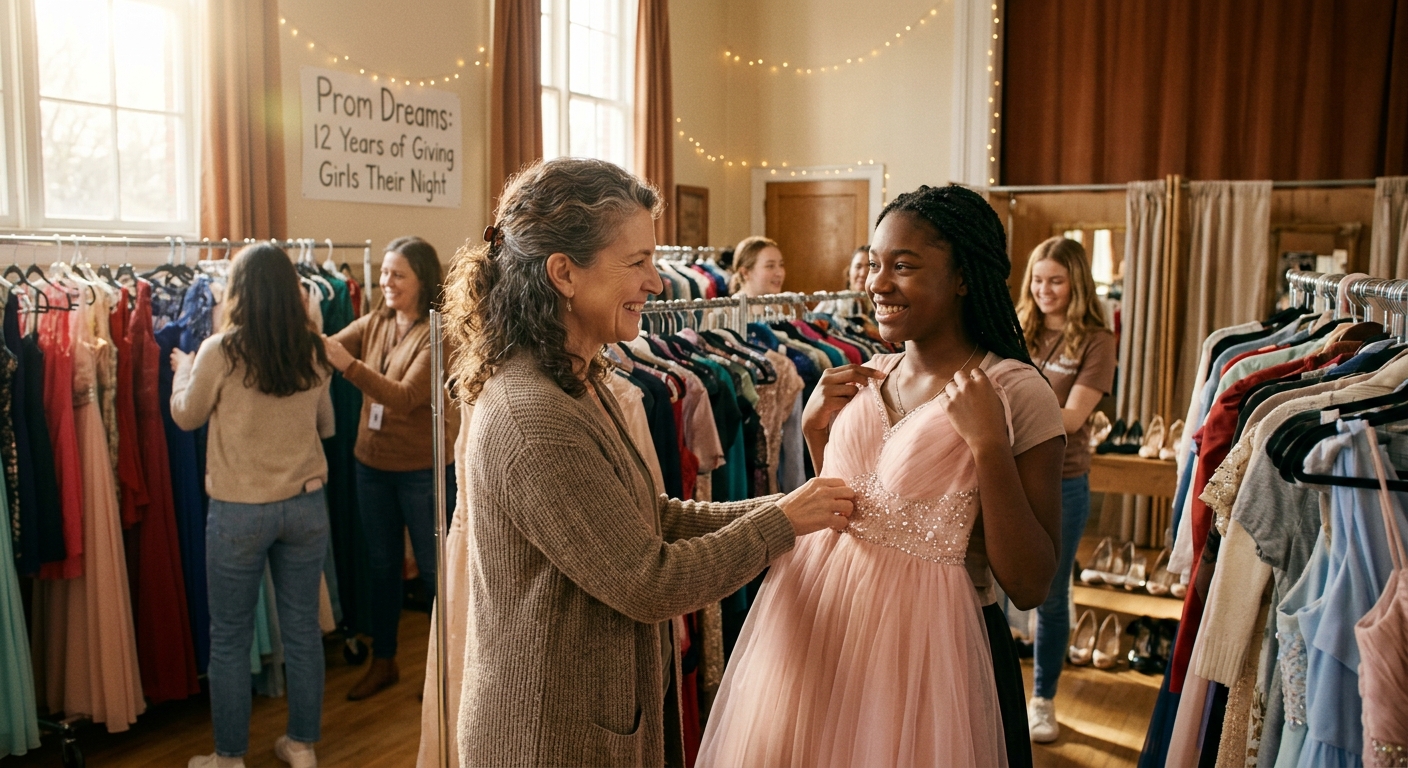
Today, A Night to Remember Closet operates out of a donated retail space in a local strip mall, staffed entirely by volunteers ranging from retired seamstresses to high school seniors completing community service hours. The numbers are striking:
- More than 4,200 dresses have been donated and distributed over the program’s lifetime
- Girls come from over 30 surrounding zip codes, some driving two hours for an appointment
- A volunteer team of 60-plus people handles alterations, dry cleaning, accessories, and intake
- The program now also provides shoes, jewelry, and undergarments, because Linda quickly learned a girl needs more than just the dress
- A partnership with a local hair school means free updos are available for any girl who visits the closet
None of it costs the girls or their families a single dollar.
The Volunteers Who Keep It Running
Ask Linda who deserves the credit and she will immediately redirect you to her volunteers. People like Marta, a retired seamstress in her 70s who comes in every Saturday from October through May to take in hemlines and let out seams. Or Deja, a 28-year-old who received a dress from the closet herself eight years ago and now coordinates the accessories station every spring.
‘Deja is the reason I keep going on the hard days,’ Linda said. ‘She came back. She wanted to give what she was given. That’s the whole point, right there.’
The volunteers speak about their work with a reverence that surprises first-time visitors. For many of them, this is not charity in the detached, obligatory sense. It is deeply personal. Several are mothers who remember scrimping for their own daughters’ prom costs. Others are women who went without themselves and know exactly what it feels like to be excluded from a milestone everyone else seems to share so easily.
More Than a Dress: What the Girls Actually Take Home
Linda is careful to point out that while the dress is the centerpiece, the experience of the closet is designed to be something larger. Every girl who comes in is paired with a volunteer stylist, someone whose only job for that hour is to make her feel seen and celebrated.
‘We tell every volunteer the same thing during training,’ Linda explained. ‘Your job is not to find her a dress. Your job is to make her feel like she deserves one.’
That distinction matters more than it might sound. Many of the girls who walk through the closet door carry visible tension when they arrive. They apologize for taking up space. They qualify their preferences with ‘whatever is leftover is fine.’ They are practiced in making themselves small so their need feels smaller.
The closet, intentionally and deliberately, pushes back against all of that.
A Ritual of Celebration
When a girl finds her dress, the volunteers mark the moment. There is applause. Sometimes there are tears. The girl is photographed if she consents, and a small card is written with her name and the year, added to a growing wall of honorees near the entrance. It is, as Linda describes it, ‘a wall of proof that every single one of them belonged here.’
The Challenges Nobody Talks About
Running a nonprofit on love and determination has its costs. Linda works a second job in healthcare administration to help cover gaps in funding. Some years, donation volumes are lower and she has to scramble. Dress sizes have historically skewed narrow, and sourcing gowns in extended sizes requires extra effort and targeted outreach.
She has also navigated the delicate emotional terrain of working with teenagers experiencing hardship. Some girls arrive dealing with situations far heavier than prom: homelessness, parents incarcerated, aging out of foster care. The dress is a small grace in the middle of something enormous.
‘I’m not a social worker and I never pretend to be,’ Linda said. ‘But I keep a list of resources on hand. If a girl needs more than what we have, we try to connect her to someone who can help.’
What This Story Teaches Us
Linda Hargrove did not set out to build a movement. She saw a girl in a hallway and felt something pull at her. That pull became a phone call, which became a Facebook post, which became 80 dresses in her living room, which became 12 years and thousands of prom nights that might otherwise have passed without celebration.
There are a few things her story quietly insists upon:
- Small moments of noticing matter. The entire program began because one person stopped and asked a simple question.
- Community responds when someone leads. Linda did not wait for an organization to exist. She became the organization.
- Giving forward creates givers. Deja is not an exception. Dozens of former recipients have returned as volunteers.
- Dignity is a need, not a luxury. Helping someone feel celebrated is not frivolous. It is necessary.
How You Can Help, Or Start Something Like This Yourself
A Night to Remember Closet accepts dress donations year-round, with peak need arriving in January through April. Monetary donations help cover dry cleaning, alterations, accessories, and space costs. Volunteers are always welcome, particularly those with sewing skills, retail experience, or simply a warm and patient presence.
And if you are reading this from a town that does not yet have something like this, Linda’s advice is simple and direct: ‘Start anyway. You don’t need a plan. You need a spare room and the willingness to make one phone call. The rest will find you.’
Somewhere tonight, a girl is hanging a prom dress on the back of her bedroom door and smiling at it. She does not fully know the chain of generosity that brought it to her. She just knows that she gets to go, that she gets to belong to this particular night alongside everyone else her age, and that someone out there thought she was worth it.
That is Linda Hargrove’s real work. Twelve years of telling girls they are worth it, one dress at a time.