🎧 Listen to this story
Narrated by Gacrux · 7,204 characters
A Morning That Changed Everything
It started like any other Tuesday on the Oregon coast. Fishermen were checking their lines, joggers were tracing familiar paths along the shoreline, and a handful of early tourists were snapping photos of the pale morning light hitting the Pacific. Nobody had planned to become a hero that day. Nobody had signed up for anything.
Then someone spotted the whale.
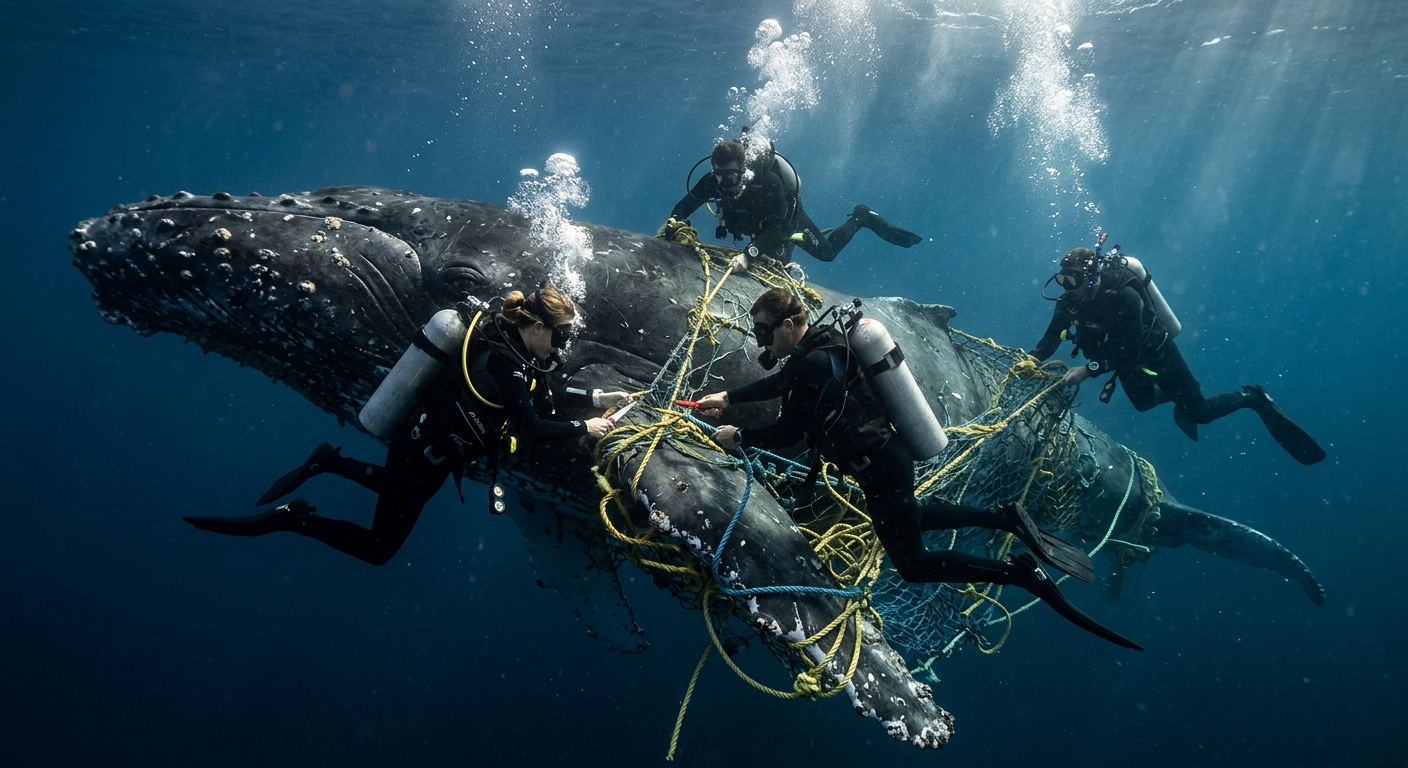
A juvenile humpback, roughly 30 feet long and estimated to weigh close to 20,000 pounds, had become dangerously stranded in a shallow tidal inlet near the small coastal town of Depoe Bay. The animal was disoriented, exhausted, and breathing in labored, infrequent bursts. Its tail barely moved. Time, as anyone who knows anything about stranded cetaceans will tell you, was not on its side.
What happened over the next 14 hours was not the work of a single agency or a coordinated rescue team that had trained for this moment. It was something far more remarkable: a community of complete strangers, drawn together by one shared instinct, who refused to let that whale die alone.
The Call Goes Out
Word spread the way it always does now: fast, imperfect, and unstoppable. A local surfer named Dana Cho posted a short video to a regional Facebook group at 6:47 a.m. The caption read simply, “Help needed at the inlet. Humpback. Alive but struggling. Anyone who knows anything, PLEASE come.”
Within 20 minutes, the post had been shared over 400 times. Within an hour, the beach was filling up.
They came from all directions and all walks of life. A retired marine biologist named Dr. Patricia Welles drove 45 minutes from her home in Newport, still in her gardening clothes. A group of college students on a spring break camping trip heard the commotion and jogged down from their nearby site. Local restaurant owners left their morning prep half-finished. A father brought his two teenage sons because, as he later told a reporter, “I wanted them to see what people can do when they decide to show up.”
None of them had a plan. But collectively, they were about to build one.
What the Science Actually Demands
Whale rescue is not intuitive. The biggest danger for a stranded cetacean is not dehydration or even the wounds that often accompany beaching. It is something far more counterintuitive: the animal’s own weight crushing its internal organs when it is no longer supported by water.
Dr. Welles gathered the growing crowd and spoke clearly and calmly. She had worked two strandings in her career, decades earlier, and she knew the urgency beneath the surface of the scene. Here is what she told them they needed to do:
- Keep the animal’s skin wet at all times, using buckets, tarps, and any container available, to prevent overheating and cracking
- Never cover the blowhole, no matter how soaked and busy things got
- Create a gentle wave motion around the animal by moving the water rhythmically to mimic ocean movement and help with circulation
- Minimize noise and touch near the head and rostrum, where the animal’s stress sensors are most concentrated
- Work in rotating shifts to sustain effort without burning out the volunteers
The crowd listened. Then they got to work.
Fourteen Hours of Ordinary People Doing Extraordinary Things
What unfolded across that long Tuesday was, by any measure, deeply human. A woman who had never seen the ocean until she moved to Oregon three years ago stood in knee-deep cold water for four hours, pouring bucket after bucket over the whale’s back without stopping. A teenage boy who admitted he was terrified of large animals held a tarp steady in the wind for so long that he lost feeling in his fingers. Two men who, as it turned out, had been in a legal dispute over a property boundary for two years ended up working side by side in silence, focused entirely on the same purpose.
The Oregon Marine Mammal Stranding Network arrived around noon and integrated seamlessly with the volunteer effort already in progress. The lead coordinator, James Orri, later said in a press statement that he had never arrived at a stranding to find the situation already so well-managed by bystanders. “Usually we’re fighting chaos,” he said. “Here, we were joining a team.”
Boats were organized to help redirect the whale toward deeper water once the tide began to shift. A makeshift sling, rigged from donated tarps and ropes brought from a nearby marine supply store, was used briefly to help stabilize the animal during a critical two-hour window when the water level dropped dangerously low.
Nobody asked who was in charge. It simply became clear, organically, as the hours passed.
The Moment Everything Changed
At 8:41 p.m., as the sun was dropping toward the horizon and casting a deep amber light over the inlet, the humpback made its move. It had been hours since anyone had dared to feel optimistic. The volunteers had gone quiet, working mechanically, some of them close to tears without fully knowing why.
Then the tail lifted.
A single, powerful stroke. Then another. The whale turned its massive body, slowly at first, then with growing confidence, and moved toward the open water that had been so close all day but somehow unreachable. People waded in up to their waists, cheering, crying, laughing in that uncontrolled way that only happens when relief and joy arrive at the same moment.
The whale breached twice about 200 meters offshore. Some witnesses said it felt like a thank you. Whether or not that is scientifically accurate is beside the point. In that moment, it felt true, and that was enough.
What We Can Take From This
Stories like this one tend to get reduced to a single feel-good headline and then forgotten. But there is something worth sitting with here, something that resists easy summarizing.
This rescue happened not because the right people were there, but because ordinary people decided to become the right people. It happened because a retired scientist shared her knowledge instead of gatekeeping it. Because a Facebook post from a surfer cut through the noise. Because two strangers who might have passed each other on the street with cold eyes ended up working toward the same thing, shoulder to shoulder, for hours.
Dr. Welles, when asked later what the day had meant to her, paused for a long moment before answering. “I spent my whole career trying to get people to care about the ocean,” she said. “And on a random Tuesday, I watched about 200 people prove that they already do. They just needed a reason to show it.”
Three Things This Story Reminds Us
- Expertise is most powerful when it is shared freely. Knowledge held close helps no one. Knowledge offered openly can save a life.
- Community is not built in advance. It is built in the moment, by whoever shows up and decides to stay.
- We are often capable of far more than we think, especially when the thing in front of us matters more than our own comfort or fear.
The whale was never given a name, officially. But among those who were there that day, who still occasionally run into each other at the grocery store or the farmers market and share a quiet nod of recognition, it does not need one. Some things do not need naming to be remembered.
They just need to have happened.