
🎧 Listen to this story
Narrated by Gacrux · 7,611 characters
Every Spring, He Shows Up
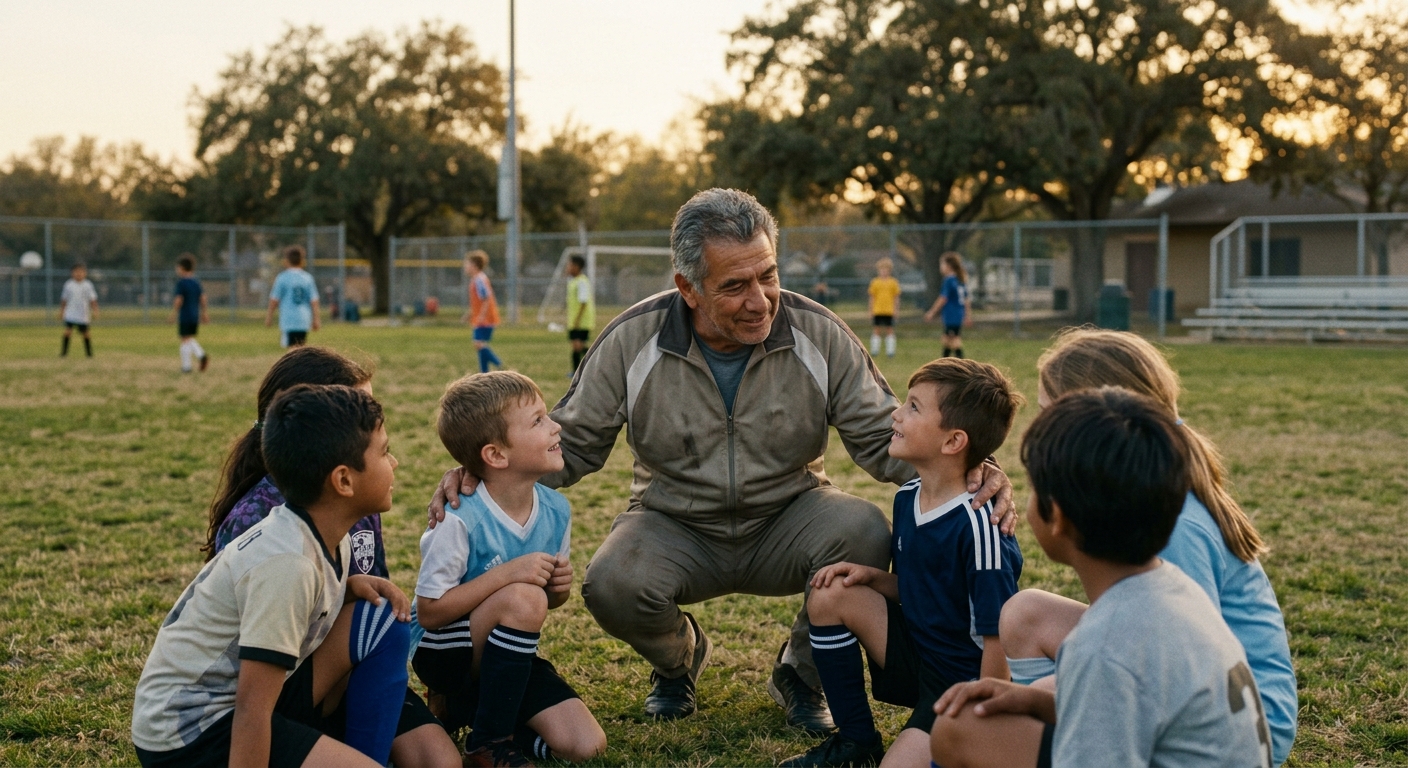
There is a particular kind of loyalty that does not announce itself. It does not post on social media, does not wait for a plaque, and does not keep score of what it is owed. It simply shows up. For thirty consecutive years, Raymond Delgado has shown up to Riverside Park in the same working-class neighborhood in Cleveland, Ohio, with a bucket of baseballs, a worn coaching binder held together by a rubber band, and more patience than most people carry in a lifetime.
He has never been paid. Not once. Not even a symbolic dollar.
What he has given, however, is harder to calculate than money. By conservative estimates, Raymond has coached somewhere between 1,200 and 1,500 children through his little league program. Some of those kids went on to play high school ball. A handful earned college scholarships. One, Marcus Trevino, now plays in the minor leagues and still calls Raymond every Father’s Day. But for most of the kids who wore those dusty red uniforms, the gift was something far less visible and far more permanent than athletics.
How It All Started
Raymond was 34 years old when he first volunteered to help with the local little league in 1994. He was working double shifts at a sheet metal plant and raising two kids of his own. His neighbor, who had been running the program for years, was moving out of state and asked Raymond if he knew anyone who might take over.
“I told him I’d help find somebody,” Raymond recalls with a laugh. “I never found anybody. So I just kept doing it myself.”
What began as a temporary solution became a calling. The neighborhood, already struggling with economic decline in the mid-nineties, was losing resources fast. Schools cut their sports programs. Recreation centers reduced their hours. Parents worked multiple jobs and had little time for extracurricular coordination. The little league field behind Riverside Park was one of the last free, structured activities available to kids who needed exactly that kind of structure.
Raymond saw the gap clearly. And he stepped into it.
What a Season Actually Looks Like
To understand what Raymond does, it helps to understand what he does not do. He does not have a staff. He does not have a budget beyond the modest registration fees families pay, which he supplements out of his own pocket when families cannot afford even those. He does not have a fancy facility. The backstop is patched with zip ties. The bases are replaced every two seasons whether they need it or not, because Raymond buys them himself from the sporting goods store on Route 9.
A typical season under Coach Delgado looks something like this:
- February: Raymond begins calling families, knocking on doors, and posting handwritten flyers at the laundromat and the corner grocery to recruit players for the spring season.
- March: Tryouts and team formation. Raymond intentionally balances the teams so no single group dominates. “Winning is fine,” he says. “But lopsided leagues are boring and they teach kids the wrong thing about life.”
- April through June: Three practices and one game per week, rain or shine. Raymond has coached in sleet. He has coached with a broken toe, wrapped in athletic tape, limping between bases.
- July: End-of-season cookout, paid for entirely by Raymond and a rotating cast of former players who come back to help every summer.
He does all of this while holding down a job, first at the sheet metal plant and now, in semi-retirement, part-time at a hardware store two miles from his house.
The Lessons Were Never Really About Baseball
Ask any of Raymond’s former players what they remember most about playing for him, and almost none of them lead with a specific game or a particular win. What they remember are the conversations.
“He used to pull you aside after practice,” says DeShawn Morris, now 28 and a middle school teacher in the same neighborhood where he grew up. “Not to yell at you. Just to ask how things were going at home. At first I thought it was weird. Then I realized no adult had ever really asked me that before.”
Raymond has a rule he has followed for three decades: he learns the name of every child’s parent or guardian before the first practice. He learns whether there is instability at home. He notices when a kid shows up hungry or distracted or wearing the same clothes three days in a row. He does not make a show of noticing. He just responds quietly, consistently, and without judgment.
Over the years, he has driven kids to doctor’s appointments when parents could not get off work. He has sat with teenagers in hospital waiting rooms. He has written character letters for kids applying to jobs and technical schools. He has shown up at funerals for children whose brief lives were cut short by the very violence that the little league field was, in some small but real way, designed to stand against.
What Former Players Say Now
The testimonials from former players read less like sports memories and more like gratitude letters to a man who helped raise them.
“Coach Ray was the most consistent adult in my life from age eight to fourteen,” says Angela Ruiz, now a registered nurse. “My parents were dealing with a lot. He never made me feel like their problems were my fault. He just showed up. Every single week. You cannot underestimate what that does for a kid who wonders if anything in their world is reliable.”
Marcus Trevino, the minor league player who still calls on Father’s Day, puts it even more simply: “He taught me that showing up is the whole thing. Not talent. Not luck. Showing up, every time, no matter what. That is what got me where I am.”
Why He Has Never Left
The question people ask Raymond most often is some version of: why? Why keep doing something unpaid, physically demanding, and emotionally exhausting for thirty years when you could have stepped back at any point?
He thinks about the question carefully before answering, which is very much in character for a man who has spent decades listening before speaking.
“I grew up without a lot of people in my corner,” he says. “Not because nobody cared. Just because people were busy surviving. I know what it feels like to be a kid and not have anybody in your corner. Once you know that feeling, you either let it make you bitter or you let it make you useful. I decided a long time ago I wanted to be useful.”
He also mentions, quietly and without drama, that the neighborhood has given him more than he has given it. The friendships. The continuity. The strange and profound privilege of watching children become adults and watching those adults become parents who then bring their own children to tryouts at Riverside Park.
“Last spring,” he says, “I had a kid on my team whose father I coached in 1998. That does not happen if you leave.”
A Legacy Written in Small Moments
There are no banners with Raymond’s name on them at Riverside Park. There is no scholarship fund named in his honor, no documentary, no viral moment that put his face in front of millions. What there is, instead, is something quieter and arguably more durable: a neighborhood that knows, in its bones, that one person stayed.
In an era that celebrates scale, influence, and visibility, Raymond Delgado is a reminder that the most important work is often invisible. It happens in Tuesday evening practices when nobody is watching. It happens in the five-minute conversation after a tough loss. It happens in thirty years of rubber-banded binders and zip-tied backstops and a man who decided, once, to be useful, and simply never stopped.
Spring is coming again. Raymond is already making calls.