🎧 Listen to this story
Narrated by Kore · 6,734 characters
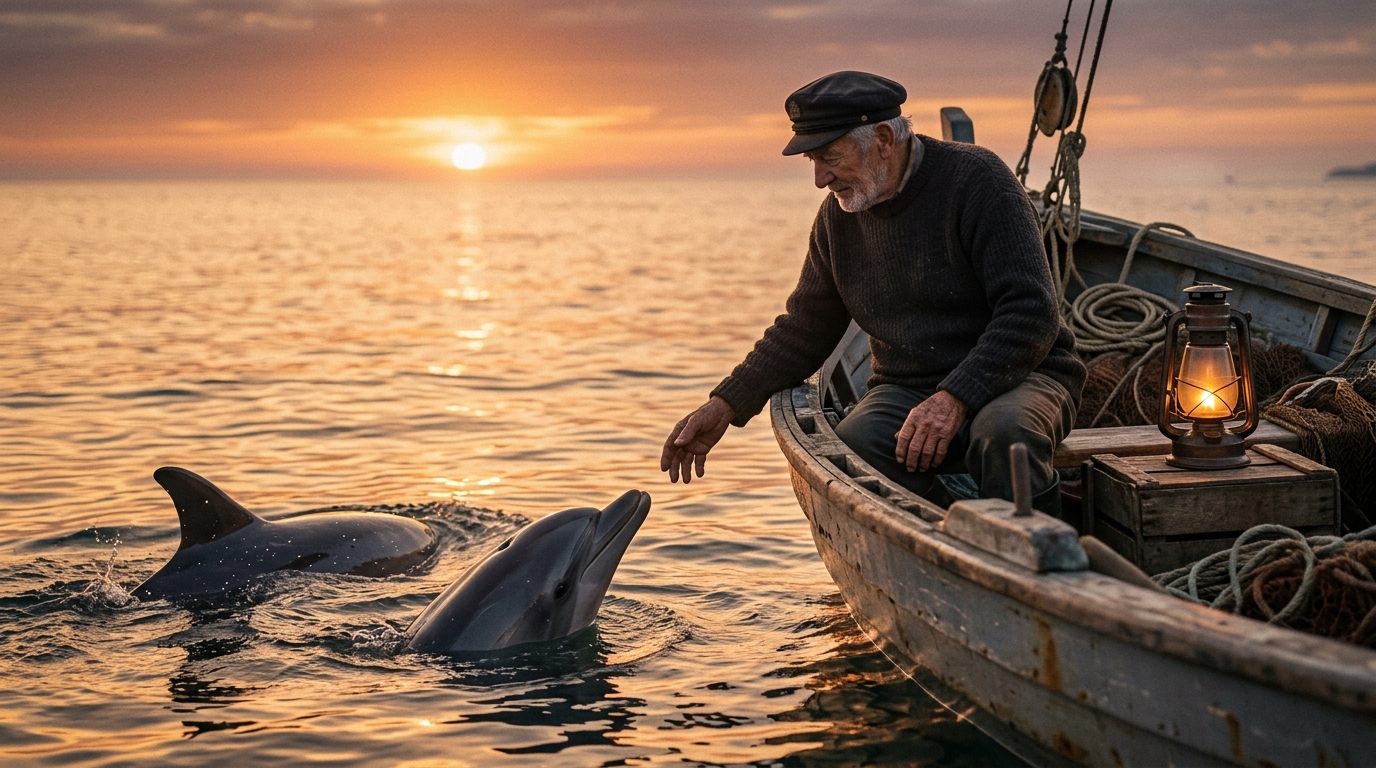
There is a particular hour on the southern edge of the bay when the light turns the color of weak tea and the water goes flat as poured glass. The tourists have gone back to their rentals. The gulls have stopped arguing. And on a weathered stretch of shoreline, a man named Tomas Reyes, seventy-one years old, wades in to his knees with a bucket at his side and waits.
He will tell you he is not waiting for anything. But the dolphins know better.
The Hour Everything Slows Down
Evening has a way of sorting what matters from what doesn’t. The emails, the errands, the arguments from noon: they all get quieter as the sun drops. By the time the sky bruises into violet, most of us are left with only the things that were actually important, and sometimes a surprising number of them are small.
For Tomas, the small important thing arrives in a gray, curved line breaking the surface about two hundred yards out. First one fin, then three, then a whole pod rolling through the shallows in unhurried arcs. They have been doing this, according to the handful of locals who have watched it unfold, for the better part of eleven years.
How It Started
The story, as Tomas tells it, begins with a bad morning rather than a good evening. His wife, Marisol, had passed away that spring. He had been a working fisherman for four decades, and in the weeks after the funeral he found he could not bring himself to go out on the boat. The water that had been his livelihood now felt like an accusation.
So he started walking the beach instead, at the end of each day, when the house felt too quiet. One evening he brought along a bucket of the day’s small catch, mostly mullet and sardines that he had no use for, and simply stood in the surf holding it, not knowing why.
A single young dolphin surfaced about thirty feet away. It looked at him. He looked back. Then, almost on impulse, he tossed a sardine into the water.
The dolphin took it, dipped under, and was gone.
He assumed that was the end of it. The next evening, at nearly the same minute, the fin appeared again.
What the Locals Have Noticed
Over the years, the habit has settled into something close to a ritual. Neighbors who walk the beach at dusk have started to keep a kind of informal record. Here is what they say they have observed:
- The timing is eerily consistent. The pod tends to appear within a few minutes of the same point in the sunset, regardless of the season.
- They arrive in a loose formation. An older, larger dolphin usually leads, with younger ones trailing and circling behind.
- They do not come close for just anyone. Several visitors have tried waiting in the same spot, with no luck. The animals hold back until Tomas steps into the water.
- They stay only a short while. Ten or fifteen minutes, then they curve back out toward open water as the last light drains from the horizon.
Marine biologists who study coastal dolphins often point out that these animals are intelligent, social, and capable of forming lasting associations with specific places and even specific people. Dolphins are known to remember individual whistles, in some documented cases for decades. Whether what happens on this beach is memory, habit, curiosity, or something closer to affection, no one can say for certain. Tomas says he stopped asking a long time ago.
A Different Kind of Company
Here is the part that surprised me when I first heard the story. Tomas does not talk about the dolphins as if they were a miracle. He talks about them the way you might talk about an old friend who drops by after supper.
“They don’t need anything from me,” he told one neighbor. “I give them a few fish, sure, but they could catch their own in two minutes. I think they just come to say they are still here. And that I am too.”
That last sentence is the one that stays with you.
Grief has a cruel schedule. It tends to arrive hardest in the evening, when the distractions have thinned out and there is nothing left to stand between a person and the empty chair. For eleven years, Tomas has had a reason to be standing in the ocean at exactly that hour, looking outward instead of inward, waiting for something that reliably comes.
The Lessons That Settle In With the Dusk
I keep turning this story over in the quiet before sleep. It would be easy to reduce it to a sweet anecdote about a lonely man and some friendly animals. But the evening has a way of showing you the quieter truths underneath.
1. Showing up is its own kind of love.
Nothing dramatic happened to build this bond. There was no rescue, no grand gesture. There was only a man who returned to the same spot at the same time, again and again, until returning became a language both sides understood.
2. Healing rarely announces itself.
Tomas did not set out to be comforted. He set out to get through an evening. The comfort arrived sideways, in a gray fin on a flat sea, and it asked nothing of him except that he be there.
3. Some friendships don’t need words.
We spend so much of our lives explaining ourselves. It is a relief to imagine a relationship built entirely on presence: two kinds of creatures acknowledging each other across a stretch of shallow water, then parting without a goodbye, certain of tomorrow.
4. Routine can be a lifeline.
The same hour, the same shoreline, the same bucket. There is a gentle dignity in small rituals, especially after loss. They give the days a shape when the days feel shapeless.
The Boat Is Back in the Water
Here is the quiet postscript. Sometime in the second year of their evening visits, Tomas started fishing again. Not as often as before, and not as far out, but enough. He says it was the dolphins who nudged him back, though he cannot explain how.
“I figured if they trusted the water enough to come into it every night,” he said, “I could probably manage the same.”
These days, on the evenings he does go out, he is usually home before the light begins to turn. The bucket is already waiting by the door.
A Gentle Question for Your Own Evening
As the day settles around you, perhaps with a lamp on and the noise finally dropping away, it might be worth asking: what is the small, reliable thing in your life that shows up at the end of the day? A friend who calls at the same hour. A pet waiting by the door. A walk around the same block. A song you put on while the kettle heats.
We tend to overlook these small recurrences. But they may be doing more holding-together than we realize. Somewhere along a quiet shoreline, a man and a pod of dolphins have been proving it for more than a decade, one unhurried sunset at a time.
The tide goes out. The light goes soft. And if you are lucky, something gray and curious comes circling back to remind you that you were expected.