
🎧 Listen to this story
Narrated by Orus · 9,116 characters
The Fall That Changed Everything
It happened on an ordinary Tuesday morning in October 2019. Gerald Watkins, a 59-year-old retired electrician from Knoxville, Tennessee, was climbing a ladder to clean out his gutters when one of the rungs snapped beneath him. He fell approximately twelve feet, landing hard on the concrete driveway below. His neighbors found him there, conscious but unable to move his legs.
The diagnosis from Vanderbilt University Medical Center was sobering: a T6 incomplete spinal cord injury, with significant damage to the nerves controlling his lower limbs. His spinal surgeon, Dr. Patricia Holt, was compassionate but measured in her assessment. Gerald remembers her exact words: ‘We can hope for some return of function, but I have to be honest with you, Gerald. Walking independently again is not something I can promise you.’
He was 59 years old, a widower, a grandfather of four, and according to the medical prognosis, someone who would likely spend the rest of his life in a wheelchair or with severe mobility limitations. What happened over the next three years, however, is the kind of story that reminds us just how stubbornly the human spirit refuses to accept a ceiling.
The Darkest Period: Learning to Grieve a Version of Yourself
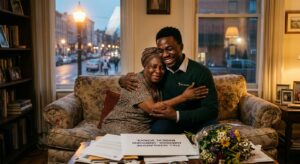
Gerald spent six weeks in inpatient rehabilitation before returning to the home he had shared with his late wife, Carol, who had passed from breast cancer two years prior. He has spoken openly about the grief that layered itself on top of his physical struggle.
‘It wasn’t just that I couldn’t walk,’ he said in a recent interview with a local Knoxville news station. ‘It was that I couldn’t be who I had always been. I had always been the guy who fixed things, who climbed the roof, who helped his daughter move furniture. Suddenly I couldn’t do any of that. I grieved it like a death.’
His daughter, Melissa Cartwright, recalls those first six months as deeply frightening. ‘Dad had always been the strong, silent type. After the accident, he went quiet in a different way. A heavy way. We were scared for him, not just physically.’
Gerald credits two things with pulling him out of that fog: his four grandchildren, and a physical therapist named Ramon Delgado who refused to treat him like a lost cause.
The Physical Therapist Who Rewrote the Story
Ramon Delgado had been working in neurorehabilitation for over fifteen years when Gerald became his patient in early 2020. He describes Gerald as ‘one of the most disciplined and quietly determined people I have ever worked with, once he decided to fight.’
The early sessions were humbling in ways that Gerald describes with a kind of raw honesty. ‘We were celebrating that I could wiggle a toe. That was a victory. A wiggling toe.’ But Ramon understood something important: incomplete spinal injuries carry a unique kind of potential. Because the spinal cord was not fully severed, nerve pathways could, over time and with intense repetitive therapy, be coaxed back into function. It was not guaranteed. It was not even likely. But it was possible.
The therapy protocol was demanding:
- Daily sessions of locomotor training using a body-weight support treadmill system
- Electrical stimulation therapy to stimulate dormant nerve pathways
- Aquatic therapy three times per week to build strength with reduced joint stress
- Mindfulness and visualization practices to build the mind-body connection
- Resistance training for the upper body and any available lower body function
Progress was measured in millimeters and minutes. But it came.
First Steps: Month Eight
In August 2020, nearly ten months after his accident, Gerald Watkins took four unassisted steps between two parallel bars in Ramon’s therapy gym. His daughter was there. She cried. Ramon quietly pumped his fist. Gerald just stood there for a long moment, looking down at his feet like they were strangers he was finally getting to know again.
‘I don’t have the words for that moment,’ Gerald said. ‘I still don’t. There are no words big enough.’
Over the following months, those four steps became ten, then thirty, then a full walk down the hallway with a walker. By spring of 2021, Gerald was walking with a single forearm crutch. By fall of that year, he was walking unassisted for short distances, with a noticeable but manageable gait irregularity that he refers to simply as ‘my shuffle.’
The Idea That Sounded Ridiculous
It was Gerald’s granddaughter, nine-year-old Lily, who planted the seed. During a family dinner in January 2022, she announced with complete seriousness that she wanted to run a 5K race for charity and that she wanted her grandfather to run it with her. The table went quiet. Melissa started to gently explain that Grandpa was still working on walking. Gerald cut her off.
‘I told her I’d think about it,’ he recalled. ‘And I spent that whole night actually thinking about it. And by morning, I had decided that if Lily believed I could do it, then I had no right to decide that she was wrong.’
He told Ramon the next week. Ramon’s response was characteristically practical: ‘Okay. Then that’s what we’re training for.’
Fourteen Months of Training for 3.1 Miles
The race was set for March 2023, the Knoxville Heart and Sole 5K benefiting pediatric cardiac care. Gerald had fourteen months to prepare. The training shifted dramatically, incorporating:
- Progressive distance walking, starting at 50 meters and building over months
- Running interval training using a specialized exoskeleton assist device in early phases
- Core stabilization work to manage fatigue and protect his spine during impact
- Mental coaching sessions to work through anxiety and fear of falling
- Nutritional support to fuel a body working twice as hard as most to do basic movement
There were setbacks. A minor fall in September 2022 rattled his confidence for weeks. Nerve pain flares forced three separate breaks from training. He turned 62 in November 2022, and threw himself a birthday party that his family now describes as the most joyful they can remember, because every person in that room knew what he was quietly training to do.
Race Day: March 18, 2023
The morning was cold, around 38 degrees, with a low gray sky over downtown Knoxville. Gerald arrived at the starting line wearing a bright orange shirt that Lily had picked out. Ramon was there. Melissa was there. All four grandchildren were there. So were about two hundred other runners who had no idea they were about to witness something remarkable.
Gerald did not run the 5K in the traditional sense. What he did was a combination of walking at pace and short running intervals totaling perhaps 40 percent of the distance. He used a single forearm crutch. He wore a compression brace on his left knee. He finished in 58 minutes and 14 seconds, well ahead of the official cutoff time.
When he crossed the finish line, Lily was waiting for him. She had finished twenty minutes earlier and stood there, still wearing her finisher medal, jumping up and down. He bent down, and she threw her arms around his neck. The photograph that Melissa took of that moment, which she later shared on a local community Facebook group, was shared over 14,000 times in the following week.
What Gerald Wants You to Take Away From His Story
Gerald Watkins is not a man who seeks attention. He agreed to share his story publicly only because Ramon convinced him that it might matter to someone sitting in a hospital bed right now, staring at a ceiling and believing the worst. He has since spoken at two rehabilitation centers and one high school, and his message is consistent and unadorned.
‘I’m not special,’ he says. ‘I’m not some superhuman. I’m a 62-year-old man with a bad back and a shuffling walk who loves his grandkids. What I had was people who believed in me when I couldn’t, a therapist who refused to give up, and a little girl who didn’t know enough to think it was impossible. You need those three things. The rest is just showing up every single day.’
Three Lessons From Gerald’s Journey
- Grief is part of healing, not the opposite of it. Gerald did not bypass the mourning process. He moved through it, and that distinction mattered.
- Find the person who refuses to write you off. Ramon Delgado’s belief in Gerald’s potential was not naive optimism. It was informed, professional, and relentless. Everyone in recovery deserves that person.
- Let someone else’s faith carry you when yours runs out. A nine-year-old’s certainty became a 62-year-old man’s finish line. Do not underestimate who might be holding the belief you’ve temporarily lost.
Where Gerald Is Now
As of the time of this writing, Gerald Watkins walks two miles every morning with his forearm crutch through his neighborhood. He is registered for a second 5K this coming fall, this time with all four grandchildren running alongside him. He volunteers twice a month at the rehabilitation center where Ramon still works, sitting with newly injured patients and telling them, quietly and without drama, that he was once exactly where they are.
He still has the orange shirt. Lily made him promise never to throw it away.