🎧 Listen to this story
Narrated by Kore · 5,743 characters
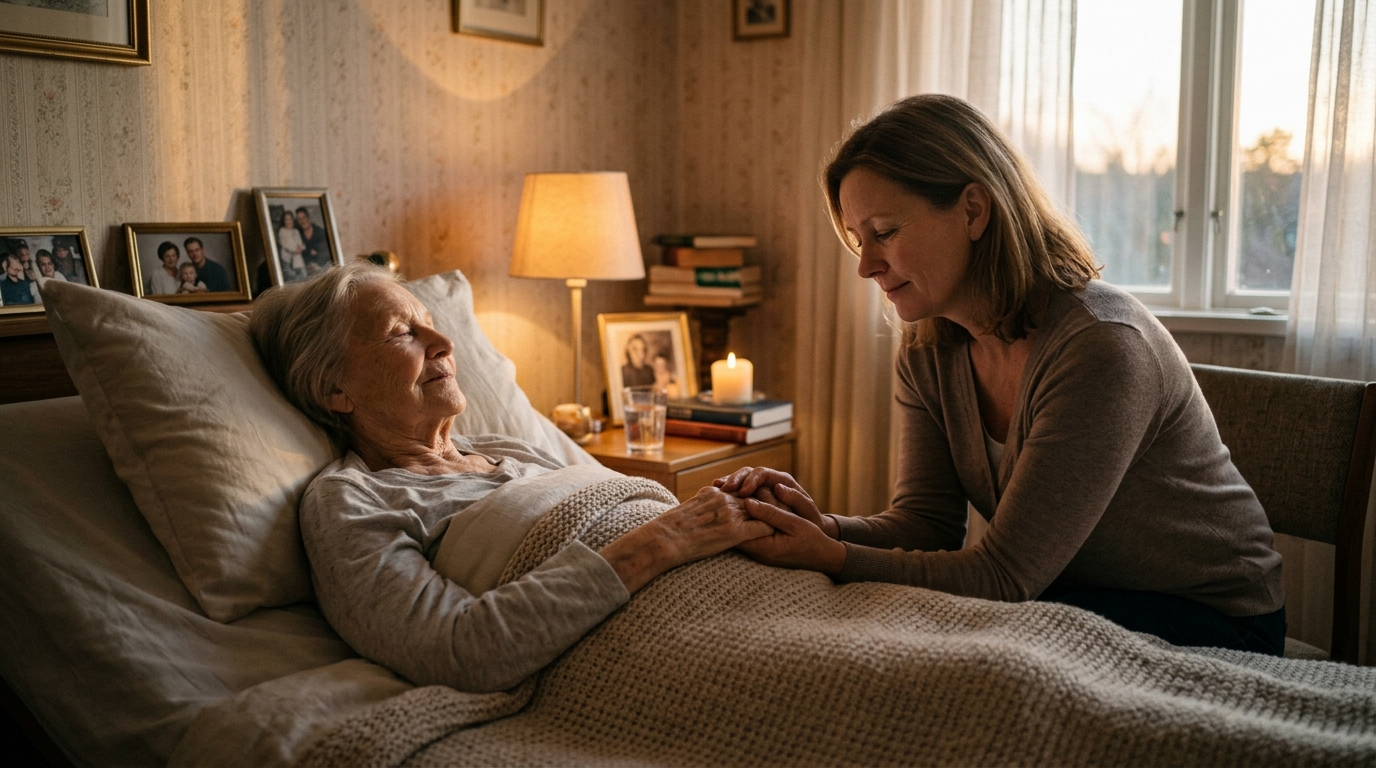
It begins around the time the sky outside turns the color of weak tea. The hallway lights dim. The televisions in the rooms go quiet one by one. And somewhere on the second floor of a small hospice house, a nurse named Marguerite sits down in a chair she has pulled up beside a bed and says nothing at all.
She has worked the evening shift for nineteen years. She says it is not the shift she chose, but it is the one that chose her.
A Conversation at the End of the Hallway
We spoke with Marguerite after her shift, in the break room, where a kettle hissed on the counter and a window held the last of the dusk. What follows is adapted from that conversation, lightly edited for length.
Why the evening?
“People assume the hardest hour is the middle of the night,” she told us. “And sometimes it is. But the hour I think about most is the last one before sleep. That is when the day finally stops asking things of people.”
During the day, she explained, a hospice room fills with activity. Doctors come through. Family members arrive carrying casseroles and brave faces. Aides adjust pillows. Phones buzz. A dying person spends the whole day being managed, being visited, being asked how they feel.
“By evening, everyone has gone home or gone quiet,” she said. “And that is when I see it. The shoulders drop. The jaw unclenches. People who have been holding themselves together all day suddenly do not have to.”
What does “safe” actually look like?
She was careful here. She does not believe safety is something she gives anyone. “I just stop getting in the way of it,” she said.
She described a man in his eighties, a retired machinist, who had spent weeks insisting he was fine. He joked with every visitor. He asked about everyone’s children. Then one evening, as the light went amber against the curtains, he turned to her and said, “I don’t think I’m going to see the spring.”
She did not correct him. She did not reach for a comforting phrase. She pulled the chair closer and said, “Tell me about the springs you remember.”
He talked for forty minutes. About a garden. About a daughter who used to pull up the wrong plants on purpose to make him laugh. When he finished, he was quiet for a long time, and then he said, “Thank you for letting me say it.” He fell asleep before she left the room.
The Quiet Things That Help
Over the years, Marguerite has built a small collection of habits for the final hour of the day. She is quick to say none of them are secrets, and none of them require training. Most could be done by anyone sitting with someone they love.
- Lower the light slowly. She never flips a switch. She dims the lamp in stages, the way dusk does it, so the room eases toward rest instead of being shut off.
- Ask fewer questions. “How are you feeling?” is a question that demands a performance. She prefers a simple, “I’m here, and I’m not going anywhere.”
- Let silence stay. She says the urge to fill silence is mostly the helper’s discomfort, not the patient’s need.
- Offer small physical comforts. A warm cloth for the hands. A glass of water with a straw. A blanket tucked just so.
- Name the night plainly. She tells patients what will happen: who will be on shift, where the call button is, that she will check in. Fear thrives on the unknown, and routine is its own kind of mercy.
What the Night Teaches the Rest of Us
When we asked what she wished more people understood, Marguerite did not talk about death. She talked about evenings.
“We all have a version of this,” she said. “The moment at the end of a long day when you finally put the phone down and the house goes still, and whatever you have been carrying all day comes up to the surface. Some people call that anxiety. I think it is just the truth arriving when the noise leaves.”
She believes the evening is when honesty becomes possible, for the dying and for the living alike. A teenager will finally tell a parent what is wrong at ten at night with the lights off. A husband will say the thing he could not say at breakfast. A person will admit they are scared.
“It is not magic,” she said. “It is just that the day has stopped performing for us.”
A Small Practice for Your Own Evening
You do not need to work in a hospice to borrow some of what Marguerite has learned. If you have someone in your life who is struggling, or if the struggling person is you, consider building a gentler last hour of the day.
- Soften the room. Turn off the overhead light and use a lamp. Let the space tell your body it is safe to slow down.
- Put the day down on purpose. Say it out loud or write it on paper: this is what I carried today, and I am setting it down.
- Sit with someone, or with yourself. Do not try to fix anything. Just be present for ten minutes.
- Say the true thing. If something is waiting to be said, the evening is often the kindest time to say it.
What She Carries Home
Near the end of our conversation, Marguerite got quiet. The kettle had gone cold. Outside, the window had darkened to a deep blue.
She told us she has sat with more than a thousand people in their final days. She does not remember them as losses, she said, but as lessons in what people need most. Not answers. Not cures. Just the sense that someone is staying.
“At the end of a day, a person wants to know they are not alone in the dark,” she said. “That is all. That is almost everything.”
Then she rinsed her mug, switched off the break room light, and walked back down the hallway to check on a man who was afraid of the night.
Tonight, Try This
Before you sleep, think of one person who might be carrying something heavy. Send a short message, or knock on a door, or simply sit nearby for a few minutes. You do not need the right words. You only need to show up in the quiet and stay.