🎧 Listen to this story
Narrated by Kore · 5,915 characters
The last bell at Ridgemont High rings at 3:15. By 5:30, the hallways have gone quiet in that particular way schools do, a hush that feels almost borrowed, as if the building is catching its breath before tomorrow. It is in that hush, as the sky outside the east windows turns from gold to a bruised violet, that Walter Okonkwo begins his shift.
Walter has been the night custodian at Ridgemont for eleven years. Most of the staff have never seen him work, because by the time he arrives, they have gone home. But a surprising number of students know exactly who he is. And for a handful of them, he is the reason they finished high school at all.
The Light in Room 114
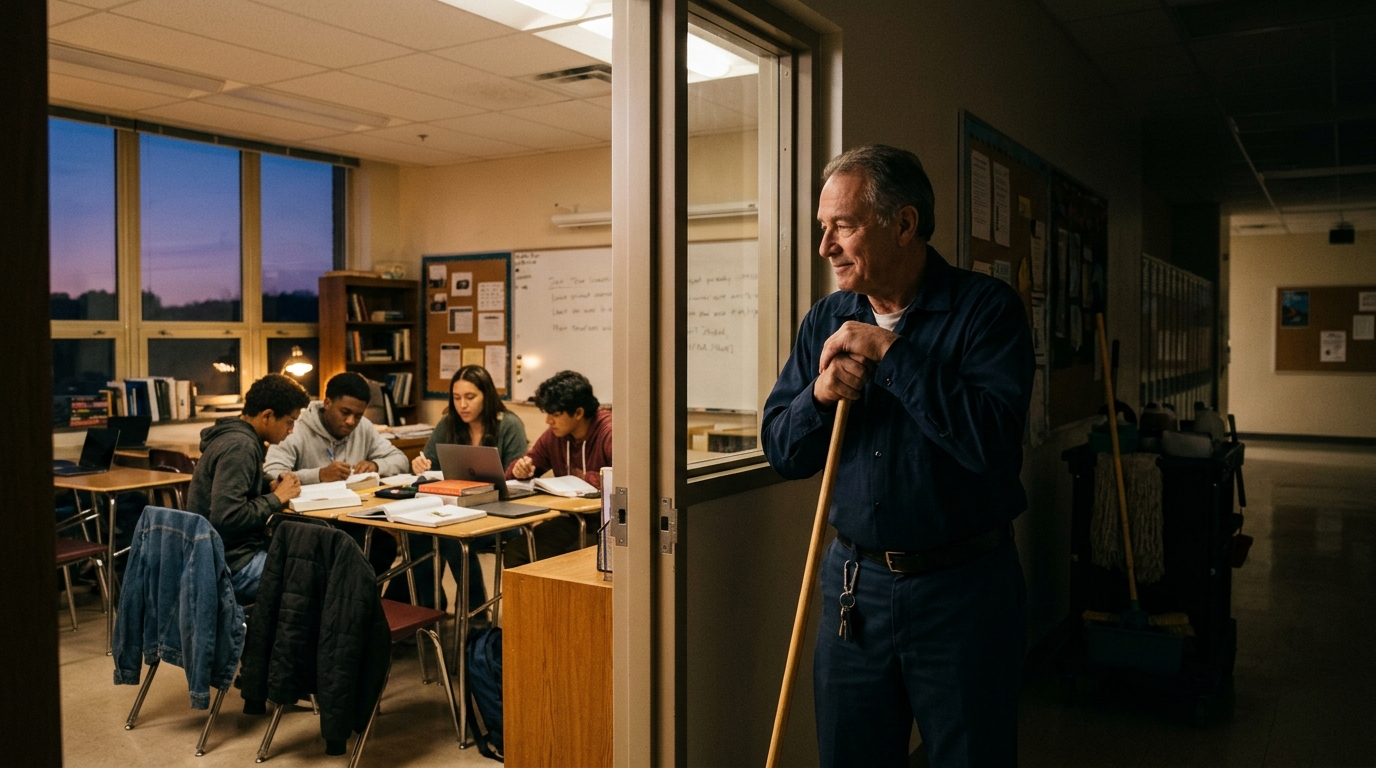
It started, as the best things often do, by accident. Three autumns ago, Walter was running his floor buffer down the east wing when he noticed a light still burning in Room 114, a worn-out classroom at the end of the hall. Inside, a sophomore named Dario sat alone at a desk, a textbook open and untouched, staring at nothing.
Walter did not ask what was wrong. He had learned long ago that the question “what’s wrong?” tends to make people close like doors. Instead, he said, “I’ve got about forty minutes of floors to do. Mind if I leave this light on for you?”
Dario shrugged. Walter finished the hallway, emptied the bins, and when he passed by again, the boy was still there. This time, Walter set a paper cup of hot chocolate from the staff-room machine on the corner of the desk and kept walking.
“That was it,” Walter told me when I spoke with him last month, leaning on his mop handle in a quiet corridor. “I didn’t say a word about school or grades. I just figured a person shouldn’t sit alone in a cold room.”
What the Evening Offers That the Day Cannot
There is something about the end of the day that loosens people. The daytime school is loud with performance: who is smart, who is popular, who is failing. By evening, those masks slip. The building empties, the shadows lengthen across the linoleum, and a kid who spent eight hours trying to look like he did not care can finally admit that he does.
Walter understood this instinctively. He never ran a program or wore a name tag that said Mentor. He simply made himself a steady, unhurried presence in the part of the day when students felt the most unseen.
Over the following weeks, Dario kept coming back to Room 114. Then a girl named Priya started appearing, a junior who was working nights at her family’s restaurant and had nowhere quiet to study. Then two more. By winter, a small, unofficial group of students had quietly begun using the east wing as their evening refuge.
The Small Things Walter Did
Ask anyone who passed through that hallway, and they will not describe grand gestures. They describe a pattern of small, deliberate kindnesses, the kind that add up to a feeling of being held.
- He left the lights on. It sounds trivial, but a lit room says someone expected you.
- He never asked students to explain themselves. If they wanted to talk, he listened. If they wanted silence, he gave them that, too.
- He remembered the details. He knew Priya was studying for a chemistry exam and would ask, simply, “How did the test go?”
- He kept a drawer of granola bars. Several students admitted they had come to school hungry, and he never made a show of feeding them.
- He treated them as capable. He never talked down. He talked to them as people with futures.
Priya’s Story
Priya, now a first-year nursing student, remembers the first night she felt she could breathe. “My house was loud and my brother needed help with homework and my parents needed me at the restaurant,” she said. “I’d stay at school as long as I could just to find ten quiet minutes. Walter never made me feel like I was in the way. He’d roll his cart past and say, ‘Evening, Priya,’ like it was the most normal thing in the world that I was there.”
She paused, then added something that has stayed with me since. “Nobody had ever said my name like that. Like they were glad.”
Where the Lesson Settles
I have thought about Walter often in the quiet hours since I met him. It is easy, during the day, to believe that change comes from loud things: programs, policies, funding, speeches. Those things matter. But there is another kind of change that happens in the margins, after the noise fades, when someone with no official power simply decides to notice another human being.
The teachers at Ridgemont only learned about the east wing refuge in the spring, when Dario, who had been failing three classes, brought his grades up to passing. His counselor asked what had changed. He said, without hesitation, “Mr. Walter keeps the light on.”
What Walter Wants You to Know
When I asked Walter why he did it, he laughed softly, almost embarrassed by the attention. “When I was a boy, I had a man like that,” he said. “A night watchman at the factory where my mother worked. I’d sit in his booth doing homework while she finished her shift. He never made a fuss. He just let me be there. I never forgot it.”
That is the quiet engine behind so much goodness in the world: someone once did something small for us, and we carry it forward until we can pass it on.
A Reflection for Tonight
As you wind down your own day, perhaps with a cup of something warm and the house settling around you, consider this: who in your life might be sitting alone in a lit room, waiting to be noticed? You do not need a plan or a title. You only need the willingness to say, “Mind if I leave this light on for you?”
Walter still works the east wing every evening. The room at the end of the hall still glows. And every night, as the sky outside deepens to indigo and the building falls silent, a few students still wander in, find a warm cup waiting, and remember that someone is glad they came.
That is the kind of hero who does not make the news. But for the kids who found their way to that light, he made all the difference.