🎧 Listen to this story
Narrated by Kore · 7,155 characters
There is a particular kind of quiet that settles over a neighborhood when the power goes out. The hum of refrigerators stops. The glow from living room windows vanishes. For a few minutes, everyone stands in their own dark kitchens, listening to the silence and wondering how long it will last. On a cold Thursday evening last October, that silence fell over Alder Lane, and what happened next is the kind of story people tell for years afterward.
This is a reported account, pieced together from conversations with the neighbors who were there. Names are used with permission.
The Light Mrs. Aldous Kept On
Margaret Aldous, 81, has lived at the end of Alder Lane for fifty-three years. Her husband, Walter, passed away two winters ago. For as long as anyone on the street can remember, the Aldous porch light was a fixture: a small brass lantern-style fixture Walter had wired himself in 1974, glowing amber every evening from dusk until dawn.
After Walter died, Margaret kept it burning. She never said why. Neighbors assumed it was habit, or comfort, or perhaps a quiet way of keeping a light on for someone who would not be coming home.
On the evening of the outage, a storm had knocked down a transformer two miles away. At 6:42 p.m., every house on the lane went dark at once. And the amber glow at the end of the street went out with it.
Someone Noticed
It was a teenager, sixteen-year-old Dev Ramanathan, who first noticed. He was carrying trash bins to the curb when he looked down the street and realized something felt wrong. It took him a moment to work out what: for the first time in his life, Mrs. Aldous’s porch was dark.
He walked down to check on her. She answered the door holding a flashlight, perfectly fine, a little embarrassed to be fussed over. But she mentioned, almost in passing, that she had been trying to get the old fixture working again for two weeks. The socket had been flickering since the first frost, and now, with the power out, she could not tell whether the wiring was the problem or the storm was.
“I just don’t like it being dark out there,” she told him. “Walter always said a house should have one light on.”
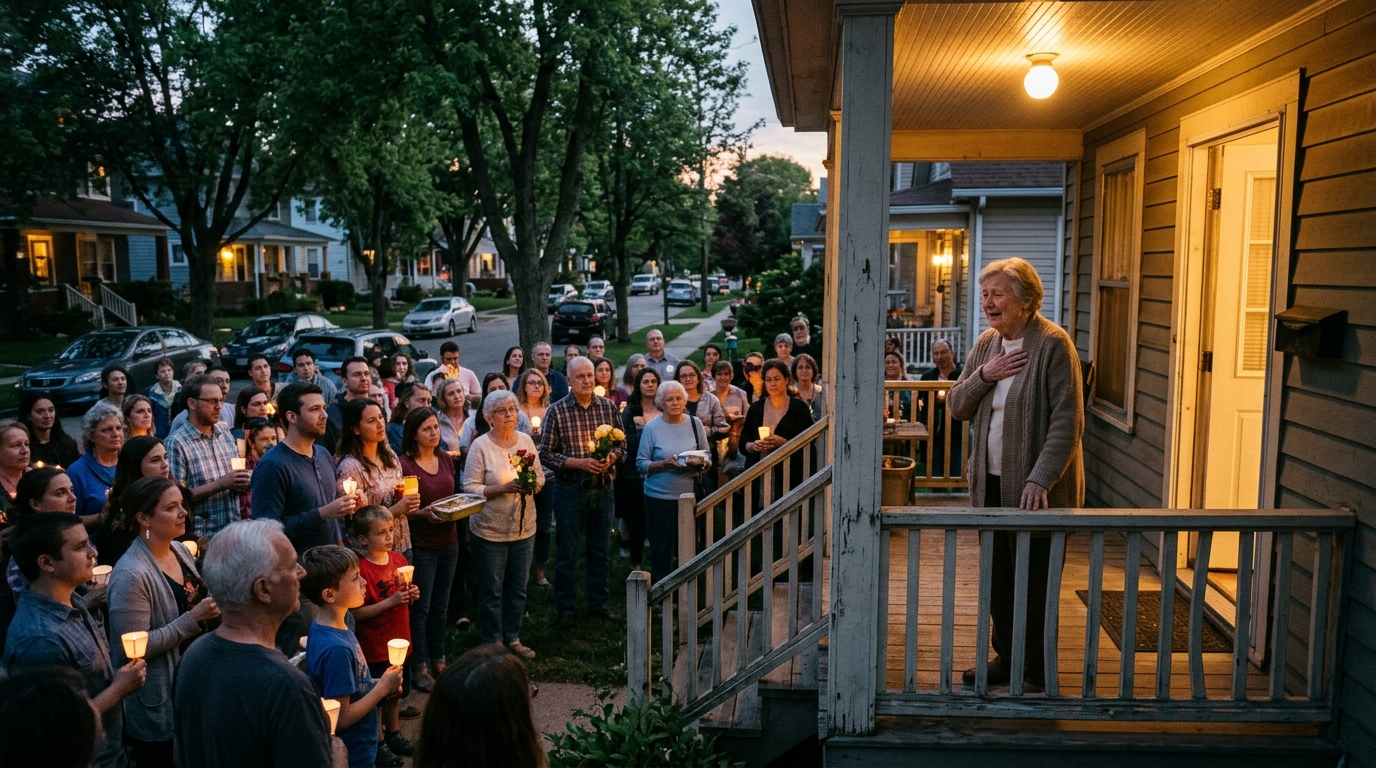
Dev went back up the street and told his mother. His mother told the Okafors. The Okafors told the couple next door. Within twenty minutes, nine people were standing in Margaret Aldous’s front yard in the dusk with flashlights, a toolbox, and a collection of candles pulled from kitchen drawers.
What Nine Strangers Can Do in the Dark
Calling them strangers is only slightly unfair. Most of them knew one another by sight and by wave, the way neighbors do. Few had ever shared a conversation longer than a minute. That evening changed it.
Here is how the work unfolded:
- The diagnosis. Tomasz Wieczorek, a retired electrician who lives three doors down, crouched on a step stool and examined the fixture by flashlight. The power was out street-wide, so he could not test it live, but he could see the problem: a corroded socket and a frayed wire where the old insulation had cracked with age.
- The supplies. Two neighbors drove to the one hardware store still open on the main road, running on generator power. They came back with a new socket, fresh wire, and a box of weatherproof connectors.
- The light. Because they needed steady illumination to work, the rest of the group arranged candles and lanterns around the porch steps, on the railing, and along the walkway. Someone brought a camping lantern. Someone else brought tea lights in jam jars.
- The hands. Dev held the flashlight. Tomasz did the wiring. A woman named Priya Nandakumar steadied the ladder. Margaret sat in a kitchen chair someone carried out for her, wrapped in a blanket, supervising.
The work took about ninety minutes. By the end, the porch looked like a small, flickering festival: dozens of candles glowing against the dark, nine neighbors working side by side, and in the middle of it all, an elderly woman watching her late husband’s light be mended by people who barely knew her.
The Moment It Came Back
Here is the part that makes the story worth telling. Because the whole street was without power, there was no way to test the new wiring. Tomasz finished the connections, sealed the fixture, and screwed the lantern back into place. Then he stepped back and said, honestly, “It should work when the power returns. I can’t prove it tonight.”
So they waited. Margaret made a pot of tea on her gas stove, and people drifted onto the porch steps with mugs, talking quietly by candlelight. Priya learned that Margaret had taught third grade for thirty-one years. Tomasz learned that Walter had once rewired the entire elementary school gym as a favor. Someone mentioned that the porch light had been the signal, decades ago, that told neighborhood kids it was time to come home.
At 9:17 p.m., the street hummed back to life. Windows lit up one by one. And at the end of the lane, the little brass lantern flickered once, then settled into a steady amber glow.
Nobody cheered. Dev said it was too quiet for that. People just stood there and looked at it for a while.
The Evening Lesson
There is something about the end of a day that strips away the performance of being busy. When Margaret finally closed her door that night, the candles were being gathered up and the neighbors were saying their soft goodnights. She told me later that she sat in her kitchen for a long time before bed, just listening to the house.
“It was the first time since Walter that the quiet didn’t feel empty,” she said. “It felt full. Like the whole street was in the room with me.”
That is the thing about evening reflection. The day’s noise falls away, and what remains is what actually mattered: who showed up, who noticed, who stayed. It was never really about the fixture. It was about a light that stood for a marriage, a street, and a woman who did not want to ask for help but received it anyway.
What We Can Carry Into Our Own Evenings
You do not need a blackout to do what these neighbors did. A few gentle takeaways from Alder Lane:
- Notice the small absences. Dev saw something missing that no one else had thought to look for. Kindness often begins with attention.
- Offer what you have. Not everyone on that porch could rewire a socket. Some brought candles. Some brought tea. Every contribution counted.
- Let people be helped. Margaret almost declined. Accepting care is its own quiet act of generosity.
- Stay a little longer. The repair took ninety minutes, but the friendships grew in the waiting. Sometimes the most meaningful part of helping is simply lingering afterward.
The Light Still Burns
Every evening now, when the sun slips below the rooftops on Alder Lane, the brass lantern at the end of the street comes on. The neighbors who rebuilt it have started a small habit: when they walk their dogs at dusk, they wave at the porch, and more often than not, Margaret is sitting there waving back.
Tonight, as the day winds down and your own porch light flicks on, consider who in your life might be sitting in the dark, too proud or too quiet to say so. A flashlight, a few candles, and a willingness to show up may be all it takes.