🎧 Listen to this story
Narrated by Kore · 7,061 characters
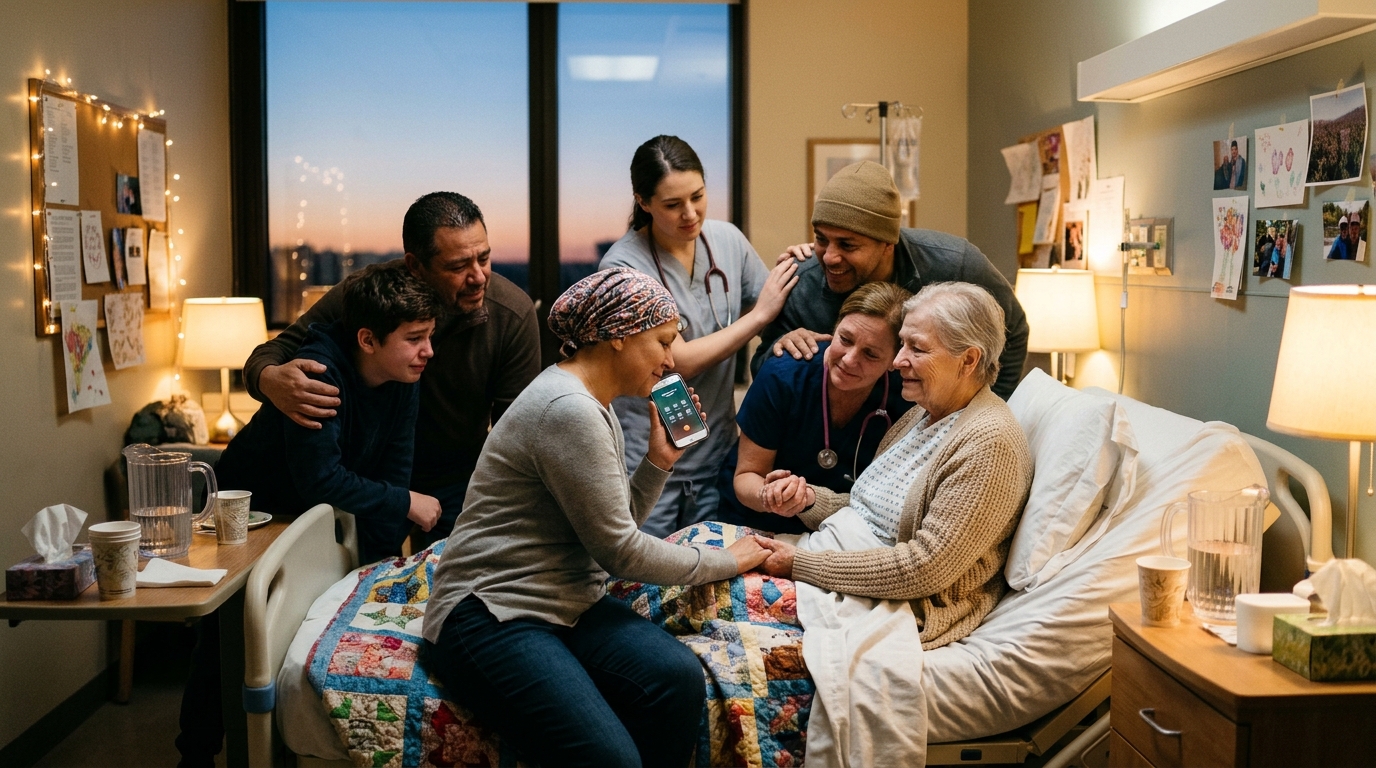
At 8:00 every evening, the hallway lights on the fourth floor dim to a soft amber. Monitors hum a little lower. Visitors drift toward the elevators. And somewhere near the nurses’ station, a phone rings, and a small, strange, wonderful ritual begins.
This is a story about that ritual, and about how three minutes of honesty at the end of the day changed the way an entire oncology ward faced the long nights.
It Started With a Sleepless Patient
The way the staff tell it, the Nightly Gratitude Call began almost by accident. A retired schoolteacher named Marguerite, in the middle of a brutal round of chemotherapy, could not sleep. Evenings were the worst part. The visitors went home, the daytime distractions faded, and the fear showed up right on schedule.
One night she asked her night nurse, Daniel, a question that has stayed with him ever since. “Would it be strange,” she said, “if I just told someone one good thing that happened today? Just so it has somewhere to go?”
Daniel did not think it was strange. He sat down on the edge of the visitor’s chair, and she told him: the lemon custard cup at lunch had been perfect, and her granddaughter had sent a drawing of a purple horse. That was it. Two small things. But Daniel noticed her shoulders drop when she finished, as if she had set down something heavy.
The next night she asked if he would call her room at eight, just to do it again. Then the patient in the next room, a quiet truck driver named Walt, overheard through the thin wall and asked if he could join.
How the Call Works
Within two weeks, nearly every room on the ward had opted in. There is no script and no pressure, and that, the nurses insist, is the whole secret. Here is how a typical evening unfolds:
- 8:00 p.m.: The ward’s intercom chimes softly, a gentle tone, not an alarm.
- The invitation: A volunteer or nurse says, “Whenever you’re ready, tell us one thing from today.”
- The sharing: Patients who want to speak do so from their beds, over the intercom or by phone. Those who prefer to listen simply listen.
- The rule: There is only one. Nothing has to be big. Small counts. Small counts most of all.
- 8:15 p.m.: The lights go lower, the ward settles, and the night begins.
Staff say the whole thing rarely runs longer than ten minutes. But the effect lingers well past the last voice.
What People Actually Say
You might expect the gratitudes to be grand. They almost never are. Over the months, the nurses began keeping a quiet list in a notebook at the station, not to analyze, just to remember. A few entries:
- “The sun came through the blinds at exactly the right angle during my nap.”
- “My nurse remembered I take my tea with too much honey.”
- “I kept down half a piece of toast.”
- “A stranger in the elevator held the door and smiled like she meant it.”
- “I laughed today. A real one. I’d forgotten what it felt like.”
Walt, the truck driver, was reluctant at first. He is not a man who talks about feelings, he admits. His first contribution was a single sentence: “The coffee was hot.” The ward applauded anyway, and he later said that was the moment he decided he might survive this place.
The Quiet Science of Saying It Out Loud
Gratitude is not a cure, and no one on this ward pretends otherwise. The treatments do the medical work. But the staff, and a growing body of research on gratitude practices, point to something real: turning attention toward small good things can ease the grip of dread, improve sleep, and loosen the isolation that illness so often builds.
Evening matters here. Daytime on an oncology ward is busy with scans, infusions, consultations, and visits. But night strips all that away. The mind has room, and it often fills that room with worry. The Gratitude Call offers the mind a different place to go at exactly the moment it is most likely to spiral.
“It gives the dark a counterweight,” Daniel says. “Not an answer. Just a counterweight.”
A Ward That Started Listening to Itself
The most surprising change was not in any single patient. It was in the ward as a whole. Strangers who had never met began checking on each other. A woman who finished treatment and went home started calling in on Thursdays to hear everyone’s three minutes. Family members who stayed overnight began joining from the pull-out chairs.
Patients started saying that the hardest part of illness is not the pain, it is the loneliness inside it. The call dissolved some of that. People who had been going through the same impossible thing, in rooms ten feet apart, finally heard each other’s voices in the dark.
When someone had a bad day and could not find a single thing to share, the ward had a gentle tradition. Someone else would offer one on their behalf. “I’m grateful you’re here tonight,” a voice would say, and the room would fill with soft agreement.
The Night Marguerite Spoke Last
Marguerite, the schoolteacher who started it all, finished her treatment in the spring. On her final evening, she asked to make the call herself. The ward gathered quietly, patients propped on pillows, nurses leaning in doorways.
She did not give one thing. She gave a list. She thanked the custard, the purple horse, the toast, the honey in the tea, the strangers, the laughter, and the nurse who sat down in a visitor’s chair on a night she could not sleep. Then she said the thing the staff still repeat to each other. “I came in here thinking the evenings would be what broke me. Instead they’re what held me together.”
Bringing the Practice Home
You do not need a hospital ward to try this. The beauty of the ritual is how portable it is. If you want to borrow it for your own evenings, here is a gentle way to begin:
- Pick a time. Tie it to something already in your night, brushing your teeth, turning off a lamp, the last cup of tea.
- Keep it small. One good thing is enough. Resist the urge to make it impressive.
- Say it out loud. To a partner, a friend on the phone, a child at bedtime, or even to the quiet room. Spoken gratitude lands differently than thought gratitude.
- Allow the empty nights. Some days you will have nothing. Let someone offer one for you, or simply sit in the stillness without forcing it.
- Let it end the day. Make it the last thing, so the good thing is the one you carry into sleep.
What the Dusk Teaches
There is a reason this ritual works best at the end of the day. Evening is when we finally stop performing, stop rushing, stop pretending we are fine. The light softens, the noise falls away, and what is left is the truth of how we are doing. On the fourth floor, that truth is sometimes frightening. But it is also, as it turns out, a doorway.
Tonight, as the lights dim on that ward and the intercom chimes its soft little tone, someone new will clear their throat and offer their one small thing. A cup of custard. A drawing. A hot coffee. Someone else will answer, “I’m grateful you’re here.”
And for a few quiet minutes, in a place where so much is uncertain, a whole ward of strangers will remember that the day held something good after all.
What would your one thing be tonight?