🎧 Listen to this story
Narrated by Kore · 7,191 characters
There is a particular kind of quiet that settles over a house around nine in the evening. The dishes are done, the porch light clicks on, and the world seems to exhale. For most of us, this is when we begin to put the day down. For Marguerite Doyle, it is when her real work begins.
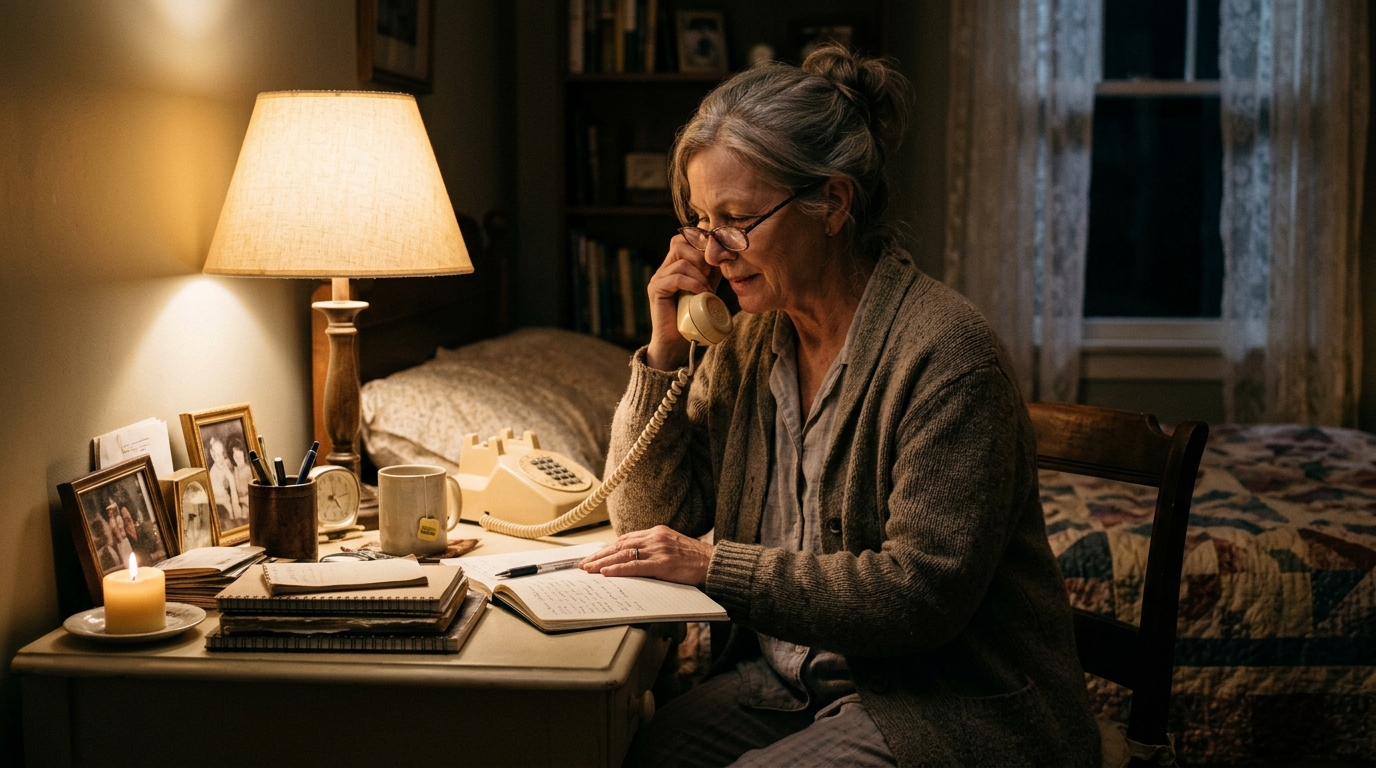
Marguerite is seventy-one years old, a retired school secretary with reading glasses on a beaded chain and a mug that has long since stopped keeping her tea warm. For fifteen years, she has sat in the same worn armchair beside the same small desk, waiting for the phone to ring. She volunteers for an overnight support line, the kind of service most people hope they will never need and are profoundly grateful exists. In all that time, she says, she has not taken a single night off.
The number surprised even me when I first heard it. Fifteen years is more than five thousand nights. I sat down with her on a gray Tuesday evening, as the light slid out of her kitchen window, to ask how a person does that, and more importantly, why.
How It Started
Marguerite did not set out to become anyone’s lifeline. She began volunteering the winter after her husband, Walter, passed away. The evenings had become unbearable. Walter had always been the one to say, “Well, that’s another day tucked in,” and without him, the hours between dinner and sleep felt like a long hallway with no door at the end.
“I was lonely in a way I didn’t have words for,” she told me. “I saw a little notice at the library asking for people who could listen. Just listen. I thought, well, I’m already awake at night anyway. I might as well be awake for something.”
She completed the training, a few weekends of learning how to hold silence, how to ask gentle questions, and when to stay on the line no matter what. Her first overnight shift was a Thursday. She has not missed one since.
What an Evening Shift Really Looks Like
People imagine a hotline as a place of constant crisis, phones ringing off the hook, voices raised. The truth, Marguerite says, is quieter and stranger. Much of the night is stillness. And that stillness, she has learned, is part of the gift.
Her routine has barely changed in fifteen years:
- Seven in the evening: She eats a light supper and waters the ferns on her windowsill.
- Eight-thirty: She sets out her tea, her blanket, her notepad, and a small lamp with a warm yellow shade.
- Nine o’clock: She picks up the line. The first calls are usually people who cannot bear the dinner-to-bedtime gap, the same hallway she once walked.
- Midnight to four: The deepest hours. The calls get heavier, and also, she says, more honest.
- Dawn: She watches the sky go from ink to pale gold, and she often cries a little from relief that another person made it to morning.
“The night does something to people,” she said. “The day gives you a thousand ways to avoid your own heart. Then the lights go off and there’s nowhere left to hide. That’s when people finally pick up the phone.”
The Rule She Never Breaks
Marguerite is quick to say she is not a saint, and that she is certainly not a counselor. She is a listener. Her guiding principle is simple: the person on the other end is never a problem to be solved, only a person to be kept company.
“I used to think I had to fix things,” she admitted. “I’d rush in with advice. Then a young man on the line said to me, very gently, ‘I don’t need you to fix it. I just need you not to hang up.’ I have never forgotten that. Now I just stay.”
What staying looks like
Staying, she explained, is its own kind of skill. It means:
- Letting a silence stretch without filling it nervously.
- Repeating back what you heard so the caller knows they were truly heard.
- Resisting the urge to say “everything happens for a reason.”
- Being willing to hear the same sorrow told three times in one night.
The Calls She Carries
She does not share the details of any conversation, and she should not. But she will speak about the shape of what she has seen. There was a woman who called every Sunday night for two years, never saying much, just breathing and listening to Marguerite hum. There was a father whose daughter had stopped speaking to him, who practiced aloud what he would say to her until, one evening, he finally said it to the right person. There was a teenager who asked only that Marguerite stay on the line while she walked home in the dark, narrating each streetlight until she reached her front door.
“That last one,” Marguerite said softly, “I think about whenever I turn out my own porch light.”
Why She Has Never Taken a Night Off
I asked the question I had been circling all evening. Fifteen years without a single night off seems almost impossible. Has she never been sick? Never wanted a vacation? Never simply been tired?
She smiled, the kind of smile that takes its time.
“Oh, I’ve been sick. I’ve worked a shift with a fever and a box of tissues. I had my gallbladder out and arranged to take calls from a recliner the week after. But I’ve never wanted to skip. Because I know what a night feels like when no one answers. I lived those nights. If I can be the voice on the other end even once, then it’s worth every sleepy morning.”
The organization she volunteers with confirmed what she was too modest to say: her record is, as far as they know, unmatched. Newer volunteers are sometimes paired with her for their first shifts, and many have said the same thing afterward. She does not teach with words. She teaches with presence.
What the Night Taught Her
As we finished our tea and the window went fully dark, Marguerite offered a few lessons she has gathered over five thousand evenings. I wrote them down on the back of an envelope, and I think they are worth keeping.
- Almost everyone is carrying more than they show. The kindest thing you can do is assume the person in front of you is tired in ways you cannot see.
- Presence is worth more than answers. You do not have to say the perfect thing. You only have to stay.
- Small, consistent acts outlast grand gestures. One night is easy to give. Five thousand nights is what changes a life, including your own.
- Helping is not a one-way street. “I came to the phone to be less alone,” she said. “The people who call have kept me company far more than I have kept them.”
A Quiet Invitation
You may never sit by a phone at two in the morning. Most of us will not. But Marguerite’s story asks something gentle of the rest of us as we turn out the lights tonight. It asks us to think of the people in our lives who might be lying awake, someone in the hallway at the end of the day, someone for whom the quiet is too loud.
You could send a text. You could make a call you have been putting off. You could simply be the person who does not hang up.
As I gathered my coat to leave, Marguerite was already settling into her armchair, adjusting the lamp, pulling the blanket across her knees. The phone sat patient on the desk. Outside, the streetlights hummed on, one by one, like small promises.
“Well,” she said, glancing at the clock with the calm of a woman who has done this five thousand times, “another night to keep.”
And somewhere out there, in the dark, someone reached for a phone and found that she was waiting.