🎧 Listen to this story
Narrated by Kore · 8,590 characters
There is a particular kind of quiet that falls over a house at the end of the day. For most of us, it is ordinary, almost invisible. For Marguerite Delacroix, a retired school librarian from a small town at the edge of a river valley, that quiet became something she had to learn all over again.
The fire started in the early hours of a windy October morning. By the time the sun came up, the home she had lived in for thirty-one years was a blackened frame against a pale sky. Her books, her late husband’s letters, the quilts her mother had stitched, the photographs of children she had taught who grew up and sent her postcards from faraway places. All of it, gone.
What follows is the story of how she rebuilt. Not in a grand, cinematic way, but slowly, one evening at a time, beginning with a single candle.
The Night After Everything
Marguerite will tell you that the first week was a blur of paperwork, borrowed clothes, and kind faces she could not quite focus on. A neighbor, a woman she had barely spoken to in a decade, opened her spare room. A church group brought casseroles. A man from the hardware store showed up with a bag of toothbrushes and socks and refused to take a cent.
But the evenings were the hardest part. Days, she could manage. Days had tasks: phone calls, forms, decisions that needed making. It was when the light faded and the busyness drained away that the loss caught up with her.
“In the daytime, I was a person with a to-do list,” she says. “At night, I was a woman sitting in a stranger’s guest room, holding a purse and a phone charger and nothing else.”
The Small Gift That Changed the Evening
On the ninth night, the neighbor who had taken her in left a small jar candle on the nightstand. It was nothing special: plain white wax, a faint scent of vanilla, a little glass jar with a tin lid. The neighbor said only, “I thought you might like something to look at.”
Marguerite lit it that evening almost without thinking. She sat on the edge of the bed and watched the flame steady itself. For the first time in more than a week, her breathing slowed.
She did not feel healed. She did not feel hopeful. But she felt, for a few minutes, simply present, and that was more than she had felt since the fire.
The Ritual Takes Shape
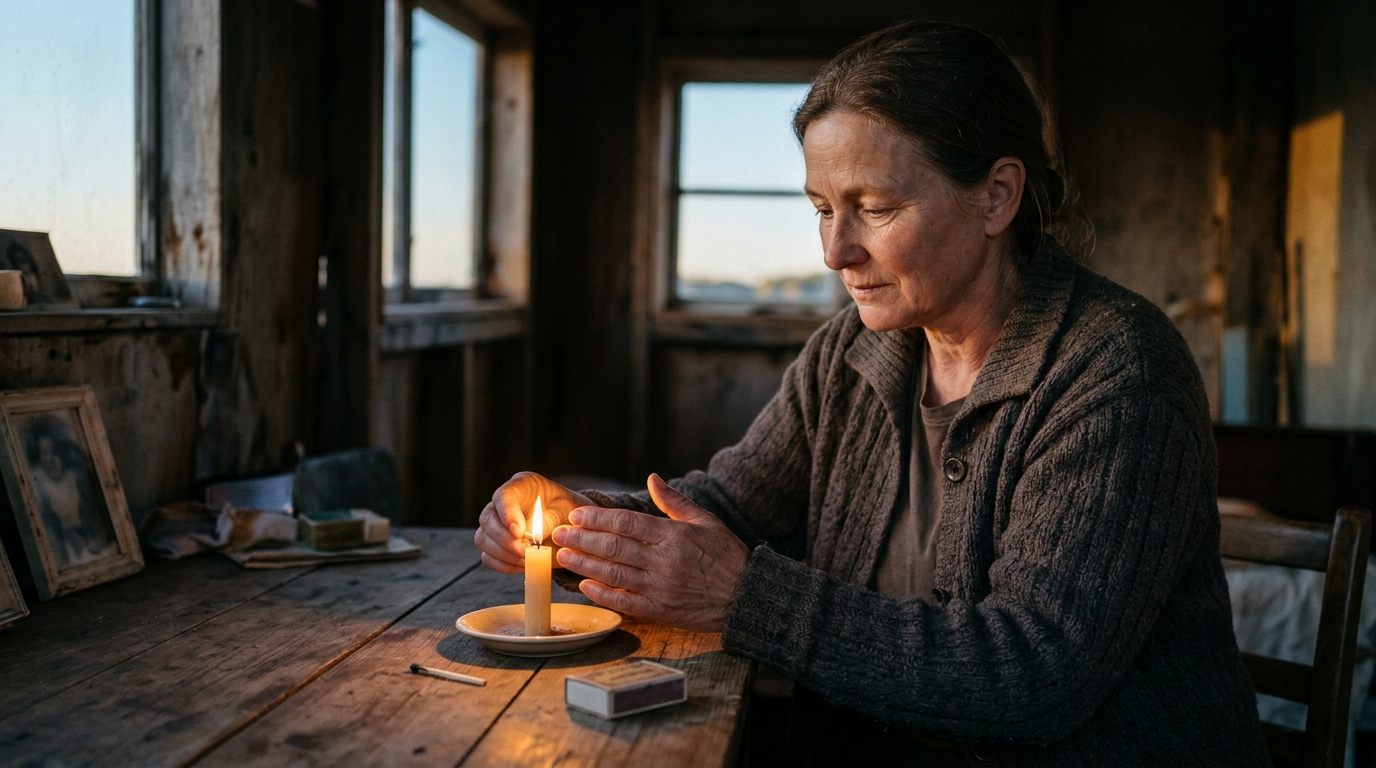
The next evening, she lit it again. And the next. Without ever deciding to, she had begun a ritual. Each night, once the dishes were done and the house had settled, she lit the candle and sat with it for a while.
At first, she just watched the flame. Then she began to talk to it, quietly, the way you might talk to a friend who does not need you to be tidy about your feelings. She said the names of things she had lost. She said the names of people who had helped. Some nights she cried. Some nights she laughed at a memory that surfaced unexpectedly, like the time her husband had tried to repair the porch swing and ended up mounting it upside down.
Over weeks, the ritual grew a little structure. She began to ask herself three small questions each evening:
- What did I lose today that I only just noticed? (A recipe card. A particular coffee mug. The sound of a certain floorboard.)
- What was one thing that went right? (A phone call returned. A stranger’s kindness. A warm meal.)
- What is one small thing I can do tomorrow? (Not a plan for the year. Just one thing.)
She wrote the answers in a cheap spiral notebook she had bought at the drugstore. It was the first new object she owned that was entirely hers.
Why Small Rituals Work
It is tempting to think that recovering from a catastrophe requires a dramatic turning point. A breakthrough, a revelation, a day when everything shifts. But those who have walked through loss often describe something quieter. Healing arrives in increments so small you only recognize them in hindsight.
A nightly ritual works, in part, because it asks very little. It does not demand that you feel better. It only asks that you show up. When everything in your life feels unstable, a small act repeated at the same hour becomes an anchor. The body begins to recognize it. The mind begins to relax into it.
Evening is an especially tender time for this kind of practice. The world slows down. The noise of obligation falls away. Whatever you have been holding at arm’s length all day has room to come closer, and with a gentle ritual, you can meet it on your own terms rather than being ambushed.
What the Candle Was Really Doing
Marguerite insists the candle itself was not magic. “It was just a way of telling myself that this hour belonged to me,” she says. “Everything else in my life had been taken or rearranged. But the evening, and that flame, were mine to keep.”
She had accidentally discovered what therapists often recommend: a predictable, soothing cue that signals safety to the nervous system. A light. A sound. A cup of tea. A familiar gesture. Something that says, you can set it down now.
Rebuilding, One Evening at a Time
Months passed. Insurance claims were filed and slowly settled. A small rental cottage became available on the far side of town, and Marguerite moved in with two suitcases of donated clothes and a box of kitchen basics gathered by her former students, many of whom had heard the news and written to her.
That first night in the cottage, the walls bare and the rooms echoing, she unpacked exactly one thing before anything else: the candle jar, now nearly burned down to its last half inch.
She lit it on the windowsill. Outside, the sky turned the color of apricots, and a few birds settled into the hedge. She sat on an overturned crate because she had no chairs yet, and she thought: I am still here.
The Things That Came Back
What surprised her most was how the small things began to accumulate again. A neighbor passed along a bookshelf. A former student mailed her a battered copy of a novel they had both loved. Someone gave her a quilt, not her mother’s, but made with the same careful stitches.
None of it replaced what was gone. She is firm about that. “You do not replace a life,” she says. “You build a new one alongside the memory of the old.”
But the new life had a shape now, and each evening she added a little more to it.
Paying It Forward at Dusk
By the following spring, Marguerite had begun to do something she had not planned. She started keeping a small box of candles by her front door. When she heard that someone in town had suffered a loss, a house fire, a death, a diagnosis, she would slip a candle and a handwritten note onto their porch at dusk.
The note was always the same, simple and unadorned: For the evenings. You do not have to feel anything. Just light it and sit for a while.
She never signed her name. But in a small town, word travels, and soon people began to leave candles on her porch in return. By the end of the year, her little cottage had a collection of mismatched jars glowing on the front step each night, a tiny constellation of gratitude.
What We Can Take From Her Evenings
You do not need to survive a fire to benefit from what Marguerite learned. Most of us carry something heavy, even if it is invisible. A grief, a worry, a season of change. And most of us rush past the evening, filling it with screens and noise to avoid the very quiet where healing begins.
If you would like to try a version of her ritual, here are a few gentle ideas:
- Choose one small cue. A candle, a lamp, a cup of tea, a particular chair. Something you can repeat every night.
- Keep it short. Five minutes is enough. The point is consistency, not duration.
- Ask kind questions. What was hard today? What went right? What is one small thing for tomorrow?
- Let it be imperfect. Some nights you will skip it. Some nights you will cry through the whole thing. Both are fine.
- Share the light. When you are ready, offer the same quiet gift to someone else.
The Last Light of the Day
Marguerite is in her seventies now. Her cottage is full of books again, a different collection, but loved just as fiercely. She still lights a candle every evening, though she says she no longer needs it the way she once did.
“It is more like an old friend now,” she says. “We do not talk about the fire anymore. We just sit together while the day ends.”
There is something quietly profound in that. Not the dramatic rebuild, not the triumphant comeback, but the soft, steady choice to light one small flame at the end of a long day and trust that it is enough.
Tonight, when the light fades and the house grows still, you might try it too. One candle. One breath. One small act of staying present with your own life.
Sometimes that is all rising up really is.