🎧 Listen to this story
Narrated by Kore · 8,480 characters
The first time Margaret saw the doe, she thought nothing of it. It was a late September evening, the kind where the light goes amber and the whole valley seems to exhale. Her husband Walter, eighty-one years old and six weeks into hospice care, had asked her to move his bed closer to the big window in the sunroom. He wanted to watch the sun go down over the meadow. It was the one request he made that week that still sounded like the man she married.
And there, at the edge of the tall grass, stood a deer.
An Ordinary Visitor, Until She Wasn’t
Deer are not rare in that part of Vermont. Margaret and Walter had lived on the same eleven acres for fifty-three years, and they had seen thousands of them. They had argued over them too, mostly about the hostas. So when a young doe stepped out of the treeline at around six o’clock and began to graze, Margaret simply noted her and went back to folding laundry.
But the next evening, the doe came again. And the evening after that.
By the end of the first week, Margaret had started to notice the details. The doe had a small notch in her left ear, a crescent-shaped nick, as though someone had taken a tiny bite from it. She always entered from the same gap in the stone wall. She always chose the same patch of clover, about forty feet from the sunroom window. And she always, always lifted her head and looked toward the glass before she settled in to eat.
“She’s checking on me,” Walter said one evening, his voice thin as paper. “Making sure I’m still here.”
Margaret laughed softly, because that is what you do when someone you love says something tender and impossible. But she did not tell him he was wrong.
What the Evenings Became
Dying, Margaret learned, has a rhythm. The mornings belonged to the nurses and the medications and the practical machinery of care. The afternoons were heavy and slow, full of sleep. But the evenings, those golden, softening hours, were different. Walter would wake a little, as if the fading light called him back to the surface.
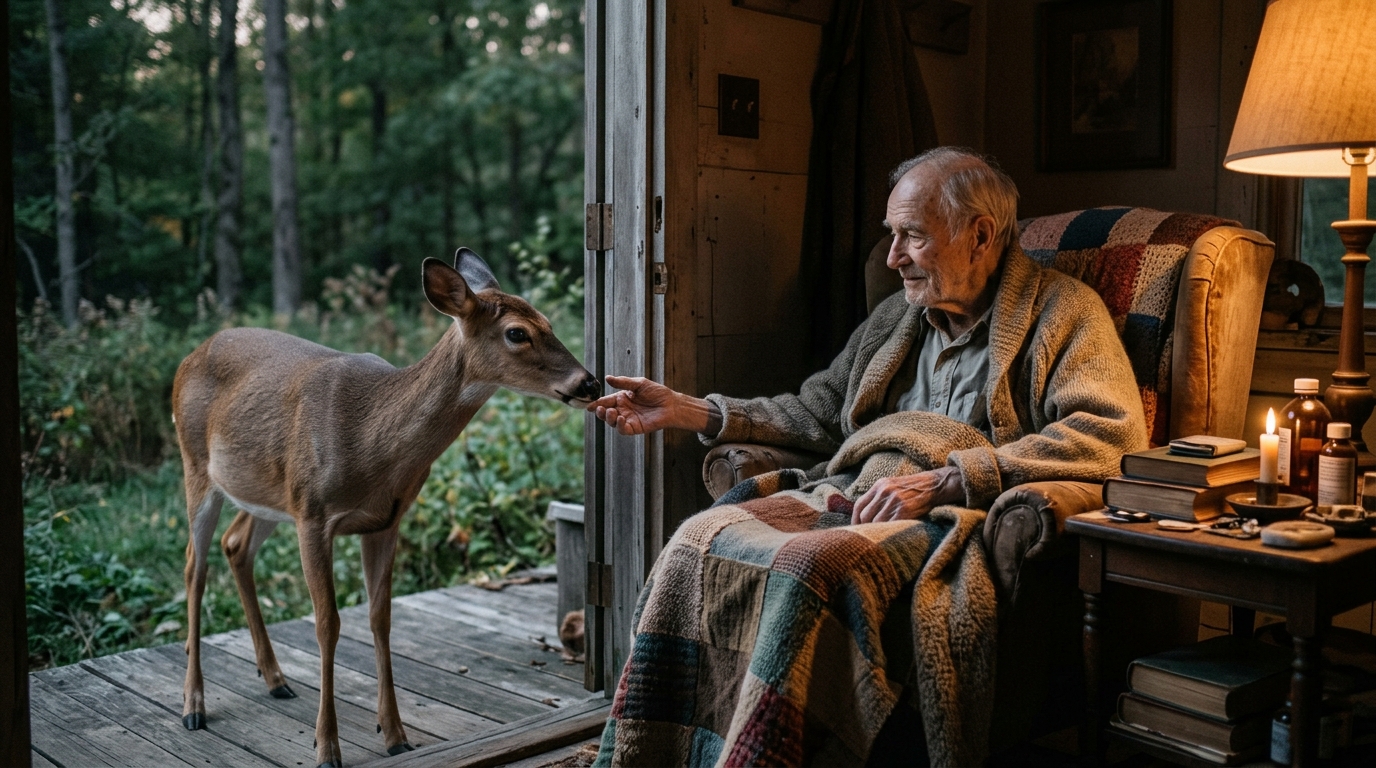
And so a ritual formed without anyone planning it. Around five-thirty, Margaret would help Walter sit up against the pillows. She would pour him a little warm tea he rarely drank, and tuck the blue wool blanket around his knees. Then they would wait.
The doe never arrived on a schedule you could set a watch by, but she came close to it. Walter began to narrate her movements in a low murmur, the way you might commentate on a quiet ball game.
- “There she goes, testing the air.”
- “She likes the clover better than the grass. Smart girl.”
- “She’s looking at us now. Hello, old friend.”
Margaret kept a small notebook on the windowsill and began to jot things down. Not for any reason, really. She just sensed that these evenings were going to matter later, in the way that small things always matter later.
The Evening Walter Talked
There was one night in early October that Margaret has never forgotten. Walter had been mostly silent for two days. The hospice nurse had gently told her that this was normal, that the body begins to turn inward. Margaret sat beside him as the sun slid toward the ridgeline, holding his hand and feeling very alone.
Then the doe stepped through the gap in the wall.
Walter’s eyes opened. He turned his head, slowly, with obvious effort, and watched her move across the meadow. For a long while he said nothing. The light turned the grass the color of honey. The doe grazed, lifted her head, and looked at the window.
“You know,” Walter said, so quietly Margaret had to lean in, “I spent sixty years worrying about whether I’d done enough. Worked enough. Saved enough. Fixed enough of the roof.” He paused. “She’s never worried about any of it. She just comes here and eats her supper and the world is fine.”
Margaret felt her eyes sting. “That sounds like a good way to live,” she said.
“It’s a good way to end,” Walter whispered. “Watching someone who isn’t afraid.”
They sat together until the light was gone and the doe had melted back into the dark. It was the longest conversation they had in his final weeks, and it happened because a deer showed up to eat clover.
Why Do Animals Return Like This?
Margaret, who is a practical woman, did eventually call a neighbor who volunteers with a local wildlife rehabilitation group to ask whether this behavior was normal. The answer was a thoughtful mix of science and humility.
Deer are creatures of habit. They establish home ranges and return to reliable food sources, often at predictable times, especially around dawn and dusk, when they are most active. A patch of clover that is rich and undisturbed is exactly the kind of place a doe would revisit again and again. Biologically, there is a simple explanation for why she kept coming back.
But the neighbor also said something Margaret wrote down and underlined. “We can explain the pattern,” she said. “We can’t really explain what it means to the person watching. And honestly, I think that part is allowed to be a gift.”
There is something worth sitting with in that. We do not need to pretend the deer understood anything about Walter’s illness. She almost certainly did not. She was a wild animal following the logic of hunger and habit and safety. And yet her reliability, her steady, unhurried presence at the edge of the day, became a kind of companionship for a man who had very little left to hold onto.
The Last Evening
Walter died on the twelfth of October, in the early hours of the morning, with Margaret beside him and the window cracked open just enough to let in the cold, clean air. He did not see the doe that final evening. He had slipped into sleep by then and did not wake.
But Margaret did.
She sat in the sunroom that last dusk with the blue blanket across her own knees, and at six o’clock, right on time, the doe stepped through the gap in the stone wall. She walked to her patch of clover. She grazed. And then, as she always did, she lifted her head and looked at the window.
Margaret raised one hand, the way you would to a neighbor across a fence.
“He’s still here,” she whispered, not sure which of them she was talking to. “For now. He’s still here.”
What an Evening Can Teach Us
Margaret still lives in the house. She still moves a chair to the sunroom window around five-thirty, and she still pours a cup of tea she does not always finish. The doe, as far as she can tell, still comes, though she wonders sometimes whether it is the same one or a daughter or granddaughter carrying on the family habit. She has stopped needing to know.
When I asked her what she had taken from those weeks, she thought for a long moment before answering.
“The evening is not the end of the day,” she said. “It’s the part where the day finally lets you rest. I used to rush through it. Now I protect it.”
Here are a few small things her story left with me, and perhaps they will settle gently in your own evening too:
- Presence is a form of love. The doe did nothing but show up, and it mattered. Sometimes the kindest thing we can offer another person is simply to be there, reliably, without needing to fix anything.
- Ritual holds us when words cannot. The tea, the blanket, the waiting. These small, repeated acts gave Margaret and Walter a structure to lean on when everything else was dissolving.
- Meaning can arrive from unlikely places. A wild animal grazing in a meadow gave a dying man a reason to stay awake a little longer and say something true.
- The quiet hours are worth guarding. The last light of the day is a gift most of us hurry past. It may be the most honest hour we have.
Tonight, Before the Light Goes
If you have a window, consider going to it this evening. You do not need a deer or a meadow. A single tree, a patch of sky turning orange, the neighbor’s cat crossing the lawn, any of it will do. Let the noise of the day fall away for ten minutes. Notice who or what is still there, still showing up, still quietly keeping its small appointment with the dusk.
And if there is someone in your life who is struggling, who is tired or frightened or winding down in ways that are hard to watch, consider that you may not need to say anything wise at all. You may only need to arrive, settle in beside them, and watch the light go gold together.
Somewhere in a Vermont meadow, a doe with a notched ear is lifting her head toward a lit window. She does not know what she has given. She never will. But on the other side of the glass, a woman raises her hand, and the evening holds them both.