🎧 Listen to this story
Narrated by Kore · 6,659 characters
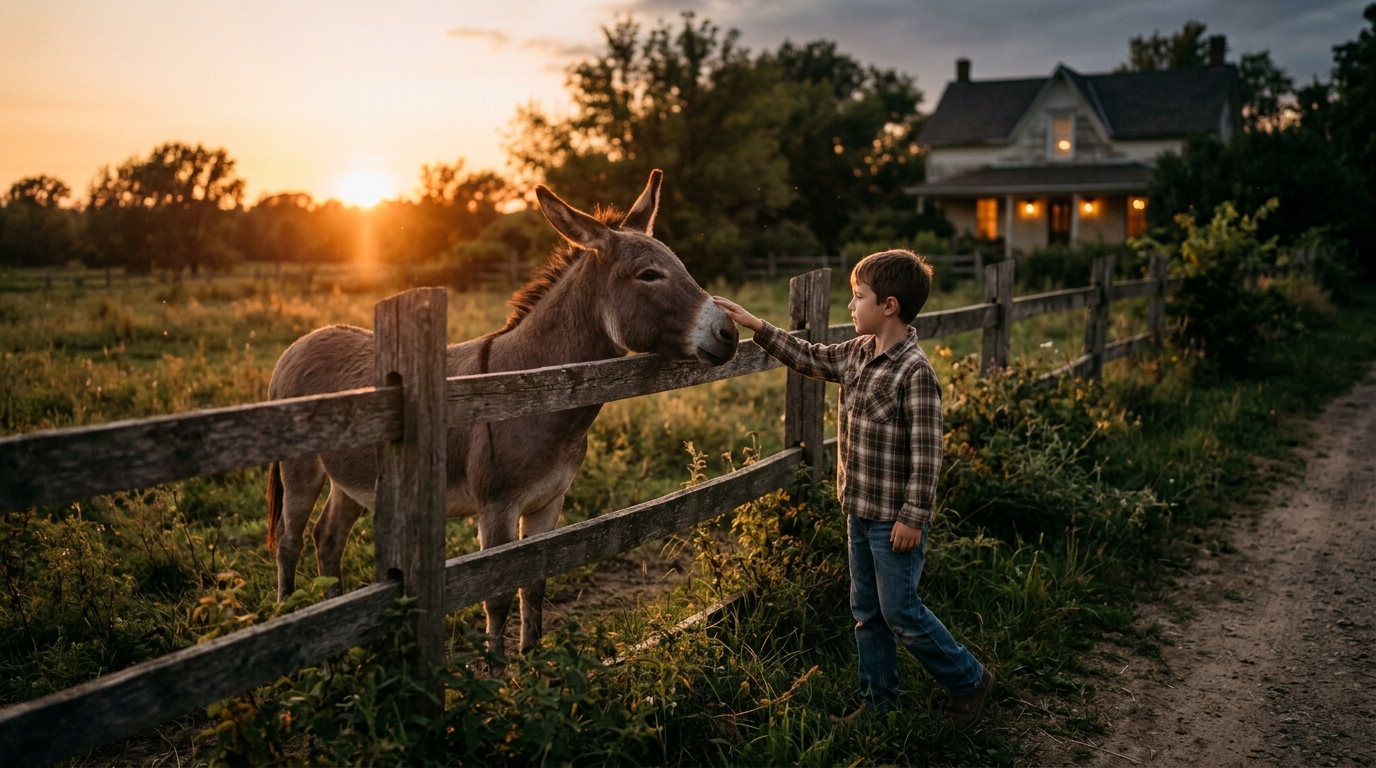
There is a gravel lane in a quiet corner of the countryside where, every evening just as the light turns from white to honey, a small gray donkey named Biscuit stops whatever he is doing and walks to the fence. He does not hurry. He does not bray. He simply stands at the corner post, ears tipped forward, watching the road with the patient certainty of someone who has never once been let down by the person he is waiting for.
The boy he waits for is eleven-year-old Mateo Alvarez. And the reason Biscuit waits is a story that begins on one of the worst days of the donkey’s life.
The Day Everything Went Quiet
Two summers ago, Biscuit was not a well-loved sanctuary resident. He was an abandoned animal, left in a dry paddock behind a farmhouse that had stood empty for months. His hooves had grown long and cracked. His ribs showed beneath a coat gone dull and patchy. Neighbors later said they had seen him standing in the same corner for days, not moving, not calling out. He had simply stopped expecting anyone to come.
Mateo, then nine, was cutting through the field on his bicycle after school, taking a shortcut he had been told more than once to avoid. He nearly rode right past. It was the stillness that made him stop. Animals, he said later, are supposed to look at you. This one would not even lift his head.
Mateo did not know much about donkeys. He knew that something was wrong, that the water trough was bone dry, and that he had half a bottle of water and a squashed granola bar in his backpack. He used both. Then he pedaled home faster than he had ever pedaled in his life and told his mother, who stopped what she was doing and picked up the phone.
A Slow Return to Trust
The rescue that followed took a few weeks and a lot of patience. A local animal welfare volunteer arranged for Biscuit to be moved to a small hillside sanctuary run by a retired schoolteacher named Odile Thornbury, who had spent a decade quietly taking in animals nobody else wanted. She was not sure the donkey would survive the transport. She was even less sure he would ever let a person near him again.
Healing, she told me, did not look like a dramatic turning point. It looked like small, unglamorous things.
- Biscuit eating a full meal without flinching at footsteps.
- Letting a farrier lift a hoof without pulling away.
- Sleeping lying down in the open, which donkeys only do when they feel safe.
- Finally, after nearly a month, lifting his head when someone approached.
The first person he lifted his head for was Mateo, who had asked if he could visit and had been coming ever since, every day after school, rain or shine.
The Six O’Clock Ritual
Mateo’s visits settled into a rhythm. He would finish his homework at the kitchen table, pack a carrot or two into his jacket pocket, and walk the half mile to the sanctuary just as the afternoon began to soften. He would sit on the bottom rail of the fence and talk. About his day. About a spelling test. About a friend who had been unkind at recess. Biscuit would stand beside him, chewing slowly, one ear swiveled toward the voice.
Odile noticed it first. About a month in, Biscuit began drifting toward the fence a little before Mateo was due to arrive. Within a few weeks, he was at the corner post by six o’clock sharp, no matter where he had been grazing. When Mateo once missed a day with a fever, Biscuit stood at the fence until the stars were out and had to be gently coaxed back to the shelter.
“He knows the sound of the gate latch,” Odile said. “He knows the sound of the boots on the gravel. But I think it is more than that. I think he knows that this is the one who came back.”
What the Evening Teaches
There is something about the end of the day that makes a story like this land differently. In the morning, the world is loud with plans and obligations. By evening, the noise falls away, and what is left is the plain question of who showed up for whom.
Odile told me that the sanctuary is at its most peaceful as the light fades. The other animals drift toward their shelters. The air cools and smells of cut grass and woodsmoke from a distant chimney. And at the corner of the paddock, a boy and a donkey sit in the quiet, saying nothing in particular, which she suspects is the point.
Mateo’s mother, Lucia, said she has watched her son change in the time he has been visiting. He used to be anxious at bedtime, lying awake replaying the small worries of his day. Now, she said, he falls asleep easily. “He says goodnight to the donkey in his head,” she told me with a smile. “I think having somewhere to put all of it, all the worries, has made the nights easier for him too.”
Why This Story Stays With Us
It would be easy to frame this as a tale of a child rescuing an animal. But the longer I sat with it, the more it seemed like a story about being rescued in both directions. Biscuit was pulled out of a long, silent neglect. Mateo, in a quieter way, found a place where he was needed and a creature who trusted him without condition.
A few small lessons worth carrying into tonight
- Stopping matters. Mateo was told to avoid that shortcut. He nearly rode past. The whole story hinges on a nine-year-old choosing to stop and look.
- Consistency is its own kind of kindness. Biscuit did not learn to trust from one grand gesture. He learned it from a boy who showed up at the same hour, day after day.
- Waiting is not weakness. The donkey at the fence is not sad. He is certain. There is a difference, and it is worth noticing.
- Evening is a good time to be grateful. When the day goes quiet, we can finally hear who has been quietly good to us.
The Last Light at the Fence
On the evening I visited, the sky had gone the color of apricots and the first bats were stitching the air above the paddock. Biscuit was already at the corner post when we arrived, a small gray shape against the glow. Mateo hopped up onto the bottom rail, pulled a carrot from his pocket, and held it out flat on his palm, the way he had been taught.
Biscuit took it gently, then rested his chin on the boy’s shoulder, and the two of them stayed like that while the light drained slowly out of the sky. Nobody spoke. Odile, standing a little way off with her arms folded against the cooling air, wiped her eyes with the back of her hand and pretended it was the wind.
Somewhere in your own evening tonight, there may be a small thing worth stopping for. A neglected corner. A quiet voice. Someone who has stopped expecting anyone to come. You do not have to fix everything. You only have to do what a nine-year-old on a bicycle did: notice, and then return.
Biscuit will be at the fence tomorrow at six. He always is.