🎧 Listen to this story
Narrated by Kore · 7,496 characters
The clinic closes at five, but Dr. Marian Okafor’s real work often begins around seven, when the light turns the color of weak tea and the parking lot behind her office goes quiet. That is when a handful of her patients show up, not for an appointment, but for an assignment. She calls it the sunset prescription, and she has been writing it on actual pad paper for almost eleven years.
I first heard about it from a reader who wrote to us after her brother’s recovery. ‘He stopped taking the extra pills,’ she said, ‘and he started watching the sky.’ I wanted to know more, so I spent an evening talking with Dr. Okafor, a psychologist who works with anxiety, grief, and the slow exhaustion of people who have forgotten how to stop. What follows is part profile, part conversation, and part invitation.
The Day She Ran Out of Words
Dr. Okafor did not set out to become the sunset therapist. The idea arrived after a session that went nowhere. A patient, a man in his fifties grieving the sudden death of his wife, sat across from her for fifty minutes and said almost nothing. When time was up, she found herself saying, ‘Tonight, I want you to go home and watch the sun go down. That’s all. No thinking required.’
He came back the next week and said it was the first time in months he had sat still without his chest tightening. ‘I did not feel better,’ he told her. ‘I felt accompanied.’
She has thought about that word ever since. Accompanied. Not fixed, not cured, but held by something larger than the problem.
What a Sunset Prescription Actually Looks Like
Dr. Okafor is careful to say that she does not replace medication. ‘I am not anti-medicine,’ she told me, folding her hands. ‘Some of my patients need it and thrive on it. What I am against is the idea that every ache has to be answered with a pill and a follow-up. Some aches are asking for something simpler.’
Her prescription has a few simple rules, which she writes out by hand:
- Go at the same time each evening. Rhythm matters. The body learns to expect the pause.
- Leave the phone in your pocket or at home. Not on silent. Away.
- Stay until the light is gone. The last ten minutes are the medicine, she says, when most people want to leave.
- Do not try to feel anything in particular. No gratitude quota, no forced calm.
- Notice one small thing. The color of a cloud edge, the sound of a neighbor’s door, the temperature change on your arms.
That is the entire protocol. No app, no subscription, no worksheet.
Why Dusk, of All Times?
I asked her why evening, and she did not hesitate. ‘Because the day has done its worst by then,’ she said, smiling. ‘The emails are sent or ignored. The decisions are made. There is nothing left to win. People are most receptive when they have stopped bracing.’
She believes the transition from day to night is one of the few shared rituals still available to almost everyone, free and unscheduled. The light changes whether or not we pay attention. ‘It is the most generous thing happening in anyone’s day,’ she said, ‘and most of us are looking at a screen while it happens.’
The Quiet Science Behind It
She is quick to note that she is not selling magic. Research on attention, stress, and time spent outdoors points in a gentle direction. Slow, passive observation of natural scenes appears to ease the mental chatter that feeds anxiety. Regular exposure to the shifting light of evening may also support healthy sleep rhythms, helping the body understand that the day is ending. She shared these ideas with a careful shrug. ‘I cannot promise anyone a result. I can only tell you what I have watched happen in my office, and what I have felt on my own back steps.’
A Woman Named Delphine
One of her patients, whom she calls Delphine to protect her privacy, came to her after a year of insomnia and a medicine cabinet that kept growing. She was a nurse who spent her days caring for everyone else and her nights staring at the ceiling.
Delphine was skeptical. ‘Sit and watch the sunset? I do not have time for that,’ she said at the first session. Dr. Okafor asked only for five minutes. ‘Just until the sun touches the roofline across the street.’
The first week, Delphine checked her watch four times. The second week, she brought a cup of tea. By the third, she told her therapist something she had not expected to say aloud: ‘It is the only part of my day where nobody needs anything from me.’
She did not stop her sleep medication overnight, and Dr. Okafor never suggested she should. But over several months, working with her own doctor, she found she needed less of it. More than that, she found a small, reliable place to put her tired mind down.
The Evening I Joined Them
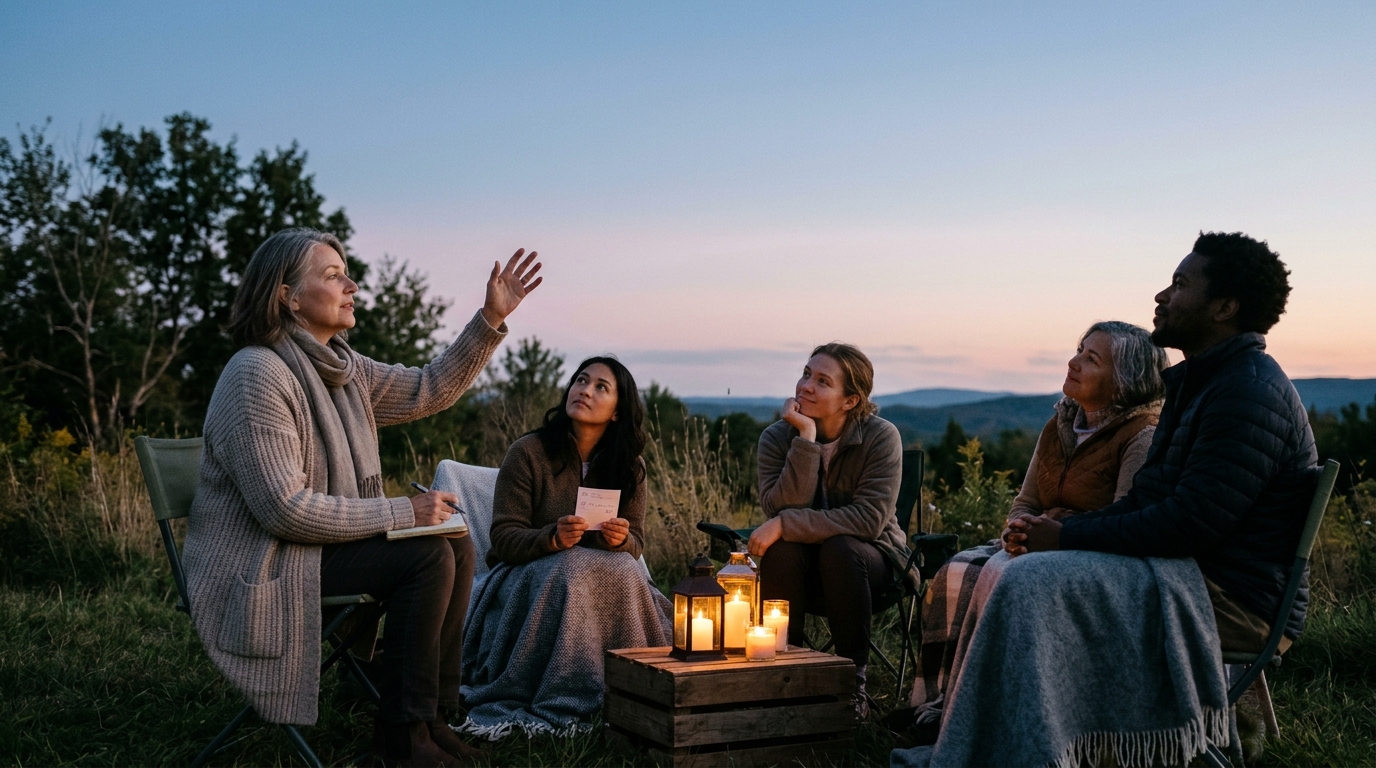
After our interview, Dr. Okafor invited me to stay. We walked to a low wall at the edge of the clinic’s back lot, where a few patients were already scattered along it like punctuation marks, each a respectful distance apart. No one spoke.
The sky went from gold to peach to a bruised, glowing violet. A bird I could not name crossed the whole width of it in silence. At some point I realized I had not thought about my inbox in twenty minutes, which, for me, is something close to a small miracle.
When the last light slid off the rooftops, nobody clapped or sighed or made a speech. People simply stood, nodded to one another, and drifted toward their cars. It was one of the gentlest endings to a day I can remember.
What Her Patients Say They Gain
Over the years, Dr. Okafor has kept informal notes on what people report back. She was clear that these are not clinical findings, just patterns she has noticed:
- A softer transition into the evening, with less of the dread that comes from jumping straight from work into chores.
- A sense of perspective. Problems stay the same size, but they feel less like the whole sky.
- Easier conversations at home, because they arrive having already exhaled.
- A feeling of belonging to something older and steadier than their worries.
It Is Not for Everyone, and That Is Fine
She is honest that the practice does not land with everyone. For some people, stillness stirs up difficult feelings, and she meets that with care rather than pressure. ‘If sitting alone with your thoughts is hard, we start with company, or with walking,’ she said. ‘The goal is never to force peace. The goal is to make a little room for it.’
Try Your Own Quiet Hour
You do not need a therapist to borrow this idea. Tonight, or whenever the day finally lets go of you, try this:
- Find a window, a porch step, a bench, or a patch of sidewalk with a view of the sky.
- Set your phone aside, truly aside.
- Stay until the color fades, even if your mind wanders and wanders.
- When you go inside, notice whether anything in you has loosened, even by a degree.
You may feel nothing at all the first night. That is allowed. Dr. Okafor says the practice works the way a path through grass works: not because of any single walk, but because of the walking, again and again, until the way is worn soft.
The Last Light
As I left the clinic that evening, Dr. Okafor lingered on the wall a few minutes longer, watching the final thread of orange disappear. I asked whether she ever tires of it.
‘Never,’ she said. ‘Every night it is a different sky, and every night it asks the same gentle question: can you let the day be over?’
It is a good question to carry home. Somewhere out there, the sun is already sliding toward the horizon, patient and free, offering the same quiet prescription to anyone willing to look up.