🎧 Listen to this story
Narrated by Kore · 7,352 characters
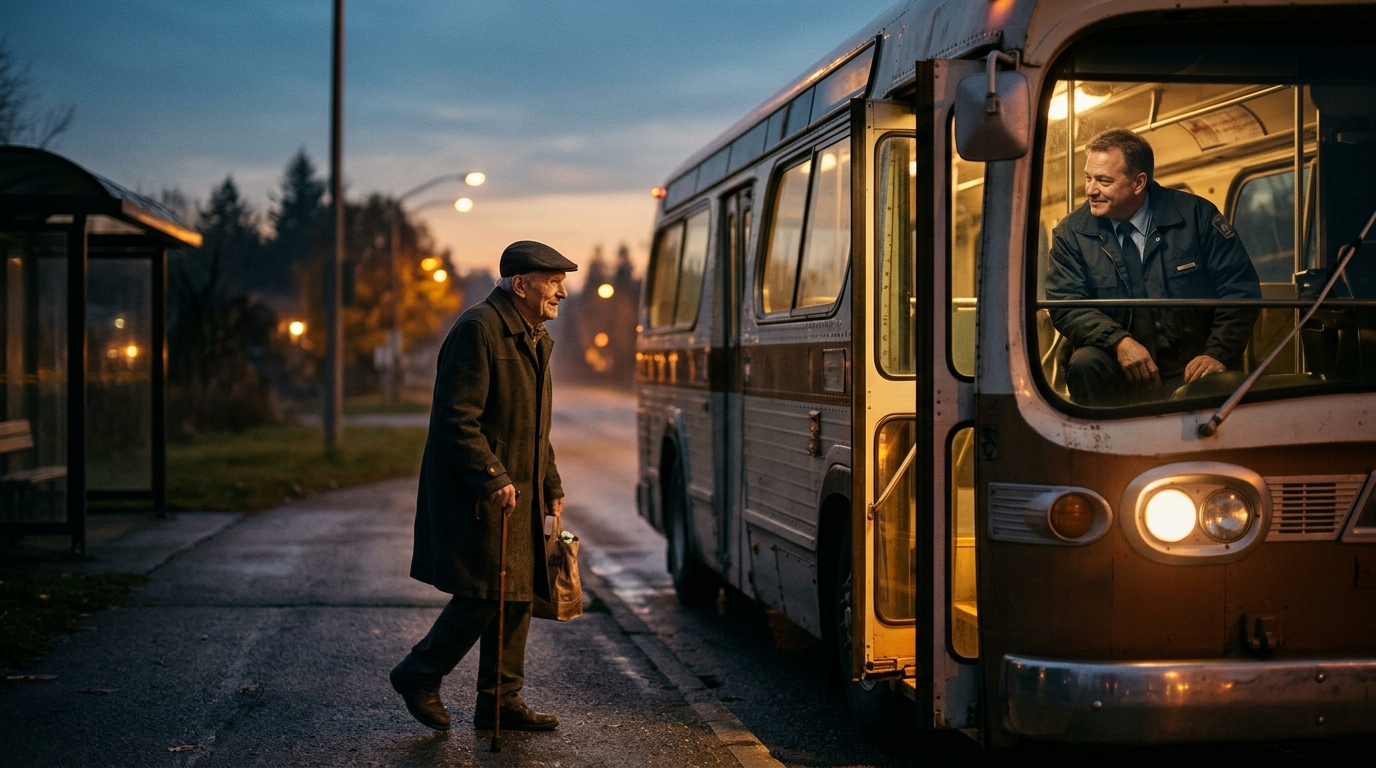
There is a particular kind of quiet that settles over a city around seven in the evening. The commuter rush thins out, the streetlights flicker on one by one, and the buses that once groaned with standing passengers glide through the dusk half empty, their windows glowing like small lanterns. It is the hour when people finally exhale. And it is, for one bus driver on the number 14 line, the hour of a small ritual that has quietly become the best part of his day.
His name is Raymond, and for eleven years he has driven the evening route that loops from the downtown depot out to the eastern neighborhoods. Every weekday, at a stop outside a shuttered hardware store on Calloway Street, Raymond does something that is not in any official schedule. He waits sixty seconds. Sometimes a little more. He waits for a man who is almost always running late.
The Man With the Unraveling Scarf
Raymond does not know the man’s name. For the first few months, he did not even know his story. All he knew was what he saw in the wide rearview mirror: a tall, slightly stooped figure in a wool coat and a long gray scarf that always seemed to be coming undone, hurrying down the sidewalk with a lunch bag swinging from one hand. He ran with the careful, hitching gait of someone whose knees had long ago stopped cooperating with his ambitions.
The first time it happened, Raymond had already pulled the doors shut. He saw the man in the mirror, one arm raised, one foot already mid-stride on the pavement, and something made him open the doors again. The man climbed aboard breathless, murmured thanks, and found a seat near the back. Nothing more was said.
But the next evening, the man was late again. And the evening after that.
A Habit Is Born
Somewhere in those first weeks, Raymond stopped thinking of it as a favor and started thinking of it as part of the route. He began timing his approach to Calloway Street so that he arrived a minute early, giving himself a cushion to wait without falling behind. He never mentioned it to dispatch. He never mentioned it to the other drivers. It simply became one of those unspoken things a person does because it feels right, the way you hold a door a little longer than necessary.
Over the years, the man’s name finally came out in passing. His wife, it turned out, worked a second shift cleaning offices downtown, and he rode the bus to meet her at her last stop so they could ride home together. She was always waiting for him. He had never once wanted to leave her standing in the cold.
What a Minute Is Worth
Sixty seconds does not sound like much. In a day that holds eighty-six thousand four hundred of them, it is barely a rounding error. But anyone who has ever missed a bus by a single breath knows how large a minute can feel from the wrong side of a closing door.
Consider what that minute actually holds for the man in the scarf:
- It means his wife does not wait alone in the dark at a bus stop.
- It means he does not have to stand in the cold for another twenty-five minutes until the next bus.
- It means a tired man with bad knees does not have to feel like a burden to a schedule.
- It means, quietly, that someone noticed him.
That last one is the heart of it. Most of us move through our days feeling like small gears in a very large machine. To have a stranger look up and decide that you are worth a pause, that your lateness is not a failure but simply a thing to be accommodated, is a rare and tender kind of dignity.
The Evening Reflection
When I spoke with Raymond about it, he laughed and waved the whole thing off. “It’s nothing,” he said. “The bus is going to the same place whether I leave at 7:02 or 7:03.” But then he went quiet for a moment, and when he spoke again his voice had softened.
“You know what I think about at night?” he said. “After I’ve parked the bus and gone home and the house is finally still. I don’t think about the traffic or the delays. I think about whether I was kind that day. Whether I let someone down. And on the days I held the door for him, I sleep a little easier.”
It struck me that this is something we rarely say aloud. The end of the day has its own kind of honesty. When the noise fades and the lights go low, we tend to take quiet inventory of ourselves. We replay the sharp word we regret, the call we forgot to return, the moment we could have helped and did not. And, if we are lucky, we also find the small good things sitting there waiting, like warm stones at the bottom of a pocket.
The Kindnesses That Settle In
Raymond’s sixty seconds is exactly that kind of warm stone. It is not dramatic. No one will write a headline about it. But it is the sort of act that, once the day has quieted, settles into the mind and makes the dark feel a little friendlier.
The Day He Wasn’t There
There was one evening, Raymond told me, when the man did not come. The stop at Calloway Street sat empty. Raymond waited his sixty seconds anyway, then another thirty, watching the mirror, an odd worry gnawing at him. Eventually he pulled away, and the whole rest of the route felt strangely hollow.
The next evening, the man was back, scarf trailing, lunch bag swinging. He had been sick, he explained, a bad flu that kept him home. Then he did something he had never done before. He reached into his coat and handed Raymond a small paper bag. Inside was a slice of homemade pound cake wrapped in wax paper, still faintly warm.
“My wife made it,” he said. “She said to tell you thank you. She said you’re the reason I always make it home.”
Raymond told me he ate that cake in the empty depot after his shift, sitting on the steps of his parked bus under the orange glow of the security lights. “Best thing I ever tasted,” he said, and he was not joking.
What We Can Learn From the Number 14
It would be easy to file this away as a sweet little anecdote and move on. But there is something worth carrying with us, especially in the quiet hours when we are inclined to think. A few gentle truths seem to sit inside this story:
- Small accommodations are acts of love. You do not need a grand gesture to make someone feel seen. Sometimes it is simply the willingness to wait.
- Kindness thrives on routine. The most meaningful generosity is often the kind we repeat without announcement, day after day, until it becomes part of who we are.
- We rarely know the full story. The late man on the sidewalk had a wife in the cold and a reason for his hurry. Most latecomers do.
- Being kind benefits the giver too. Raymond sleeps better. That is not a small thing.
A Closing Thought for Tonight
As you read this, perhaps the day is winding down for you too. Maybe the dishes are drying on the rack, or the lamp beside your bed has been switched on. Take a moment, if you can, and ask yourself the question Raymond asks himself: where did I hold the door today?
It does not have to be a bus door. It might have been a lingering word in a conversation, a text you answered patiently, a stranger you let merge ahead of you. Or perhaps it was nothing at all today, and tomorrow is a fresh chance to find your own sixty seconds.
Somewhere out on the east side of town, the number 14 is making its last loop of the night. The doors are open at Calloway Street. A tall man in a long gray scarf is hurrying down the sidewalk, and a quiet driver is watching the mirror, in no rush at all.