🎧 Listen to this story
Narrated by Kore · 6,651 characters
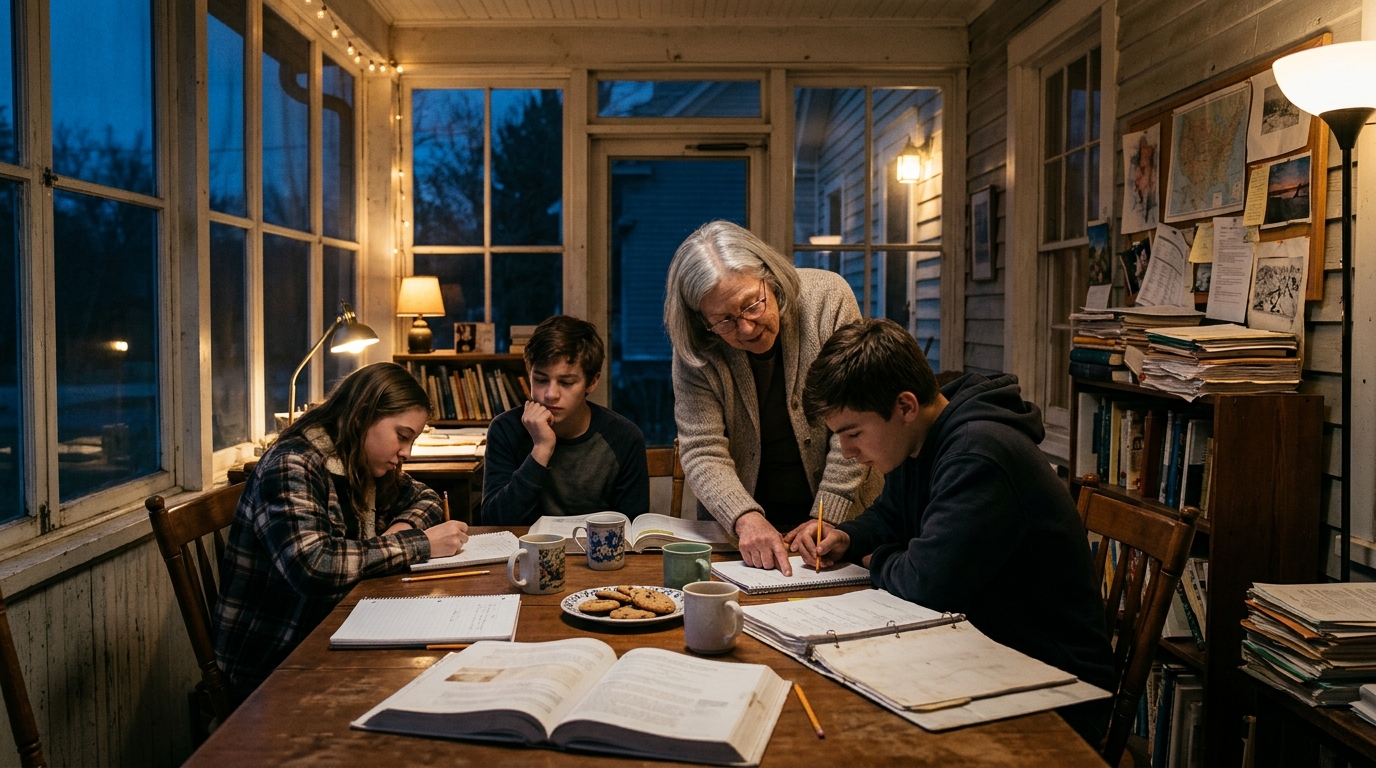
Most evenings around six, when the street goes quiet and the sky turns the color of weak tea, a yellow lamp clicks on in the front window of a small brick house. It is not there for decoration. It is a signal, one that neighborhood kids have learned to read the way sailors read a lighthouse.
Behind that window sits Margaret Ellison, 71, a retired middle school teacher with reading glasses pushed up into her silver hair, a kettle on low heat, and a kitchen table that has seen more long division than most classrooms.
This is a report on what she does there, why she does it, and what a few of her students taught me about the strange, gentle power of an evening hour.
The Table by the Window
Margaret taught for thirty-four years. When she retired, she planned on gardening, crosswords, and long unhurried mornings. She got all three. What she did not get was peace about the kids.
“I’d see them at the grocery store,” she told me, stirring honey into her tea. “Kids I recognized from the hallway, the ones who always sat in the back and got quieter every year. Nobody was mean to them. They just slipped. A missed month of school, a hard year at home, and suddenly they were two grade levels behind and too embarrassed to say so.”
So one autumn she mentioned to a neighbor that she’d be happy to help any child who wanted to catch up. That neighbor mentioned it to another. Within a month, three children were sitting at her kitchen table after dinner. Within a year, there were nine.
She does not charge. She does not advertise. The lamp is the only sign she has ever needed.
Why Evening, Of All Times
I asked Margaret why she tutors at night rather than after school, when most programs run. Her answer reshaped how I think about learning.
“Daytime is loud,” she said. “Daytime is where they failed. Every one of these children has a story about standing at a whiteboard while twenty-five classmates watched. Evening is different. The house is quiet. Nobody is watching. There’s a lamp and a pencil and a person who isn’t in a hurry.”
It is hard to argue with. There is something about the end of the day that lowers the walls. The performance is over. The kids have eaten, the pressure has drained out of the afternoon, and what is left is the small, honest part of a person that is finally willing to say, “I don’t understand this.”
Margaret has built her whole method around that moment of admission.
The Rules of the Lamplight Hour
Over the years, Margaret has settled into a few simple rules. She did not read them from a manual. She earned them across thousands of evenings.
- No red pens. Mistakes are circled in pencil, gently, and discussed like interesting puzzles instead of failures.
- Start with something they can win. Every session begins with a problem or a page the student can finish. Confidence is the first lesson, and everything else is built on it.
- Tea or cocoa before numbers. The first ten minutes are for talking. Math can wait. Some nights it waits the whole hour, and Margaret considers that a fine night’s work.
- No grades, no reports. What happens at the table stays at the table. There is no scoreboard to dread.
- End with one thing learned. Before the lamp goes off, each child names one thing that clicked. It does not have to be big.
Three Evenings I Won’t Forget
Dev and the Fractions
Dev is eleven and, by his own cheerful admission, “allergic to fractions.” When he first arrived, he could not tell whether one half or one third was bigger, and he had been hiding it for two years.
Margaret did not pull out a worksheet. She pulled out a loaf of bread. They cut it, compared it, and ate the evidence. “I have never forgotten what a third looks like,” Dev told me, grinning, “because I ate it.”
Priya and the Silent Reader
Priya, thirteen, could decode words perfectly but had decided at some point that she hated reading aloud. Margaret never made her. Instead, she read to Priya for the first twenty minutes of every session, long chapters from old adventure novels, while Priya doodled in the margins of her notebook.
One evening in February, Margaret paused to sip her tea, and Priya, without looking up, said the next sentence of the book out loud. Then the next. Margaret said nothing. She just kept her face very still and let the lamp do its work.
Marcus and the Walk Home
Marcus, fourteen, lives three streets away and comes alone. Last winter, his mother mentioned that he used to dread the evenings because the house was loud. Now he asks what time it is by four o’clock. “It’s the one hour of my day,” he told me, “where nobody needs me to be anything.”
He walks home when the streetlights are on, his backpack a little lighter than it used to be.
What the Quiet Teaches
Here is the part I keep turning over. We tend to think of tutoring as a transaction: an adult delivers information, a child receives it, and test scores rise. Margaret’s kitchen table runs on something older and softer than that.
What she offers is attention without an audience. In a world where children are measured constantly and loudly, she gives them an hour where they are simply seen. The fractions and the reading and the long division are real, and the improvements are real. But I suspect the deepest thing happening at that table is the quiet, repeated message: you are not behind, you are just not finished yet.
A Note for the End of Your Own Day
You do not need a kitchen table or thirty-four years of classroom experience to borrow a page from Margaret’s book. As this day winds down, consider a few small, evening-sized ideas:
- Think of one young person in your life who may be quietly struggling, and decide to check in with them tomorrow, without an agenda.
- Offer an hour of your skills, whatever they are, to someone who would never think to ask.
- Turn on a lamp instead of a screen, and give someone your unhurried attention for even fifteen minutes.
Kindness rarely arrives as a grand gesture. More often it sits patiently at a kitchen table, with a pencil and a cup of tea, waiting for someone to knock.
The Lamp Goes Off
By eight o’clock, the last student has gone. Margaret rinses the mugs, wipes down the table, and straightens the stack of pencils. She stands for a moment in the quiet kitchen, listening to the refrigerator hum.
“People ask if I get tired,” she said. “I do. But it’s a good tired. It’s the tired of a day that went somewhere.”
Then she reaches over and clicks off the lamp in the window. Tomorrow evening, around six, it will come back on. And somewhere down the block, a child who once felt left behind will look up, see that small yellow glow, and know that someone has saved them a seat.