🎧 Listen to this story
Narrated by Kore · 6,694 characters
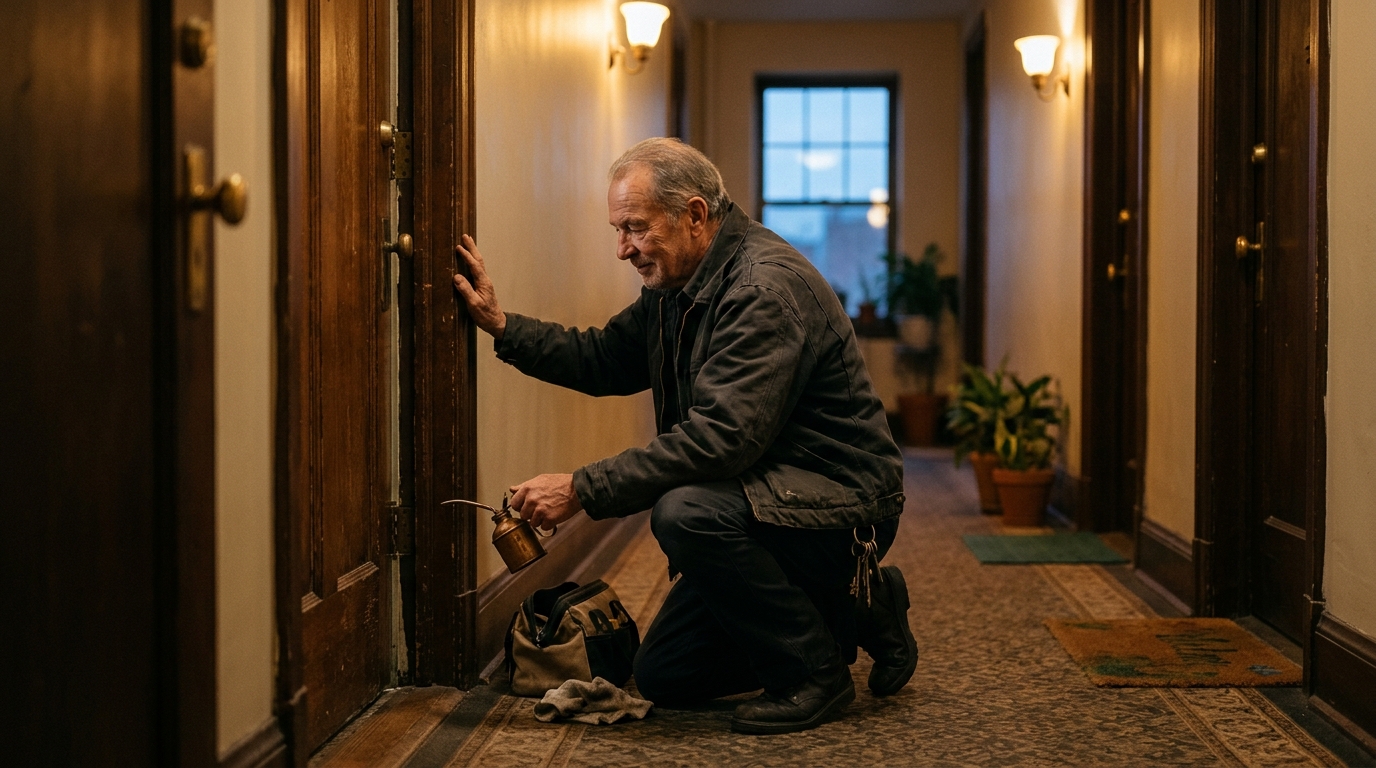
Every evening around nine, when the lobby lights soften and the last delivery driver has gone, a man named Desmond Okafor-Reyes pulls out a worn paper notebook and begins his rounds. He has done this for eleven years. And somewhere in those years, without anyone quite noticing when it happened, the Marlowe Court apartments stopped being a building where people double-checked their locks three times and started being a place where people simply slept.
This is a story about the unglamorous kind of heroism: the kind that happens after the dinner dishes are done, when most of us are drifting toward the quiet of our own evenings.
Before Desmond: A Building That Held Its Breath
Residents of Marlowe Court will tell you the building was not always peaceful. Before Desmond arrived, the nights had a particular sound: a stairwell door slamming somewhere, a car alarm that no one came to silence, footsteps in the parking structure that belonged to no one anyone knew. The building had cameras, but the cameras recorded and never responded. Locks were fine. What the building lacked was a presence.
Ingrid Valdez, a school librarian who has lived on the fourth floor for fourteen years, remembers it clearly. “I used to lie in bed and list the sounds,” she told me. “That’s the pump, that’s the elevator, that’s the neighbor’s TV. If a sound wasn’t on the list, I was awake until morning.”
That kind of vigilance is exhausting in a way people rarely talk about. It is not dramatic fear. It is a low hum of unease that follows you from room to room, the sense that safety is something you must personally maintain, hour by hour, long after you are tired.
The Notebook
Desmond’s approach was not complicated, and that is part of why it worked. In his first month, he did something the previous night staff had never bothered to do: he learned the building. Not the floor plan, but the people and the patterns.
He wrote it all down in that notebook. Which tenant works night shifts at the hospital and comes home at 2 a.m. Which elderly resident leaves a lamp on in the hallway because she is afraid of the dark. Whose teenager sometimes comes home late and needs the side door unlocked without a lecture. Which dog barks at the third-floor landing and which one only whimpers.
“Safety is mostly knowing what normal sounds like,” Desmond says. “If I know what normal is, I notice the second something isn’t.”
That single idea, that a guardian’s real tool is attention and not force, became the quiet foundation of everything that followed.
The Small Things That Added Up
Ask residents about Desmond and you will not hear stories of dramatic rescues or confrontations. You will hear a long list of tiny, almost invisible kindnesses:
- He started walking the nurse from the hospital shift to her door whenever she came home after midnight, so she never had to cross the parking structure alone.
- He noticed when Mr. Abernathy on the second floor had not collected his mail for three days, knocked gently, and discovered a man who had fallen and could not reach the phone.
- He learned the delivery drivers by name, so that a stranger waiting by the door was never simply “someone” but either a known face or a flagged one.
- He kept a spare flashlight and a thermos of tea behind the desk, offered freely to anyone who wandered down unable to sleep.
- He never made anyone feel foolish for calling him over a noise that turned out to be nothing.
That last one matters more than it sounds. A neighbor who is afraid of looking silly will stay quiet, and a quiet building is not a safe building. Desmond made it ordinary to say, “I heard something, can you check?” and made the answer always kind.
The Night It Mattered
There was one night, a winter evening several years ago, when the quiet work paid off in a way no one will forget. Around eleven, Desmond noticed a faint, unfamiliar smell on the sixth floor, not smoke exactly, but something warm and wrong. A lesser watchman might have shrugged it off. Desmond had spent years learning what the sixth floor smelled like on an ordinary night.
He followed it to a unit where a space heater had been left too close to a curtain. He knocked, then knocked harder, then used the master key. The resident, a man in his seventies, was asleep and had no idea. Desmond woke him, unplugged the heater, and stayed until the smell was gone and the man was settled again.
No alarm had gone off. No camera had caught anything. The only thing that caught it was a person who cared enough to pay attention.
What Evening Teaches Us
There is something fitting about the fact that Desmond’s work belongs to the hours when the rest of the world is winding down. While the building sleeps, he is awake so that others do not have to be. That is the whole secret of it, really. His wakefulness is what lets everyone else rest.
Many of us carry our own version of the nine o’clock rounds. The parent who checks on sleeping children one last time. The neighbor who leaves the porch light on. The friend who sends a quiet “home safe?” text. These small evening rituals are the same instinct in smaller form: the belief that someone should be watching over the people we love while they cannot watch over themselves.
Three Things Desmond’s Story Teaches Us
- Presence beats technology. Cameras recorded the building for years. It took a person to make it feel safe.
- Attention is a form of love. Learning someone’s normal is one of the quietest ways to care for them.
- Make it easy to ask for help. A kind response to a small worry is what prevents the big ones from going unspoken.
The Building Today
These days, Ingrid no longer lists the sounds. She falls asleep without counting them. When I asked her what changed, she thought for a long moment before answering.
“It’s not that bad things stopped being possible,” she said. “It’s that I know someone is out there who would notice. That’s all safety ever really is. Knowing you are not alone in the dark.”
On the lobby desk, a small card now sits beside Desmond’s thermos. The residents signed it together last year. It does not say anything grand. It just says: Thank you for learning our doors.
Tonight, around nine, the lobby lights will soften again. Desmond will open his notebook, tuck a flashlight in his pocket, and begin his walk. Upstairs, a building full of people will brush their teeth, turn out their lamps, and sleep, not because they have stopped caring about the dark, but because someone has made them a promise they never even had to ask for.
So tonight, as your own day settles into stillness, think about who keeps watch over your small world. And think about whether you might quietly keep watch for someone else.