
🎧 Listen to this story
Narrated by Sulafat · 8,347 characters
The Bird That Never Forgot
Most of us forget the faces of strangers we met last week. We lose names, blur timelines, and let ordinary moments dissolve into the background noise of daily life. But crows, it turns out, operate on a completely different level. They remember. Vividly. Sometimes for decades.
This is the story of one crow, one kind-hearted child, and a bond forged through small, consistent acts of compassion that stretched across fifteen years. It is not a fairy tale. It is documented animal behavior, witnessed by researchers and ordinary families alike, and it asks us a quiet but urgent question: if a bird can hold onto a single act of kindness for that long, what does that say about the kindness we give, or withhold, every single day?
How It Started: A Girl, Some Peanuts, and a Rainy Afternoon
The story begins the way most remarkable things do: quietly, and without any fanfare. A seven-year-old girl, living near the edge of a city park in the Pacific Northwest, started leaving peanuts on the backyard fence every morning before school. She had seen a crow watching her from a nearby oak tree and, driven by the pure, unfiltered instinct of a child who sees something alive and wants to connect with it, she started feeding it.
She did not do it for a reward. She did not post it on social media. She simply fed the crow because she thought it might be hungry, and because something in its sharp, intelligent eyes made her feel like it was paying attention.
It was.
Within a week, the crow began leaving small objects on the fence in return. A button. A shiny bottle cap. A tiny fragment of blue sea glass. Researchers who study corvid behavior will tell you this is not unusual. Crows have been documented leaving gifts for people who feed them regularly, a behavior that scientists believe reflects a form of reciprocal social bonding.
But what happened next is what makes this story extraordinary.
What Science Tells Us About Crow Memory
Before we continue, it is worth pausing to understand just how remarkable corvid cognition actually is. Crows belong to the family Corvidae, which includes ravens, jays, and magpies. These birds possess a brain-to-body ratio comparable to that of many primates, and their problem-solving abilities have repeatedly stunned researchers around the world.
Dr. John Marzluff, a wildlife biologist at the University of Washington, has spent decades studying crow cognition. His landmark experiments demonstrated that crows could not only recognize individual human faces but could communicate those identities to other crows, hold grudges against perceived threats, and maintain emotional associations with specific people across years of separation.
In one famous study, crows that were captured and banded by researchers wearing specific masks continued to scold and dive-bomb people wearing those same masks for over five years, even training younger crows who had never experienced the original encounter to react the same way.
If crows can remember a threat for five years across generations, it is entirely plausible, and in fact scientifically supported, that they can remember a kindness for even longer.
The Reunion: Fifteen Years Later
The girl grew up. She moved away for college, came back, built a life. The backyard fence changed. The oak tree was trimmed. Years passed in the way they do, and the memory of her childhood crow, the one she had privately named Edgar, softened into the kind of warm, fuzzy recollection that belongs to childhood summers.
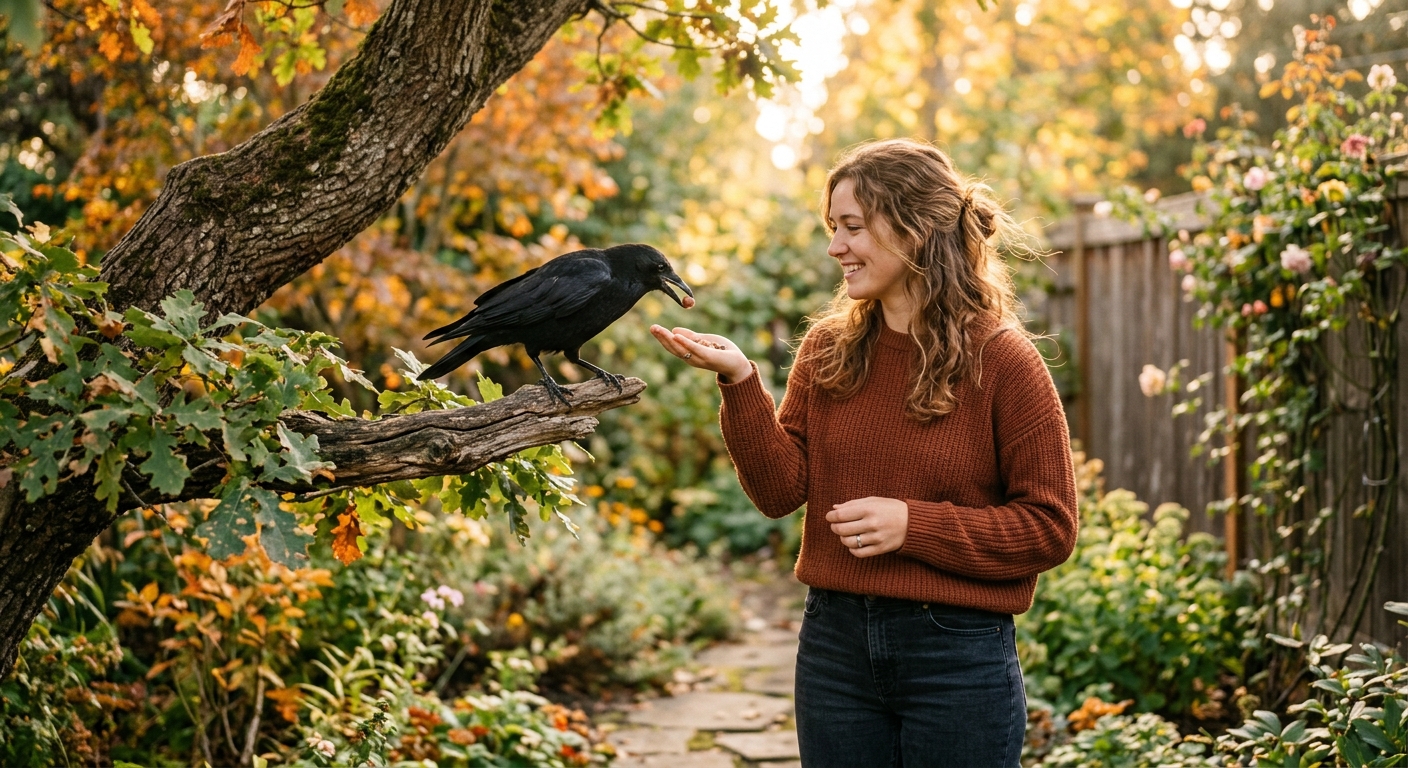
Then, at twenty-two, she was standing in her childhood backyard during a family visit when a crow landed on the fence. Not an unusual thing. Crows are common in that part of the country. But this one did something peculiar. It tilted its head, looked at her directly, and dropped something small and silver onto the post.
A bottle cap. Old and weather-worn, but deliberately placed.
She stood very still. The crow did not fly away. It stayed, watching her with those mirror-black eyes, in the same unhurried way she remembered from fifteen years earlier. She went inside, found the old container where she had kept the gifts she received as a child, and compared. The same dull silver. The same type, the same brand.
Whether or not this was the exact same crow, or perhaps a descendant that had been taught about her by the original bird, scientists who were later told the story did not dismiss it. American crows live an average of seven to eight years in the wild, but some have been recorded living well past twenty. The timeline was plausible. The behavior was consistent with documented corvid social bonding.
And in that moment, it did not really matter which explanation was true. What mattered was that something had remembered.
What This Story Teaches Us: 6 Lessons from a Bird With a Long Memory
- Small kindnesses are not small to the ones who receive them. A handful of peanuts meant nothing to the girl beyond a moment of connection. To the crow, it may have been the defining relationship of its life.
- Consistency builds trust across every species. The girl did not feed the crow once. She did it every day, before school, in the rain and the sun. Trust, whether with animals or people, is built in repetition.
- Intelligence wears many different faces. We tend to reserve our deepest respect for minds that look like ours. Crows ask us to reconsider that habit entirely.
- Children have an instinctive capacity for empathy that adults often bury. No one taught that seven-year-old to feed the crow. She did it because her heart told her to, before social logic had a chance to intervene.
- Nature is paying far more attention to us than we realize. We move through parks, yards, and streets assuming we are unobserved. We are not.
- The gifts we give without expecting return are often the ones that echo the longest. She never expected the crow to come back. She never expected to be remembered. That is precisely why it matters so much that she was.
The Wider World of Human-Crow Relationships
This story is remarkable, but it is not entirely alone. Around the world, similar accounts have surfaced, gathering quiet attention from both researchers and ordinary people who simply could not explain what they had experienced.
In Seattle, a family reported that neighborhood crows began delivering small trinkets to their eight-year-old daughter after she started leaving cat food out for them during a particularly harsh winter. The gifts, catalogued by the family over several years, included a miniature plastic dinosaur, a corroded coin, and several small stones of unusual color.
In Japan, where urban crow populations are dense and highly studied, wildlife observers have noted that crows near school zones frequently develop what appears to be protective behavior toward children who interact with them gently, following them along their routes and alerting with alarm calls if strangers approach.
These are not isolated incidents. They form a pattern, a quiet, ongoing conversation between two kinds of intelligent beings sharing the same cities, the same parks, the same early morning skies.
What We Owe the Minds We Share This World With
There is something deeply humbling about the idea that a crow remembered a child’s kindness for fifteen years. It forces a reckoning. How many creatures are we passing every day, creatures with memories, preferences, fears, and loyalties, that we dismiss without a second glance?
The crow did not ask for much. It asked for peanuts, for acknowledgment, for the basic dignity of being seen as something worth feeding. And when it received that, it gave back everything it had to offer: attention, loyalty, and small bright objects that carried no logical value but enormous emotional weight.
That is, when you think about it, not so different from what most of us are hoping to give and receive from the people in our own lives.
A Final Thought
If you have a crow in your neighborhood, or a sparrow, or any creature that returns to the same spot day after day, consider the possibility that it is not random. Consider the possibility that you have already begun a relationship you simply have not noticed yet.
Because out there, in the branches above your yard, something may already know your face. And it may be waiting to see what kind of person you decide to be.