🎧 Listen to this story
Narrated by Kore · 7,337 characters
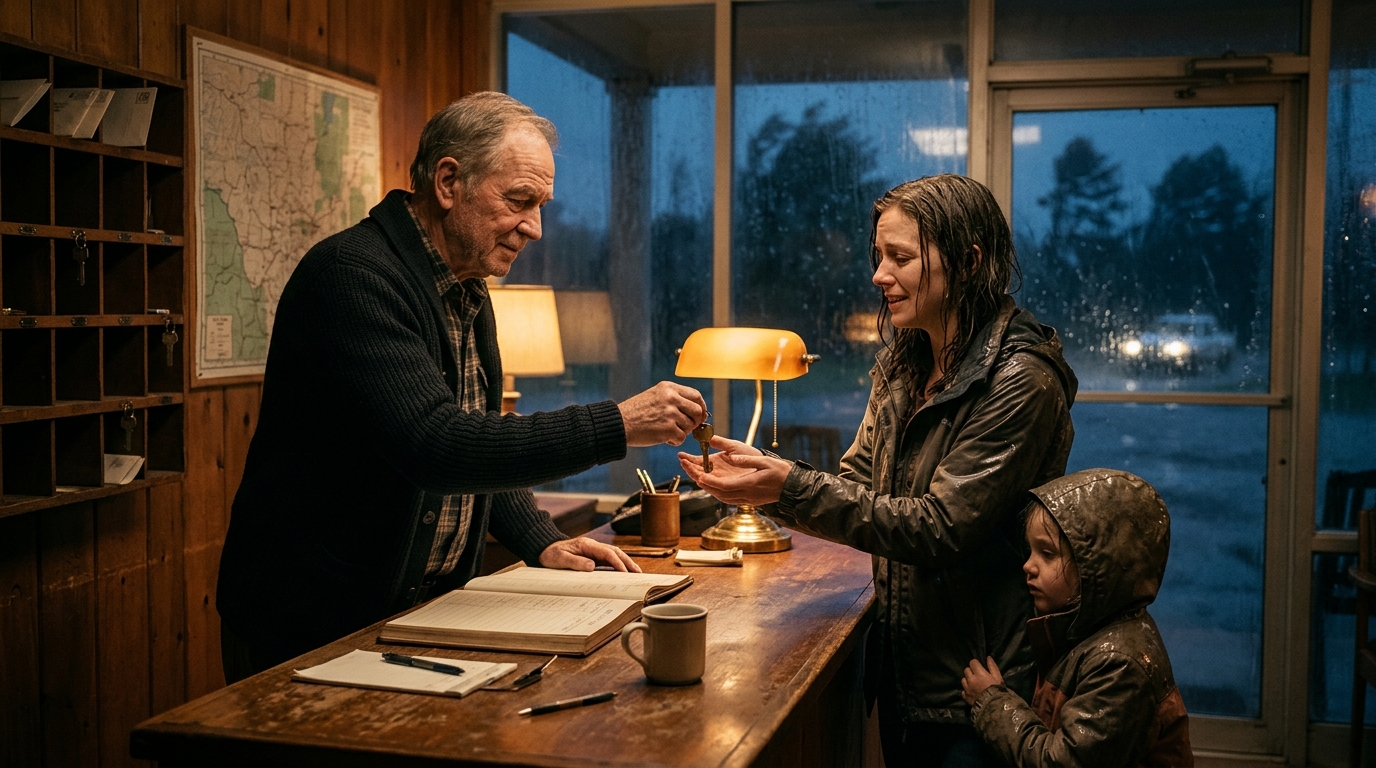
There is a particular kind of quiet that settles over a hotel lobby after midnight. The luggage carts are parked. The coffee urn has gone lukewarm. The only sound is the soft hum of a refrigerator behind the front desk and, on the night I’m writing about, the rain hammering the glass like a hundred small fists.
It was the sort of storm that makes you grateful for a roof. For one family, it nearly became the thing they were most afraid of losing.
A Night Built for Closing Up
Daniel Reyes had worked the overnight desk at a modest roadside hotel for eleven years. He liked the hours, which surprised people. He liked the way the building exhaled once the check-in rush faded, the way the lobby lamps took on a honey glow, the way a person could finally hear their own thoughts.
By 11:40 that night, the hotel had posted its sign: NO VACANCY. The storm had shut down the highway twenty miles in either direction. Travelers who had planned to push through to the next city had instead pulled off, one after another, until every last room was spoken for. Daniel had even turned away two truckers and a retired couple, apologizing each time, feeling the small sting of saying no.
He was making his final round of the night’s paperwork when the automatic doors slid open and let in a gust of wet wind.
The Family in the Doorway
A father stood there first, holding a toddler against his chest, a blanket thrown over the child’s head like a tent. Behind him came a mother carrying a diaper bag in one hand and the small hand of a sleepy six-year-old girl in the other. All four of them were soaked to the skin. Their car, Daniel would learn later, had stalled on a flooded stretch of road, and they had walked the last half mile to the only lit building they could see.
The father did not ask for much. He asked, with the careful politeness of someone trying very hard not to cry in front of his kids, whether there might be any room at all. Even a chair in the lobby, he said. Anything dry.
Daniel looked at the screen. He already knew the answer. Every room was occupied. He looked at the little girl, whose teeth were chattering, and at the toddler, whose cheeks were flushed an unhealthy red.
And then he thought about his own room.
The Room He Wasn’t Supposed to Mention
Because Daniel lived forty minutes from the hotel, and because the overnight shift sometimes ran long when weather hit, the owner had set aside one small room on the ground floor for staff. It had a made bed, a lamp, a bathroom with a real shower, and a radiator that actually worked. Daniel had planned to rest there for a few hours once things quieted down, since the roads were too dangerous to drive home.
He did not deliberate for long. He slid a key card across the desk.
“Room 104,” he said. “It’s not on the system. It’s mine for tonight. But it’s yours now.”
The father stared at the card as though it might evaporate. The mother pressed her hand to her mouth. Daniel waved off every attempt at thanks, grabbed two spare blankets and a stack of towels from the supply closet, and walked them down the hall himself.
What Daniel Did Next
He did not stop at the key card. Over the next hour, in the stillness after the family had gone in, Daniel quietly did a few small things that turned a bare room into a refuge:
- He brought extra pillows and a spare comforter from the housekeeping closet so all four of them could sleep comfortably.
- He warmed a cup of milk in the break room microwave for the toddler, then added a little sugar the way his own mother used to.
- He found a sleeve of crackers and a few apples from the continental breakfast stock and left them outside the door with a note that said, simply, “Help yourselves.”
- He called a local tow company and left a message so the family’s stalled car could be dealt with first thing in the morning.
None of it was on any checklist. No one would ever have asked him to do it.
The Long Hours Until Dawn
Daniel spent the rest of that night in a stiff lobby armchair, a thin jacket over his shoulders, listening to the rain taper into a drizzle. He dozed in fits. Every so often he got up to check that the front doors were secure and that no one else had wandered in needing help.
Later, when a colleague asked if he regretted it, he laughed softly. He said the strange thing was that he had never slept more peacefully in a bad chair. There is a lightness, he explained, that comes from knowing four people are warm and dry because of a decision you made in under a minute.
That is the thing about evening kindnesses. They often happen in the hours when no one is watching, when the world has shrunk to a single lit window and a handful of people who need each other. There is no audience. There is only the choice, and what you do with it.
Morning Light and a Quiet Goodbye
By sunrise, the clouds had broken open, and the parking lot shimmered with puddles. The family emerged from Room 104 looking like different people: rested, dry, wearing the same clothes but standing a little taller. The little girl held a half-eaten apple. The toddler babbled happily from his father’s arms.
The father tried again to thank Daniel. He offered to pay. He offered his phone number, his address, a promise to repay the favor someday. Daniel shook his head and told him the best repayment would be to pass it along the next time someone needed a hand.
The tow truck arrived within the hour. The car, it turned out, needed only a dried-out engine and a jump. By mid-morning the family was back on the road, headed to a wedding they had worried they would miss.
What the Night Teaches Us
Stories like this one stay with us because they ask something quiet of us. They remind us that kindness rarely arrives in grand gestures. More often, it arrives disguised as an inconvenience: a bed given up, a plan abandoned, a few hours of comfort traded for a stranger’s safety.
Here are a few reflections worth carrying into your own evenings:
- Generosity often costs us something real. Daniel gave up sleep, comfort, and a guaranteed place to rest. The gift mattered precisely because it was not free.
- The smallest details carry the most warmth. A cup of warmed milk. An extra pillow. A note on a door. These are the things people remember long after the storm passes.
- You do not need permission to do good. Daniel had no policy to cite and no manager to approve it. He simply saw a need and met it.
- Kindness thrives in the quiet hours. When the day’s noise falls away, we are often more honest about what matters.
A Thought Before You Turn Out the Light
Tonight, as you settle into your own bed and listen to whatever weather is moving outside your window, consider the people who may be walking through a storm of their own. Not all storms involve rain. Some are made of loneliness, worry, or a long stretch of hard luck.
You may not have a spare room to give. Few of us do. But most of us have something: a warm word, a spare hour, a small act that costs us a little and means the world to someone else.
Daniel Reyes still works the overnight desk. He still pours himself a lukewarm coffee after midnight and listens to the building settle. And somewhere out there, a family remembers the night a stranger handed them a key they had no right to expect.
Sleep well, and may your own small kindnesses find their way home to you.