🎧 Listen to this story
Narrated by Kore · 7,090 characters
Frank Delaney used to say the evenings were the hardest part. Mornings had their chores. Afternoons had the radio, the garden, the occasional errand into town. But when the light went amber and then gray, and the house settled into its creaks and sighs, the silence in his small farmhouse seemed to lean on him like a heavy coat.
Frank is seventy-one, a retired Army mechanic who served two tours before coming home to a quiet life in rural Vermont. His wife, Margaret, passed four years ago. His son lives across the country and calls on Sundays. And so, as the days shortened that autumn, Frank found himself sitting on the porch each night with a cup of tea going cold in his hands, watching the road and waiting for nothing in particular.
This is the story of the evening a three-legged dog changed that, as it was told to us by Frank himself, over a phone call that stretched well past dusk.
An Arrival at Dusk
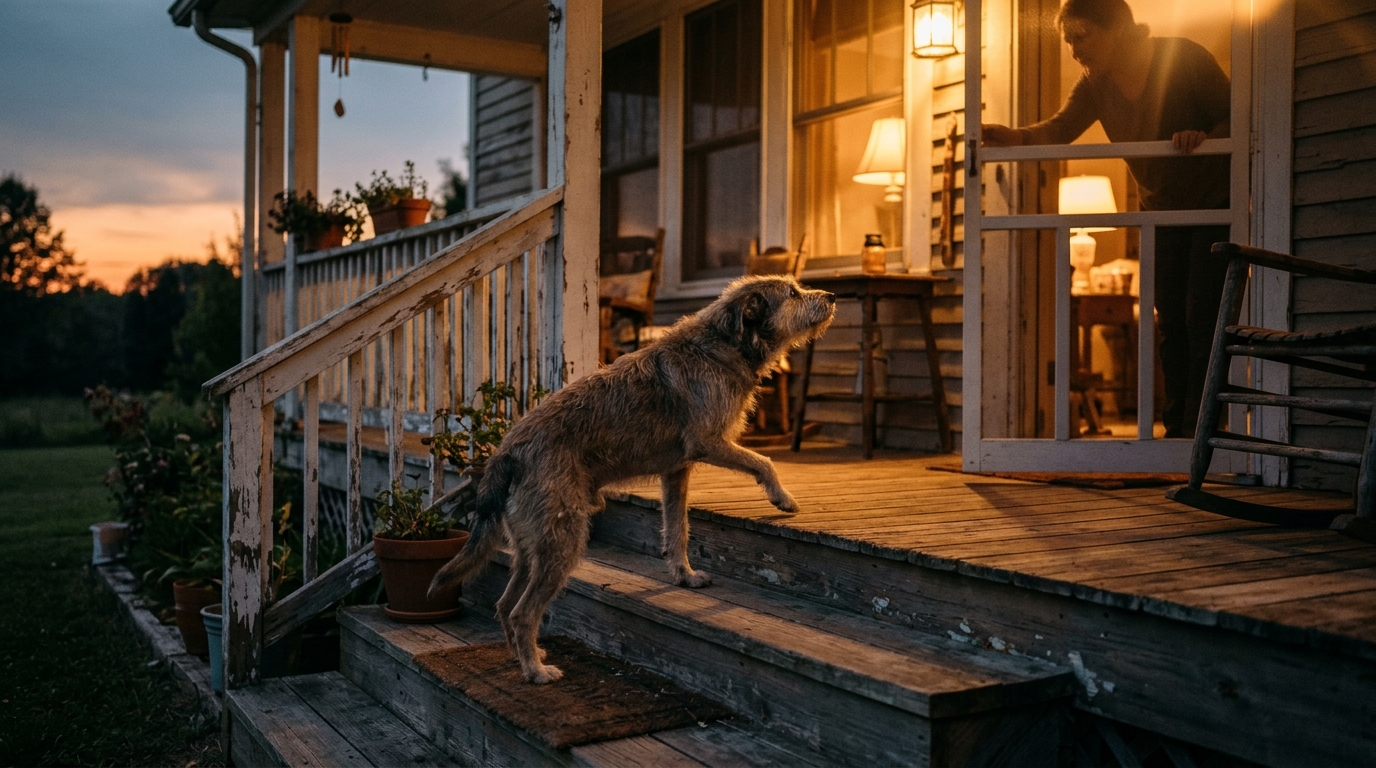
It was early October. The maples along the ridge had gone the color of embers, and the air carried that sharp, woodsmoke chill that means winter is thinking about showing up. Frank was on the porch, as usual, when he heard something moving through the dry leaves at the edge of the yard.
“I figured it was a raccoon,” he told us. “Then I saw this shape come out of the tree line, kind of bobbing, kind of lurching. A dog. A gray and white thing, maybe forty pounds, thin as a rail. And she was missing her back left leg.”
The dog stopped at the bottom of the porch steps and looked up at him. She did not bark. She did not beg. She simply stood there, balanced on three legs in the fading light, as though she were waiting to be told whether she was allowed.
“I said, ‘Well, you’d better come up, then,'” Frank remembered. “I don’t know why. I hadn’t spoken to anything alive in two days except the mailman.”
What Evening Does to a Lonely House
There is something about the last hour of daylight that makes loneliness louder. Many people who live alone will tell you the same thing: the day gives you tasks to hide behind, but dusk strips them away. The world goes quiet. The windows turn into mirrors. And whatever you have been carrying all day finally has room to speak.
For Frank, what spoke was grief, and something older beneath it. Like many veterans, he had learned to keep things folded away. He did not talk about the years overseas. He did not talk about Margaret much anymore either. He just sat, and he waited for the hour when it would be late enough to go to bed without feeling like he was giving up on the day.
The dog changed the shape of that hour. She climbed the steps, circled twice on the worn boards of the porch, and lowered herself against his boot with a long, exhausted sigh. Frank sat very still, afraid that if he moved, she might vanish.
“She fell asleep right there,” he said. “Just trusted me, like that. I sat there another hour in the dark, and I didn’t want to get up. First time in a long while I didn’t want the evening to end.”
The Ordinary Work of Caring
He called the local shelter the next morning, expecting someone to come and collect her. A volunteer told him she had no chip, no collar, and that a dog with an old amputation, healed over years ago, was unlikely to be searched for. If he wanted to keep her, they said, nobody would object.
Frank named her Maggie, after his wife. He admitted it felt a little foolish at first, and then it didn’t.
What followed was not dramatic. There was no single moment of rescue. Instead, there was a gradual accumulation of small, ordinary things, the kind that quietly rebuild a life:
- A reason to cook. Frank had been living on toast and canned soup. Now he found himself frying an egg for Maggie and sitting down to eat one with her.
- A reason to walk. Three legs or not, Maggie wanted to move. Their slow evening loop down the gravel road became the most reliable part of his day.
- A reason to talk. He started narrating the world to her out loud: the weather, the news, the way the light hit the barn. Words that had been stuck for years began to come loose.
- A reason to look up. Walking at dusk, he began noticing things again: the first stars, a barn owl on the fence post, the way the hills went purple.
What a Three-Legged Dog Knows
The longer Frank lived with Maggie, the more he found himself learning from her.
She did not dwell on what was missing. She moved through each evening as though she had everything she needed, hopping up onto the couch, nosing open the screen door, racing him to the mailbox with a lopsided, joyful gait that made him laugh out loud. The first time he laughed like that, he stopped, startled, and realized he could not remember the last time.
“She doesn’t know she’s supposed to be sad about the leg,” he said. “She just figured out how to get around. And I thought, well, maybe I can do the same. Maybe I’ve been so busy looking at what I lost that I forgot to look at what’s still here.”
Veterans’ organizations have long noted the quiet power that animals can have for those living with isolation and the weight of past service. Dogs ask nothing of a person’s history. They do not need the story told in the right way. They simply offer presence, steady and warm, at exactly the hours when it is hardest to be alone.
The Evening Ritual
These days, Frank and Maggie have a ritual. Around five o’clock, as the sun slides toward the ridge, he puts the kettle on. She waits by the door, tail thumping against the floorboards. They walk the gravel road to the old stone wall and back, Maggie ahead and Frank behind, the two of them keeping an easy, unspoken pace.
Then they settle on the porch. Frank takes the creaky rocker. Maggie takes the spot against his boot. Together they watch the sky go through its slow changes: gold, then rose, then a deep and settling blue.
“I used to dread this part of the day,” he told us. “Now it’s the part I look forward to. I don’t feel alone out here anymore. I feel like I’m sitting with someone.”
A Gentle Reflection for Your Own Evening
Frank’s story reminds us that healing does not always arrive with fanfare. Sometimes it limps out of the tree line at sundown and waits at the bottom of the steps for permission to come in.
As you wind down your own day, you might sit with a few quiet questions:
- Who in your life might be struggling in the stillness of evening, and could use a call, a visit, or simply a kind word?
- What small ritual could you build into your dusk hours that gives the day a softer ending?
- Where might you be staring at what is missing, when something good is waiting just at the edge of your yard?
And if you know a veteran, a widow, a neighbor who lives alone, consider that the hours after dark can be the loneliest of all. A porch light left on. A knock at the door. A shared cup of tea. These small things can be the hinge on which a whole life turns.
Out in Vermont tonight, the sun is going down over the ridge. On a worn porch, an old soldier sits in a rocking chair with a gray and white dog asleep against his boot. The tea is still warm. The silence, for once, is not heavy at all.