🎧 Listen to this story
Narrated by Kore · 7,893 characters
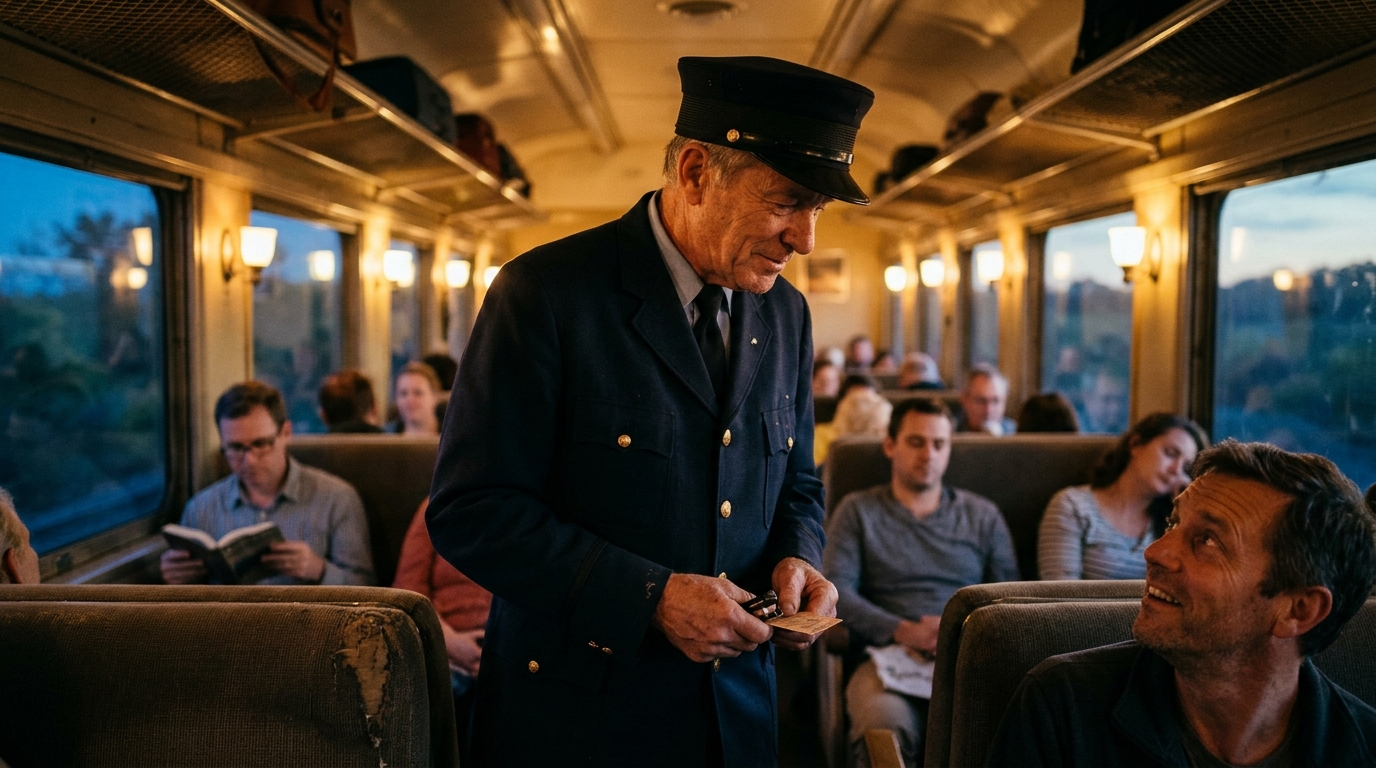
The last train of the night does not announce itself with any fanfare. It slides into the platform at 11:52 p.m., its windows glowing amber against the dark, and the people who step aboard carry the particular tiredness of those who have given the whole day away to someone else. Nurses with their shoes in their hands. Dishwashers still smelling faintly of lemon soap. A student with a laptop bag clutched to his chest like a life raft.
And standing at the door of the third car, in a navy jacket with a worn brass pin, is a man named Desmond Okafor, who greets every one of them by name.
This is a reported account of a few nights riding the Midnight Line, the final run of a regional commuter route, and of the conductor who has quietly turned it into something closer to a lantern in the dark. Names of riders have been changed at their request, but the details are as they were told to me.
The Ritual Before the Whistle
Desmond has worked the overnight shift for eleven years. He told me, as we waited for the doors to cycle, that he never planned to become anyone special. “I took the night run because it paid a little more and my kids were small,” he said. “Daytime, I wanted to be home. I figured nights would just be a job.”
What changed it, he says, was a single question he asked a sleeping woman in his second year. He had gently woken her at her stop, and she had startled, apologized, and said she had been up for thirty hours. He asked, almost by accident, what she did. She told him she was a hospice nurse. She told him she had just sat with a man while he died, because his family could not get there in time.
“I did not know what to say,” Desmond said. “So I said, ‘Thank you for being there.’ And she started to cry. Not a lot. Just a little. And she said nobody had said that to her all week.”
That was the night he started asking.
How One Man Keeps Four Hundred Stories
Desmond does not use an app or a spreadsheet. He keeps a small paper notebook in his breast pocket, the kind with a spiral at the top, and after each shift he writes a few lines before he falls asleep. He calls it his evening page.
“Everything I learn about someone, I write down when I get home,” he explained. “Not to be nosy. Just so I do not forget. If a man tells me his daughter has a recital on Thursday, I want to ask him Friday how it went. That is the whole thing. That is all it is.”
I asked to see the notebook. He hesitated, then let me flip through a few pages. The entries were short and tender:
- Marguerite, car two: Husband in rehab after the stroke. Brings him pears. Ask about the pears.
- Teodoro, the line cook: Saving for a food truck. Has a name picked out. Will not tell me yet.
- The twins who ride together: Night classes, nursing program. Exam on the 14th.
- Mr. Albright: Wife passed in March. Still buys two coffees. Do not mention it unless he does.
That last line stayed with me. There is a kind of wisdom in knowing what to leave unsaid, and Desmond seems to have it in his bones.
The Quiet Hours
There is a stretch of the route, about forty minutes long, where the city thins out and the windows turn into mirrors. The lights inside the car are dimmed, and the whole train seems to exhale. This is the part of the night Desmond loves best.
“People do their real thinking here,” he told me. “All day they have been performing. For the boss, for the customers, for the family. On this part of the line, nobody is watching. They let their faces go slack. They look out the window and you can see them just being a person again.”
I watched a woman in the corner seat press her forehead against the cool glass and close her eyes. Across from her, an older man quietly folded and refolded a paper napkin into a tiny square. Desmond walked the aisle softly, checking nothing in particular, simply passing through, a steady presence moving between them like a shepherd with no sheep to count and every reason to count them anyway.
Evening has a way of softening people. The noise falls off, the performance ends, and what is left underneath is tender and honest. Desmond has built his whole working life around being there when that happens.
The Night Marguerite Did Not Board
Not every story ends warmly, and Desmond is honest about that. A few winters ago, a regular named Walter stopped appearing on the platform. Walter was a retired machinist who rode the Midnight Line to visit his sister’s grave on the anniversary of her death each month, a habit he had told Desmond about over many quiet stops.
When Walter missed two months in a row, Desmond did something that was not in any job description. He asked the station manager if there was any way to check on him. There was not, officially. But Desmond remembered a street name Walter had mentioned once, and on his day off he walked it until a neighbor recognized the description.
Walter had fallen at home and spent weeks in a hospital, alone, with no one who knew to wonder. Desmond visited him there twice. When Walter recovered, he rode the train again, and the first thing he did was press a small, folded handkerchief into Desmond’s palm.
“He did not say anything,” Desmond recalled. “He did not need to. I keep it in the same pocket as the notebook.”
What the Riders Say
I spoke to several regulars over my nights aboard, and the theme was remarkably consistent. None of them described Desmond as a friend, exactly. They described him as something harder to name: a person who made the end of a hard day feel witnessed.
“I work doubles at the hospital,” one rider told me. “Some nights I get on that train feeling like a ghost. And then he says my name, and asks about my mother, and suddenly I am a whole human being again. I do not know how to explain what that does.”
Another, a young man heading home from a restaurant kitchen, put it more simply. “He remembered that I was nervous about my interview. The next night he asked how it went. Nobody had asked me anything like that in months.”
Lessons From the Last Car of the Night
It would be easy to treat Desmond as an exceptional man, and he is. But what struck me most is how replicable his gift really is. He has no special training and no extra time. He simply decided that the people passing through his small corner of the world deserved to be known. Here is what I carried home with me:
- Ask the second question. Most of us ask “How are you?” and accept “Fine.” Desmond asks what happens after that, and waits.
- Write it down. Care is a form of memory. Remembering that someone’s father is sick, or that their exam is Thursday, is an act of love disguised as a small detail.
- Respect the silence. Knowing when not to speak is as kind as knowing what to say.
- Do the thing that is not your job. The walk down Walter’s street was not required of anyone. It is the reason a man was found.
- Let the evening do its work. The end of the day is when people are most honest. Be a safe place for that honesty.
The Last Stop
At 12:47 a.m., the train eased into its final station, and the doors opened onto a platform lit by a single flickering lamp. One by one, the riders stepped out into the cool dark, and one by one, Desmond bid them goodnight by name. “Get some rest, Marguerite. Tell him I said hello.” “Good luck on the 14th, you two.” “Teodoro, I am still waiting on that truck name.”
Teodoro laughed, tired and bright, and shook his head. “Soon,” he said. “I promise. Soon.”
When the platform had emptied, Desmond stood a moment longer, hands in his jacket pockets, watching the taillights of the last car fade down the track. Then he took out the little notebook and a pen, and began his evening page.
Somewhere in this city tonight, someone is riding home in the dark, wondering if anyone noticed the weight they carried all day. On the Midnight Line, at least, the answer is yes. And a man with a brass pin and a spiral notebook is already waiting at the door.