🎧 Listen to this story
Narrated by Kore · 6,926 characters
At 7:42 on a late August evening, a nurse named Delphine Okafor-Reyes turns off the overhead lights in the sunroom on the fourth floor of a children’s hospital, and something close to a held breath settles over the ward. Children in wheelchairs, children dragging IV poles, children in pajamas patterned with rockets and ponies all gather at the tall west-facing window. Nobody speaks. Outside, above the old brick bell tower across the courtyard, the first bat slips out of the dark seam beneath the roof tiles.
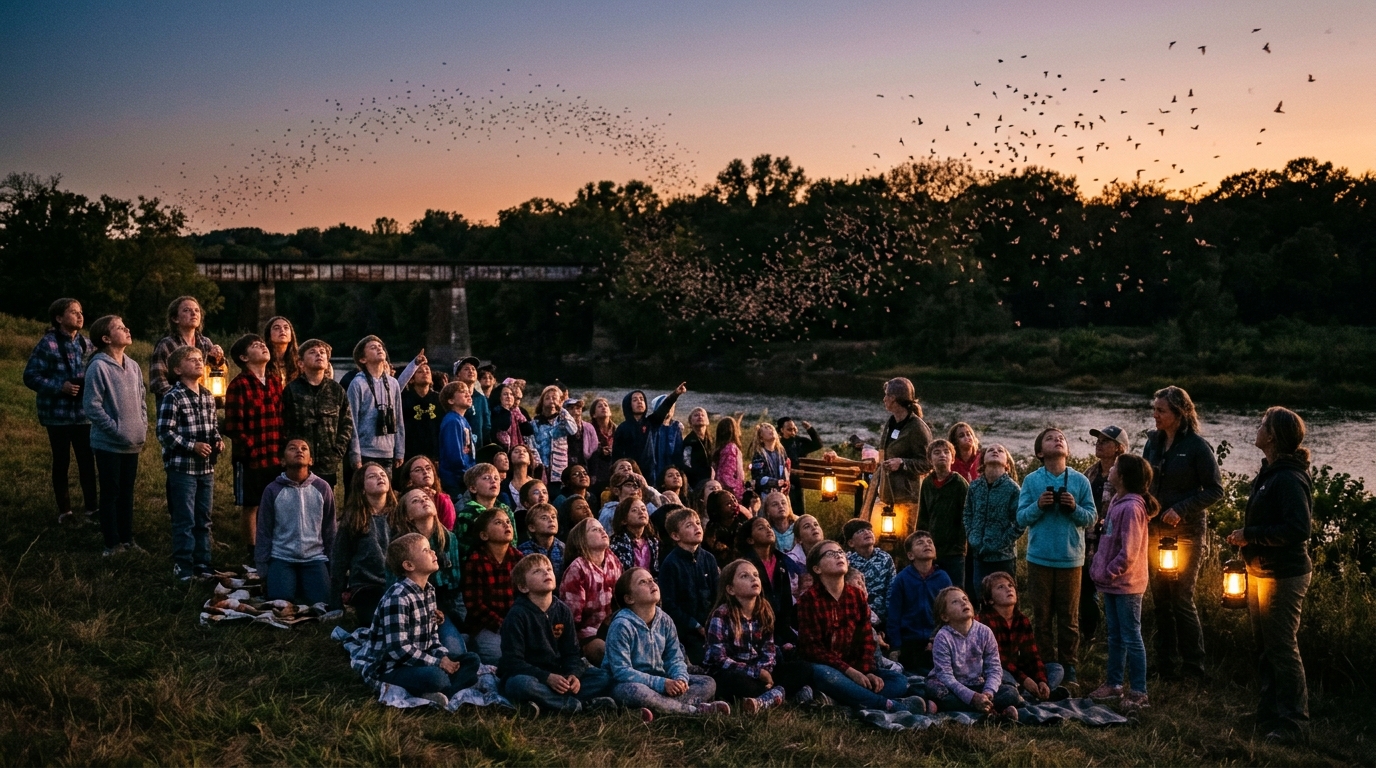
Then another. Then dozens. Then a slow, silent river of wings pouring into a sky going the color of apricot jam.
This is the Dusk Watch, and it has become, according to the staff who run it, one of the most reliable therapeutic rituals on the ward. No one planned it that way.
An Accident at the Window
The story begins with a nine-year-old patient we will call Teo, who was recovering from a long course of treatment and had stopped eating dinner. He was not in pain, exactly. He was tired in the way children get when the days all look the same: the same ceiling tiles, the same beeping, the same flavor of institutional gravy.
One evening a nurse wheeled him to the sunroom simply to change the scenery. As the light faded, Teo pointed at the tower and asked, quietly, whether the smoke was alive.
It was not smoke. It was a maternity colony of little brown bats, a few hundred of them, leaving their roost to hunt insects over the river a few blocks away. They had been doing it every summer evening for decades, and in all that time, nobody on the ward had really looked up.
That night Teo ate his dinner. He asked if the bats would come back tomorrow. They did.
Why Dusk Works
Child life specialists will tell you that hospital days are structured around other people’s schedules: vitals at six, medications at eight, rounds at nine. Children lose almost all control over their own time. The Dusk Watch offers something rare, an event that belongs to no one and answers to no clipboard.
Staff members describe several things that seem to happen in those fifteen quiet minutes:
- Attention shifts outward. A child who has spent the whole day focused on their own body gets to focus on something wild and far away.
- The wait is shared. Kids who would never speak in a group will lean toward a stranger’s shoulder and whisper, ‘There’s one, there’s one.’
- Time feels natural again. The light changes, the sky deepens, and for a little while the day has a shape that was not assigned by anyone.
- Anticipation becomes a gift. Waiting for the bats is waiting for something good, which can be a surprisingly rare feeling on a ward full of waiting for results.
The Counting Game
Within a week, the children had invented rules. Each evening, someone is assigned to count the bats. Counting a swarm is hopeless, of course, which is the point. The tallies wander into the hundreds and then into the gloriously made-up. One seven-year-old insisted the final count one night was ‘a million and also four.’
A volunteer pinned a large sheet of paper beside the window so children could record what they saw. Over the summer it filled with drawings: bats with enormous smiles, bats wearing tiny hospital bracelets, a bat carrying a balloon. A teenage patient who rarely spoke to anyone sketched the tower in careful pencil, every roof tile in place, and signed it only with initials.
Parents joined in, too. Several told staff that the quiet fifteen minutes at the window was the first time all day they had not been bracing for news.
A Guest Who Knows Bats
Midway through the summer, the ward invited a local wildlife biologist to speak with the children. She arrived with a laminated chart and a plush bat, and she did something the staff had not expected: she told the truth about bats, including the hard parts.
She explained that mother bats raise one pup a year, that the pups cling to the roost while the mothers hunt, and that every evening is a kind of promise: the mothers leave, and the mothers return. She explained that a single little brown bat can eat thousands of mosquitoes in a night. She explained that bats are far more fragile than their reputation suggests, and that they heal slowly from injuries and need quiet places to rest.
One child asked whether bats ever get sick. She said yes, and that when they do, they roost together and keep each other warm. The room went still. A nurse later said she watched three children, none of whom had ever met before that summer, shift a little closer together on the couch.
What the Staff Noticed
The ward’s team is careful not to oversell it. This is not a cure, and no one claims the bats fix anything. But they have observed small, consistent changes that coincide with the ritual:
- Evening restlessness, once a nightly struggle, has softened on Dusk Watch days.
- Children who were withdrawn have begun to initiate conversations, usually starting with ‘Did you see the big one?’
- Siblings visiting after school now time their arrival for the bats.
- Bedtime routines have an anchor: a thing to look forward to, and a thing to talk about while drifting off.
Delphine, the nurse who dims the lights each night, says the part that moves her most is the exit. ‘When the last few stragglers fly out, there is this little pause,’ she told us. ‘And then somebody always says goodnight to them. Out loud. Like they are leaving for work.’
The Evening Lesson
There is something worth sitting with in all of this, especially if you are reading this at the end of your own long day. The bats do not know they are doing anything for anyone. They are simply leaving home to do what they do, at the hour they have always done it, trusting the dark to be survivable and the roost to be there when they return.
The children seem to understand this without being told. Dusk is not an ending. It is the hour when the quiet, overlooked creatures of the world go out to do their work, and when those who are tired get permission to stop and watch.
Maybe that is the real therapy: a few minutes each evening of being a witness instead of a patient. Of being reminded that the world keeps turning, that wings still beat over the rooftops, and that tomorrow at 7:42 the sky will open again.
A Small Ritual of Your Own
You do not need a hospital or a bell tower to borrow this idea. Tonight, if you can, try a Dusk Watch of your own:
- Step outside or sit by a window as the light begins to fade.
- Put the phone in another room for fifteen minutes.
- Look up at the edges of the sky, where the day lets go.
- Notice anything that moves: birds heading home, moths at the porch light, a bat if you are lucky.
- Say a quiet goodnight to whatever you see.
On the fourth floor, the lights are going down again. The bell tower is dark against a fading orange sky. Somewhere in the sunroom, a child is whispering a number that cannot possibly be right, and the first small wings are just beginning to unfold.