🎧 Listen to this story
Narrated by Kore · 6,827 characters
Margaret Ellison did not plant the moonflowers for herself. She planted them because her husband, Walter, had spent forty-one years saying he would one day grow a garden that opened when the rest of the world closed. He never got the chance. In the spring after he died, she found a packet of seeds in the pocket of his gardening coat, soft from being carried and forgotten, and she did not know what else to do with them.
This is the story of what grew from that packet, and of the slow, unexpected way a handful of white blossoms taught a grieving woman how to walk out her own back door again.
The Hardest Hour of the Day
Anyone who has lost someone will tell you that grief has its own clock. For Margaret, the mornings were manageable. There were errands, phone calls, casseroles that kept arriving long after the funeral. The afternoons passed in a haze of small tasks. But the evenings were another matter entirely.
Evening had been their time. Walter would put the kettle on at six, and they would sit together on the back step with two mugs and not say much. When he was gone, the kettle stayed cold. The light would turn gold, then amber, then gray, and Margaret would pull the curtains tight and sit in a house that had grown far too quiet.
“I stopped going outside,” she told her neighbor months later. “The yard reminded me of him everywhere I looked. So I just stopped looking.”
A Packet of Seeds in a Coat Pocket
It was her daughter who suggested she go through Walter’s things, gently, a little at a time. In the pocket of his canvas gardening coat, Margaret found the seed packet. On the front, in faded print, was a picture of a large white flower and the words Moonflower: blooms at dusk, fragrant by night.
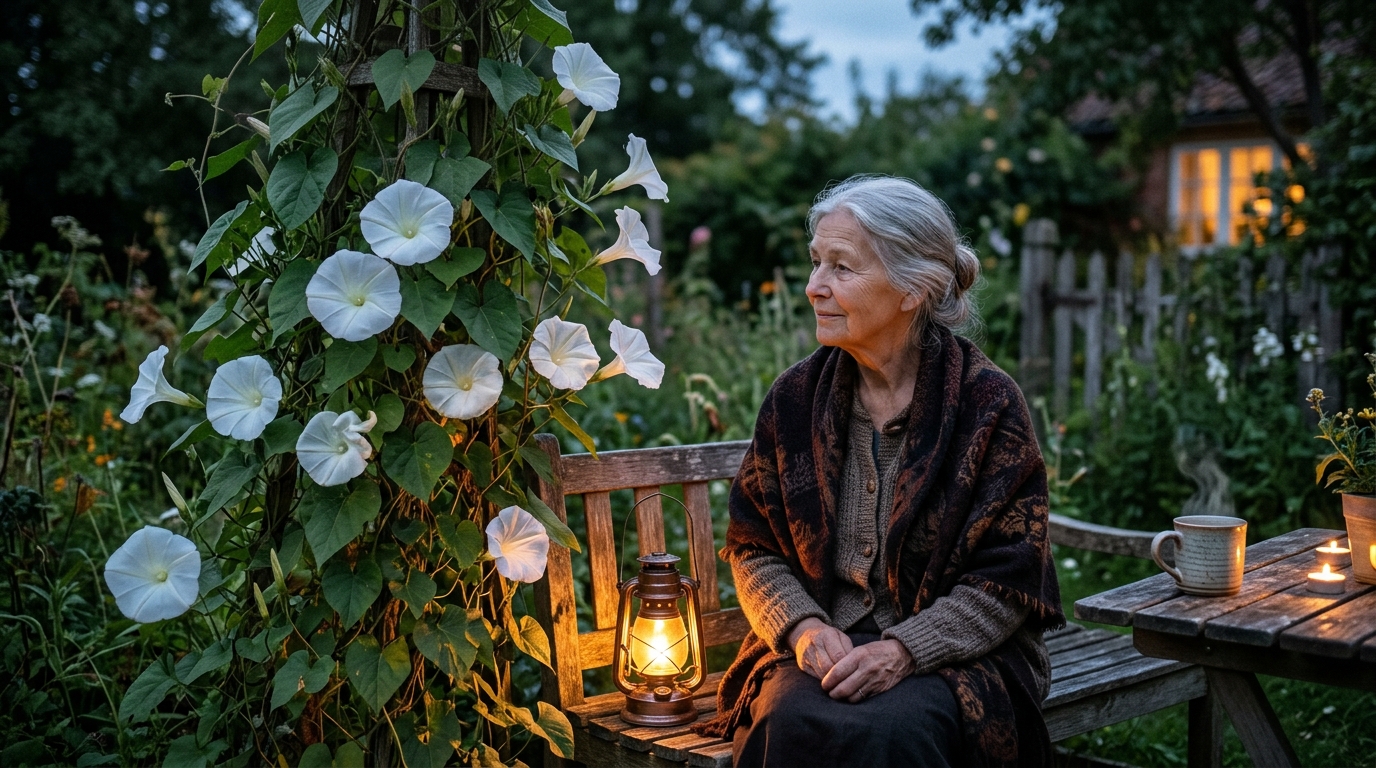
Moonflowers are a climbing vine in the morning glory family. Their buds stay tightly furled all day, and then, as the light fades, they unfurl in a matter of minutes, sometimes right before your eyes. The blooms are wide, pale, and sweetly scented, and they are visited after dark by hawk moths and other nocturnal pollinators. By morning they close again, spent.
Margaret read the packet twice. Then she did something she had not done in weeks. She put on her shoes, found a trowel, and walked to the fence at the edge of the yard.
What She Learned About Planting Moonflowers
She was no gardener, so she asked questions at the local nursery and wrote down what she learned. For anyone curious about growing a night garden of their own, here is what helped her most:
- Soak the seeds first. Moonflower seeds have a hard coat. Nicking them lightly and soaking overnight helps them sprout.
- Give them something to climb. A trellis, a fence, or a simple arrangement of twine will do. These vines grow fast and reach for the sky.
- Wait for warm weather. They are sensitive to cold, so planting after the last frost matters.
- Be patient. The vines can take weeks to flower, and the blooms arrive late in the season.
- Plant them where you can see them at dusk. This turned out to be the most important lesson of all.
The Waiting
For weeks, nothing happened. Green tendrils climbed the fence. Heart-shaped leaves unfurled. Margaret watered them each evening, mostly because it gave her a reason to stand outside while the light changed.
That small ritual began to anchor her days. She would finish her supper, fill the old watering can, and step through the back door. At first she stayed only a few minutes. Then she began to linger. She noticed the way the swallows swooped low over the grass. She noticed the cooling air, the first fireflies, the hush that settles over a neighborhood when dinner dishes are done.
She had avoided the evening for so long that she had forgotten how gentle it could be.
The Night the First Bloom Opened
It happened in late July. Margaret had gone out with her watering can and found a single fat bud, swollen and spiraled like a closed umbrella. She sat down on the back step, on the very spot where she and Walter used to sit, and decided to wait.
The sky went from gold to rose to a deep blue. Just as the first stars appeared, the bud began to tremble. Slowly, then all at once, the petals peeled open, pale as paper, glowing faintly in the dusk. A sweet scent drifted across the yard.
Margaret said she did not cry, exactly. “It was more like something loosened in my chest,” she remembered. “Like I’d been holding my breath since March and finally let it out.”
Within minutes, a hawk moth arrived, hovering at the bloom like a tiny hummingbird, its long tongue unrolling to drink. Margaret watched it for a long while. It occurred to her that Walter would have loved this more than anything, and that in a way, he was getting to see it after all.
A Garden That Asked Her to Come Back
By August, there were eleven blooms on the vine, opening one after another as the evenings grew shorter. Margaret began inviting people over. First it was her daughter, who sat beside her and said nothing, which was exactly right. Then a neighbor, then two women from her old church group, who brought a thermos of tea and stayed until the last petal opened.
Without meaning to, she had built a small evening ritual that drew people to her door. The garden asked very little of her. It simply opened, night after night, whether she was ready or not.
What the Moonflowers Taught Her
- Some things only bloom in the dark, and that does not make them any less beautiful.
- Healing rarely announces itself. It arrives in small habits, like a watering can and a back step.
- Grief and wonder can sit side by side on the same evening.
- You do not have to be ready to begin. You only have to walk outside.
The Quiet Lesson of Dusk
There is something about the end of the day that invites honesty. The noise falls away. The light softens. We are left alone with what we have been carrying, and for many people, that is the hardest part. But it can also be the most healing, if we let it.
Margaret still sits on the back step most nights. She puts the kettle on at six now, and she pours two mugs out of habit, setting one beside her. She does not apologize for it. When the moonflowers open, she lifts her cup toward them, a small, private toast to a man who planted a dream he never got to see.
“I used to dread the evenings,” she says. “Now they’re the part of the day I look forward to most.”
A Gentle Invitation
If you are carrying a loss of your own, you do not need a garden to begin. You only need a reason to step outside as the day winds down. Plant a seed. Fill a watering can. Sit on a step and watch the light change. Let the evening hold you for a little while.
Tonight, as the sky dims and the world grows quiet, somewhere a pale flower is unfolding in the dark. Perhaps it is a reminder that some of the loveliest things take their time, and that they open only for those who stay to watch.