🎧 Listen to this story
Narrated by Kore · 8,143 characters
There is a particular kind of quiet that settles over a highway shoulder at dusk. The sky goes the color of a bruised peach, the traffic thins into scattered pairs of lights, and the ordinary rush of the day gives way to something softer. It is the hour when people start thinking about home. It is also, for some, the hour when home suddenly feels very far away.
This is the story of one of those evenings, as told by the man who stopped, and the woman who was waiting on the other side of his windshield.
The Call That Came Before the Story
Dale Whitaker, a long-haul driver with twenty-six years behind the wheel, does not tell this story often. When he does, he tells it slowly, the way people recount things that have been turning over in their minds for years.
“People think truckers are in a hurry,” he said. “And we are. There’s a clock on everything. But there’s a different clock, too. The one that tells you what kind of person you are when the first clock says keep going.”
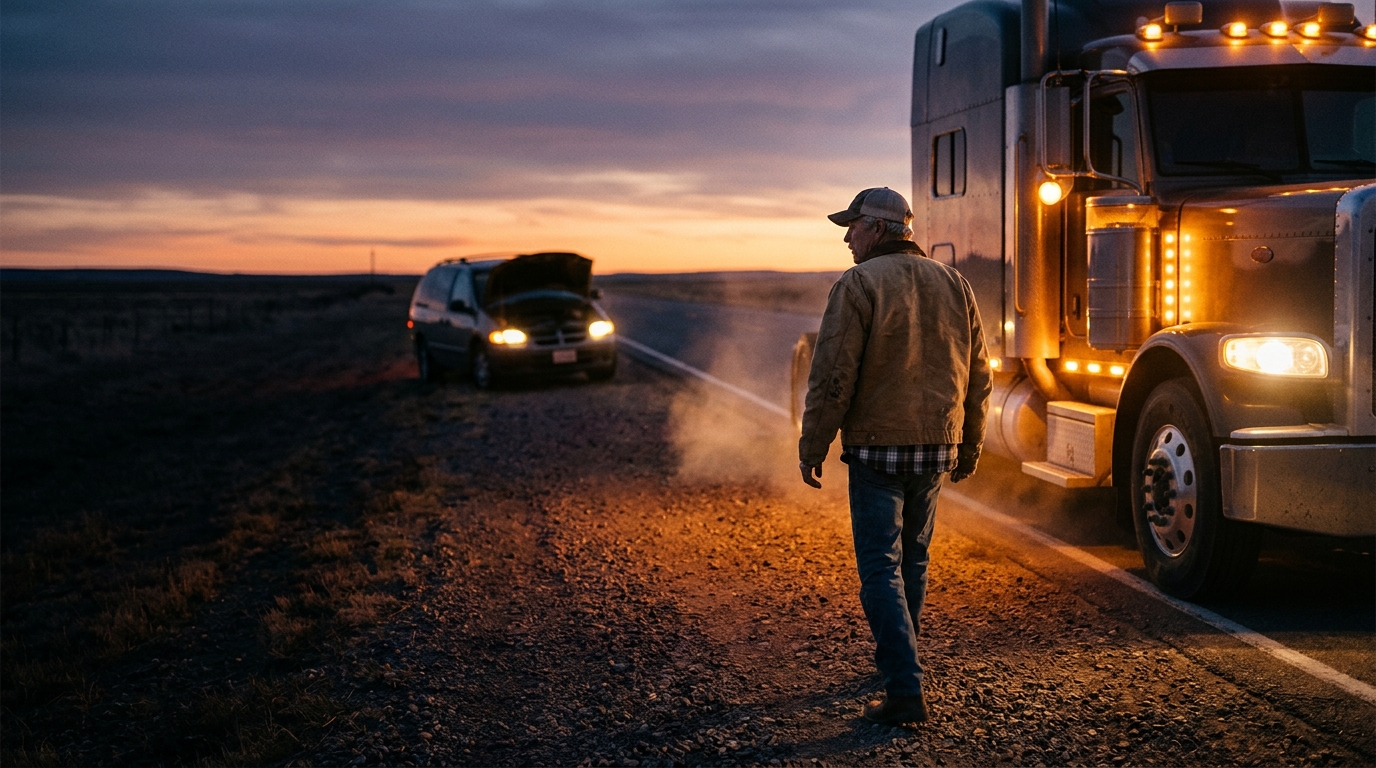
It was late October, somewhere along a long flat stretch of interstate in the Texas panhandle. Dale was running a load of paper goods, already behind schedule, and the sun was sliding toward the horizon in a way that made every fence post cast a shadow a hundred feet long. He noticed the minivan first as a small, wrong shape on the shoulder: hazard lights blinking amber, the hood propped open, and four figures standing close together near the guardrail.
What He Saw in the Mirror
He had already passed them by the time his brain finished the thought. A cargo truck does not stop on a dime. It takes a quarter mile, sometimes more, to bring that much weight to rest. So Dale had a quarter mile to decide, and he spent most of it arguing with himself.
“I told myself someone else would stop,” he admitted. “Somebody always says that. That’s the trouble with it. Everybody says it, and then nobody does.”
What tipped him was a detail he almost missed. In the side mirror, he saw one of the figures, a small child, sitting on the guardrail with a blanket around her shoulders. It was getting cold. The temperature was dropping into the forties, and the wind coming across that open country has a way of finding you.
He put on his flashers, eased the rig onto the shoulder, and walked back.
The Family on the Guardrail
The family belonged to Marisol Reyes, a nurse’s aide driving home to see her mother with her three children after a long weekend away. Their minivan had overheated, then died outright, and her phone had one bar of signal that kept flickering in and out. She had been trying to reach a tow service for nearly forty minutes. The estimate she was quoted: at least two hours, possibly three.
“I remember thinking, we’re going to be out here in the dark,” Marisol recalled. “My youngest was six. My oldest was twelve and trying very hard to act like he wasn’t scared, which is its own kind of heartbreak to watch.”
When Dale approached, she braced herself, the way anyone would. A large man walking toward you on an empty road at dusk is not automatically a comfort. But he stopped a respectful distance away, took off his cap, and said the thing that, she told me later, changed the whole feeling of the night.
“Ma’am, I’m not going anywhere until you’re sorted. Tell me what you need.”
The Quiet Work of Staying
Here is the part that rarely makes it into the headlines about kindness. The act itself was not dramatic. There was no rescue from a burning car, no heroic leap. It was a long, patient, unglamorous evening of small things done one after another.
Dale checked under the hood and found a split coolant hose, something he could not fully fix but could stabilize. He had spare hose clamps and a jug of coolant in his cab, as most drivers of his experience do. He worked by the light of a headlamp while the sky went from peach to violet to ink. The children sat in the warm cab of his truck, which he cleared out for them, handing over a thermos of hot chocolate he had been saving.
Here is what he did, in order:
- Pulled over and set out reflective triangles so no one would come up on them in the dark.
- Moved the children into his heated cab with blankets from his sleeper berth.
- Patched the coolant line well enough to get the van moving again.
- Followed the minivan for forty miles, flashers on, to the nearest town with an open repair shop.
- Waited until she was safely checked in before pulling away.
None of it was in his job description. All of it cost him time he did not have. He arrived at his delivery nearly three hours late and took a stern phone call about it the next morning.
The Stillness After
When I asked Dale what he remembers most, I expected him to describe the repair, or the cold, or the relief on the family’s faces. Instead he talked about the drive afterward.
“After they were taken care of, I got back on the road and it was fully dark. Just me and the white lines and the dash lights. And I felt this quiet come over the cab. Not lonely quiet. The good kind. Like the whole day finally exhaled.”
That detail stayed with me. We tend to imagine that goodness feels loud, like fireworks or applause. Often it feels like this: a settling. The kind of calm that arrives when you have done the right thing at the cost of your own convenience, and the day, for all its noise and deadlines, finally makes sense.
Marisol has her own version of that evening’s ending. After the repair shop, she tucked her children into a motel bed, too tired to do anything but lie awake and listen to their breathing.
“I kept thinking about how close we came to a very different night,” she said. “And how it all turned on one person deciding to apply the brakes.”
The Part Where They Never Met Again
Here is the thing that makes this story linger. They did not exchange phone numbers. Dale did not leave a card. There was no tearful reunion, no follow-up dinner, no neat ribbon tied around the encounter. He watched her taillights disappear into the repair shop’s lot, lifted a hand, and drove into the night.
Marisol looked for him. She called the shop. She searched for the trucking company name she had glimpsed on his door. She never found him. For years, he was simply a kind man with a headlamp and a thermos, a stranger who existed in her memory as a pair of steady hands and a voice that said, I’m not going anywhere.
It was only recently, when a mutual acquaintance connected the dots of the story, that the two of them were able to speak. The call lasted over an hour. Neither of them, they said, wanted to hang up.
What the Evening Teaches Us
I keep returning to this story during my own end-of-day moments, the ones where the house goes still and the mind starts replaying everything it did and did not do. We rarely remember the emails or the errands. We remember the times we stopped, and the times we did not.
Three quiet lessons from a dark roadside
- The first clock is not the only clock. Deadlines are real, but they are not the whole measure of a day.
- Someone else will stop is a dangerous sentence. Kindness often depends on whoever is willing to be the someone.
- You do not need to be thanked for it to matter. Dale never expected to hear from that family again. The act was complete the moment he did it.
A Thought for Tonight
As you read this, the light is probably fading wherever you are. Perhaps you are winding down, shoes off, the day’s weight finally easing from your shoulders. Take a moment before you close your eyes and think of one small thing you could do tomorrow that costs you a little convenience and gives someone else a lot of relief.
It does not need to be a roadside rescue. It might be a call to a friend, a door held, a seat offered, a few extra minutes of patience. The size is not the point. The stopping is.
Somewhere out on a long dark highway tonight, a driver is watching the white lines roll under his headlights, carrying the quiet satisfaction of a thing done right. And somewhere, a woman who once stood shivering on a guardrail is tucking her children in and thinking, as she does every October, of a stranger who decided that the clock could wait.
Sleep well. Be the someone.