🎧 Listen to this story
Narrated by Kore · 5,927 characters
For eleven years, my evenings ended the same way. I would sit at the kitchen table after everyone had gone to bed, pull out a yellow legal pad, and write tomorrow’s to-do list. It felt responsible. It felt like the grown-up thing to do. What I did not realize until one particular Tuesday night was that I was ending every single day by staring at everything I had not finished.
The Night the List Stopped Working
It was a rainy Tuesday in late October. I had spent twelve hours doing what I thought was a good job at being a person: a morning meeting, a school pickup, a pile of laundry, a work deadline I met by 4:58 p.m. And yet, at the kitchen table, pen in hand, I felt hollow. The list for Wednesday already had fourteen items on it. Three of them had been carried over from Monday.
I remember the quiet of the house that night. The dishwasher hummed. The porch light threw a soft amber square onto the wet driveway. And I thought, with a kind of tired clarity: I have been closing every day by handing myself a bill.
That was the moment I put down the pen. I did not have a plan. I only knew I did not want to write another list.
What I Tried Instead
The next night, I turned the legal pad to a fresh page and wrote one sentence at the top: Things that went right today. Then I sat there, embarrassed at how long it took me to come up with the first item.
That is the part nobody tells you about gratitude practices. They are not instantly warm and glowing. At first, mine felt forced. I wrote things like “coffee was hot” and “didn’t miss the bus.” It felt a little silly, like I was grading my day on a very generous curve.
But I kept going, because the alternative was going back to the debt ledger. And somewhere around the ninth night, something shifted.
The Evening Ritual That Took Shape
Over a few weeks, I settled into a small routine that I now protect fiercely. Here is what it looks like:
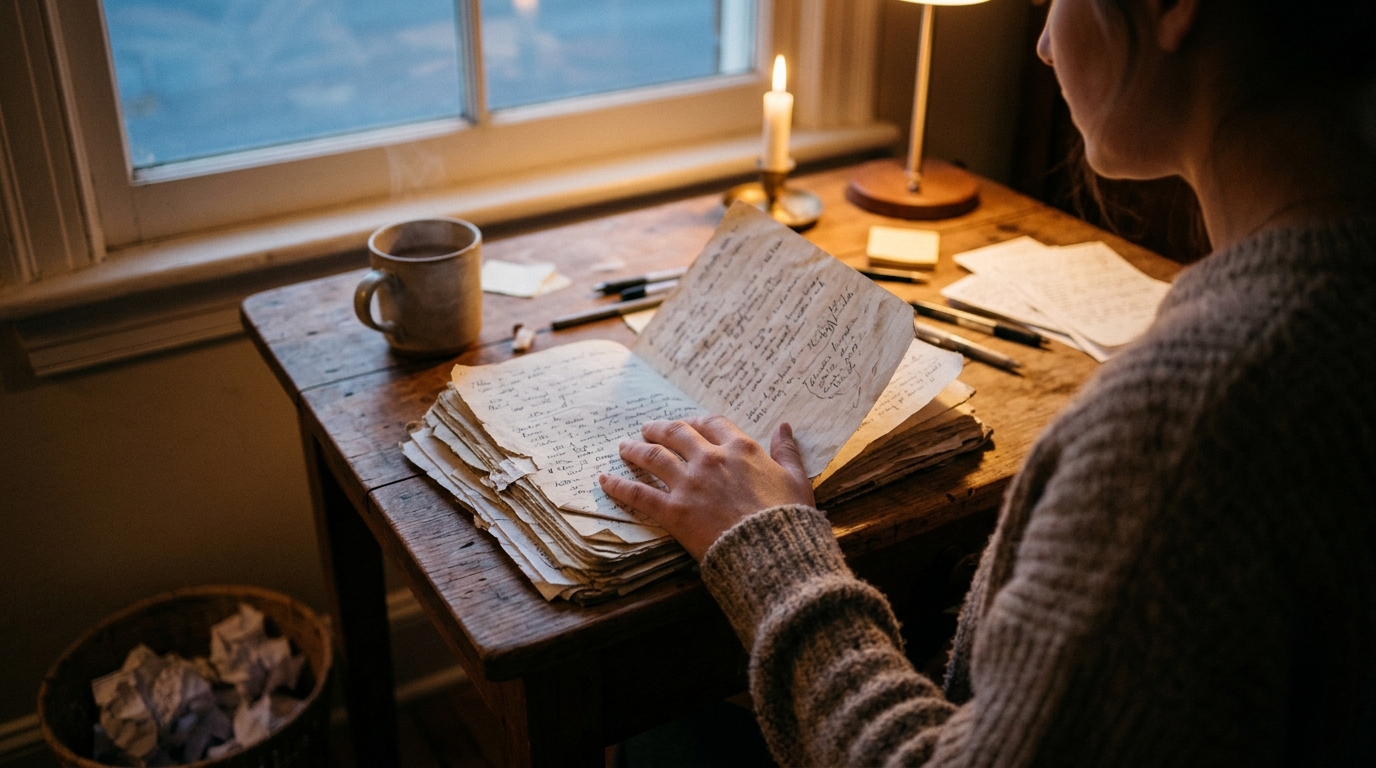
- The light goes soft. I turn off the overhead kitchen light and leave only the lamp by the window. The dimness tells my body the work of the day is over.
- One cup of something warm. Usually chamomile, sometimes just hot water with lemon. It gives my hands something to do.
- Three lines, not thirty. I write three specific things from the day. Not “my family,” but “my daughter laughing so hard at dinner that milk came out of her nose.”
- One person to thank. I name one human who made my day lighter, even if I never tell them. Sometimes I do tell them, in a text the next morning.
- Then I close the notebook. No tomorrow planning. Tomorrow can wait until tomorrow.
Why Specific Beats General
The biggest lesson of those first weeks was that vague gratitude slides right off the mind. “I’m grateful for my health” is true, but it does not land. “I’m grateful that the cold morning air felt sharp and clean on my face when I walked to the mailbox” makes me actually feel the moment again. Specificity is what turns a list into a memory.
What Changed, and What Did Not
I want to be honest here, because I do not trust stories that wrap up too neatly. My life did not transform. The laundry still piled up. The deadlines still came. I still had hard days, including a week in January when I wrote “I survived” and nothing else, and decided that was enough.
What changed was the quality of my sleep, the tone of my mornings, and, strangely, my attention during the day. Once I knew I would be hunting for good moments each evening, I started noticing them as they happened. The neighbor who waved. The way the afternoon light hit the kitchen floor. My son humming while he did his homework, completely unaware he was doing it.
Gratitude, it turns out, is partly a practice of noticing. And noticing is a muscle.
The Science, Briefly
I am not a researcher, but I did go looking for whether I was imagining the benefits. Studies on gratitude journaling, including well-known work by psychologists Robert Emmons and Michael McCullough, have suggested that people who regularly record things they are thankful for tend to report better mood and more optimism, and some find they sleep better. I take that with a grain of salt, since every person is different, but it matched my own quiet experience.
But Doesn’t a To-Do List Matter?
Of course it does. I am not suggesting you abandon planning or live in a perpetual haze of thankfulness. Life has real tasks and real responsibilities.
What I changed was the timing. I now plan in the morning, when I have energy and a clear head, over a cup of coffee. The evening is for something else. The evening is for setting the day down gently, like putting a sleeping child into a bed, rather than slamming the lid on a box of unfinished business.
Morning is for what needs doing. Night is for what was already good.
How to Start Tonight
If you are curious, here is the smallest possible way to begin:
- Pick one fixed moment in your evening, such as brushing your teeth, making tea, or turning off the lamp.
- Grab any scrap of paper or open the notes app on your phone.
- Write one thing that went right today. Make it specific.
- Stop there. Do not turn it into homework.
That is it. If you want to add a second and third line tomorrow, wonderful. If not, one line is a real beginning.
The Notebook Today
I did not throw the yellow legal pad away after all. It sits in a drawer, still holding that last unfinished Tuesday list with its fourteen items. I keep it as a reminder of who I was at that kitchen table, rain on the window, believing that peace was something I would earn once everything was done.
Nothing is ever fully done. I know that now. But every night, in the soft amber light, I get to close the day by remembering what was good about it. And that turns out to be a far better way to fall asleep.
So tonight, when the house goes quiet and the noise of the day finally fades, I hope you give yourself a few minutes to look back, not at what is left, but at what was already yours.