🎧 Listen to this story
Narrated by Callirrhoe · 8,134 characters
A Cart Full of Color in a Sea of White Hallways
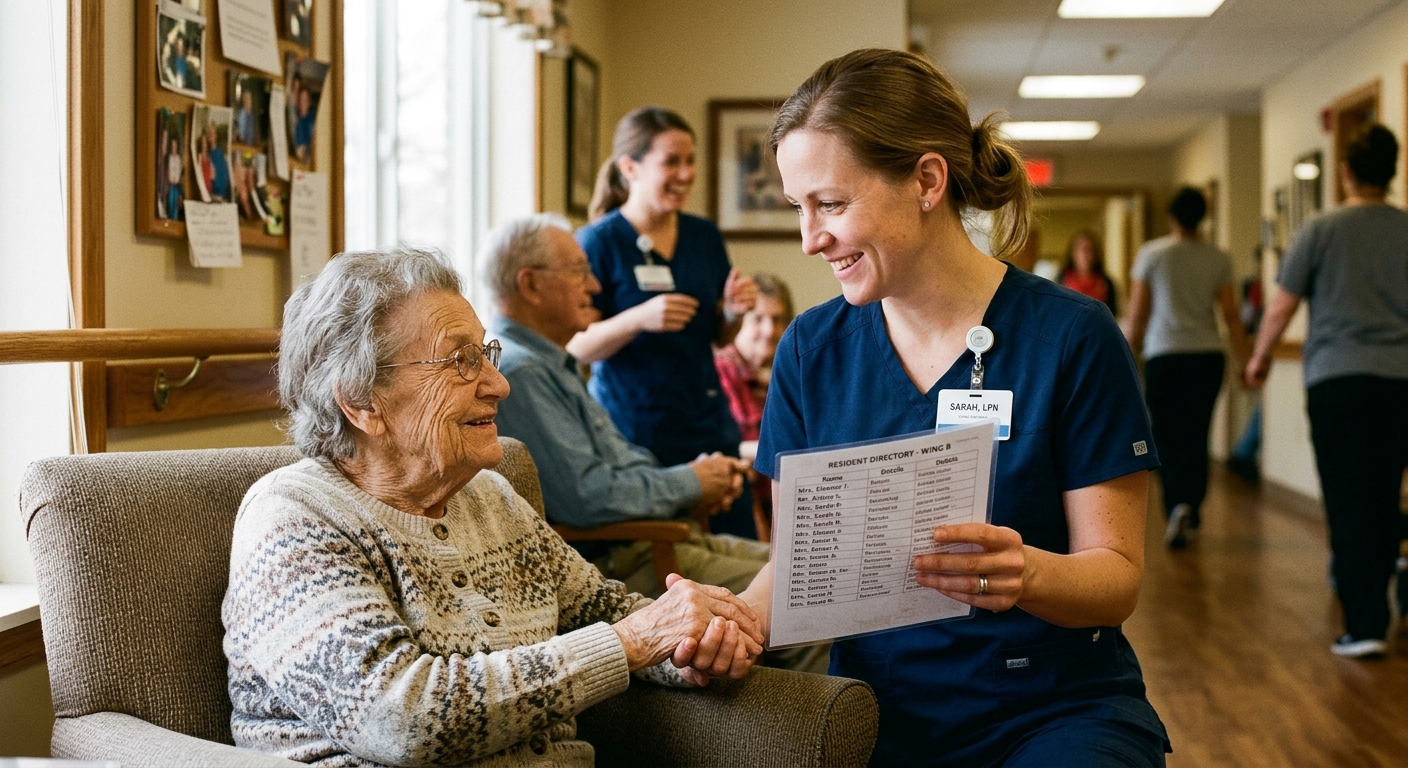
Every Tuesday morning, before most people have finished their first cup of coffee, Marielle Fontaine loads a wheeled cart with hand-labeled bags, handwritten notes, crossword puzzle books, lavender sachets, hard candies, and the occasional photograph printout from a family who emailed her the night before. She moves through the corridors of Cedarview Long-Term Care Residence in rural Vermont with the kind of unhurried purpose that feels almost radical in a world obsessed with speed.
Marielle is not a nurse. She is not a therapist. She is not on the Cedarview payroll in any official capacity. She is, by her own description, just a person who noticed something.
“I visited my grandmother here for six years before she passed,” she said, standing near the nurses’ station on the third floor, where a row of closed doors stretched the length of a football field. “And I noticed that most of the time, no one was bringing anything. Not because families didn’t love their person. But life is complicated. People live far away. Some patients don’t have family left at all. I just thought, what if somebody filled that gap?”
That was four years ago. Today, Marielle creates and delivers personalized care packages for all 300 residents of Cedarview, one at a time, every single month.
The Intake Process: More Thorough Than You’d Expect
The word “personalized” is doing a lot of heavy lifting here, and Marielle takes it seriously. Before she puts together a single package for a new resident, she conducts what she calls a “preference interview,” a conversation usually held with the resident themselves, but sometimes with a family member or a nurse if the resident is not able to communicate easily.
The questions she asks might surprise you:
- What did you do for work? Did you love it or tolerate it?
- What is your earliest happy memory?
- Do you prefer sweet or salty? Morning or evening? Quiet or noise?
- What is one thing that almost always makes you smile?
- Is there a scent that takes you somewhere good?
- What do your hands like to do, if anything?
She keeps the answers in a binder. A very full binder, color-coded by floor.
“Some people think it’s a lot of effort for a bag of snacks,” she laughed. “But the snacks are not the point. The point is that someone spent twenty minutes learning about them. A lot of these residents haven’t had that experience in years. The package is just proof that the conversation happened.”
What Goes Into a Package
No two packages look the same, and that is entirely by design. For a former high school history teacher named Walter, Marielle includes a printed historical fun fact on a notecard, a simple trivia booklet, and his preferred brand of peppermint tea. For a retired seamstress named Dottie, there are fabric swatches from a local quilting shop, a small sewing kit adapted for arthritic hands, and a catalog from a textile museum three towns over. For a 91-year-old Korean War veteran named Harold, who told Marielle during his intake that jazz was the only thing that ever calmed him down, there is a printed schedule of radio jazz programs and a small battery-operated speaker she keeps charged between visits.
She sources donations from local businesses, accepts modest contributions through a community fundraising page, and spends a significant portion of her own income on the rest. When asked how much she spends personally each month, she waves the question away with practiced ease.
“That’s not a useful number for people to focus on,” she said. “What’s more useful is knowing that a dollar store reading magnifier changed how one woman experiences her afternoon. That’s the math I care about.”
The Ripple Effect Nobody Planned For
Staff at Cedarview began noticing changes within the first few months of Marielle’s visits. Not dramatic, cinematic changes. Quieter ones.
“Residents started talking more,” said one certified nursing assistant who has worked on the second floor for eleven years. “Like, talking to us more. Because they had things to show us and tell us about. Walter would flag me down to share his trivia question of the week. Dottie would want to show me what she’d done with the fabric swatches. It gave them something to initiate. That matters more than I think people realize.”
Social isolation in long-term care settings is a well-documented crisis. Research consistently links loneliness in older adults to accelerated cognitive decline, weakened immune response, and significantly lower quality of life. Marielle does not cite studies. She does not carry a clipboard. But what she is doing aligns with what researchers have been arguing for decades: that feeling known, specifically and individually known, is one of the most powerful forces in human wellbeing.
Families Who Live Far Away Found Something Unexpected
One of the quieter stories to emerge from Marielle’s work involves the families themselves. Several have reached out to her after learning about the packages through staff or other relatives, and what they describe is a particular kind of relief that is hard to articulate.
“My mother has dementia and lives alone in that facility in the sense that I am in Oregon and my brother is in Florida,” wrote one daughter in a message Marielle shared with permission. “Knowing that someone is bringing her chamomile hand lotion because she mentioned once that she used to grow chamomile in her garden, I don’t have words for what that does to the weight I carry every day.”
Marielle has since created a simple intake form that families can fill out remotely, allowing them to contribute details she might not have gathered locally. It has become, unexpectedly, a way for families to feel involved in a care process they often feel locked out of.
What She Wants You to Take From This
Marielle is uncomfortable with the word “hero.” She visibly tenses when someone uses it in her presence, which happens more often now that local news outlets have started covering her work.
“I’m a person with time and a car and the ability to ask questions and listen to the answers,” she said. “Every community has people like that. What I want is for people to look at what I’m doing and think, oh, I could do a version of that. Not a copy. A version. For a neighbor, for a shelter, for a school. You don’t need a nonprofit. You don’t need a title. You need a cart and a question.”
She paused to knock lightly on a door at the end of the hallway, peeking her head in to deliver a small package tied with a yellow ribbon to a woman sitting by a window with a jigsaw puzzle spread across a TV tray.
The woman looked up. Her face did something complicated and immediate.
“You remembered the lemon drops,” she said.
“Of course I did,” Marielle said. “You told me they were your mother’s favorite.”
The woman picked up a lemon drop and held it like it was something very old and very precious.
That is the whole story, really. That moment. Replicated, with variation, 300 times a month, down every corridor, on every floor, in every room where someone is waiting to be remembered.
How You Can Support or Start Something Similar
If Marielle’s work has sparked something in you, here are a few ways to channel it:
- Contact your local long-term care facility and ask if they have a volunteer coordinator. Most facilities are deeply grateful for consistent, organized volunteers.
- Ask about resident preferences before donating. Generic donations are fine, but specific ones land differently. Ask what residents actually want or need.
- Start small. You do not need to serve 300 people. Start with five. Learn their names. Learn one thing about each of them. Build from there.
- Loop in local businesses. Bakeries, bookstores, florists, and pharmacies are often willing to donate items or offer steep discounts when they understand the purpose.
- Tell someone. One of the most underrated acts of kindness is simply talking about what you are doing so that others feel permission to do something similar.
Marielle will be back next Tuesday. The cart will be full. Every bag will have a name on it. None of them will be the same.