🎧 Listen to this story
Narrated by Callirrhoe · 8,994 characters
Some People Show Up Once. Gerald Shows Up Every Week.
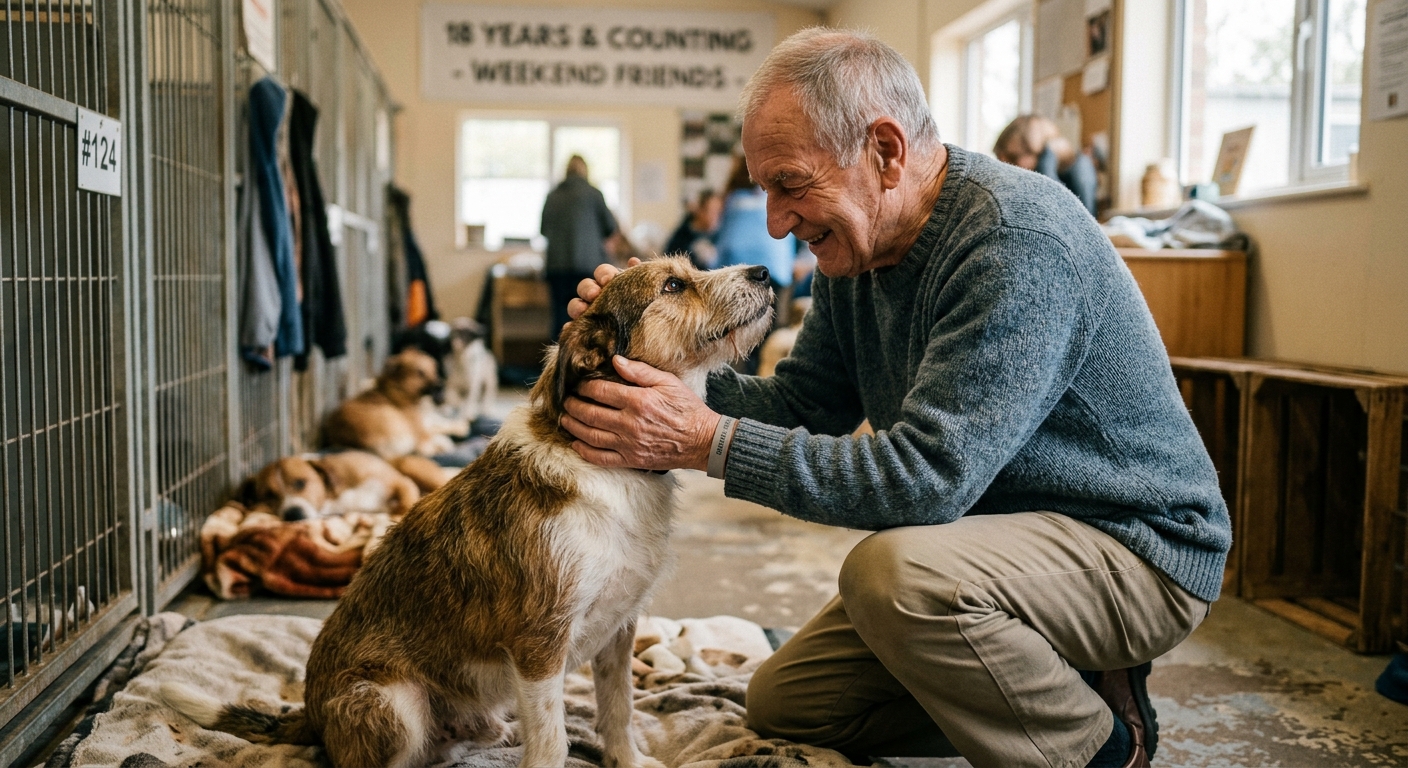
When the doors of the Maplewood Animal Shelter open on Saturday mornings, the dogs in the back kennels already know. The barking shifts. The tails start moving. There is a particular kind of anticipation that ripples through a room full of animals when someone familiar is coming, and for 18 years, that someone has been Gerald Hutchins.
Gerald is 67 years old. He is retired now, a former high school shop teacher with calloused hands and a patient way of speaking. He drives a 2009 pickup truck with a cracked side mirror and a cardboard pine tree hanging from the rearview. He is not famous. He has not written a book. He has never been on television. But ask anyone at the Maplewood Animal Shelter what keeps the place running on heart, and they will say his name without hesitation.
How It Started: A Saturday That Never Ended
Gerald’s story with the shelter began the way many great commitments do, quietly and without fanfare. In the winter of 2007, his wife Carol suggested they adopt a dog. They visited the shelter on a cold Saturday in January, walked out with a scruffy mixed-breed named Biscuit, and Gerald turned to the shelter director on the way out and said, almost as an afterthought, “You need any help around here?”
He came back the following weekend. And the one after that. And the one after that.
“I don’t think I ever made a big decision about it,” Gerald told a local community newsletter in a rare interview. “It just became what Saturdays were. I’d take care of Biscuit at home, and I’d go take care of the ones who didn’t have a home yet. It felt right.”
Over 936 weekends, Gerald has logged an estimated 7,500 hours of volunteer service at the shelter. He has walked dogs, cleaned kennels, repaired fencing, built enrichment toys from scrap wood, sat with frightened animals during thunderstorms, trained skittish rescues in basic commands, and driven animals to vet appointments when the shelter’s van was unavailable.
What 18 Years of Showing Up Actually Looks Like
To understand what Gerald’s commitment means in practical terms, it helps to break down what he actually does each week. His routine is not glamorous. It is steady.
- 6:45 a.m.: Gerald arrives before the morning staff, checks the overnight logs for any animals in distress, and begins morning walks for the dogs in the highest-stress kennels.
- 8:00 a.m.: He joins the volunteer team for feeding rounds and medication administration for animals with special health needs.
- 9:30 a.m.: He works on whatever physical project needs attention, whether that is repairing a latch, painting a kennel, or building a new scratching post for the cat room.
- 11:00 a.m.: He participates in socialization sessions, sitting quietly with new arrivals, particularly dogs that have come from abuse or neglect situations, letting them approach on their own terms.
- 1:00 p.m.: He stays for afternoon adoption hours, answering questions from potential adopters and sharing what he knows about individual animals from weeks of observation.
“Gerald knows these dogs better than anyone,” says shelter director Tamara Osei. “He remembers which ones flinch at loud voices, which ones need a certain kind of leash, which ones are ready for a family even if they’re still nervous in the kennel. That knowledge is invaluable. You can’t get it from a file. You get it from showing up.”
The Animals Nobody Wanted
One of the quieter aspects of Gerald’s work is the attention he pays to the long-term residents, the dogs and cats who have been at the shelter for months, sometimes over a year, without being adopted. These animals are at the highest risk of deteriorating emotionally. Shelter life, even in the best facilities, is hard on social animals. Routine becomes a lifeline.
Gerald has a list. Not a formal one, just one he keeps in his head. He knows which animals have been there the longest, and he makes sure they get extra time with him each week.
“There was a shepherd mix named Rudy who was with us for 14 months,” Tamara recalls. “He was shut down when visitors came by, which made it really hard to get him adopted. Gerald spent hours with him every weekend, just reading out loud nearby, not forcing anything. Slowly Rudy came around. He was adopted by a retired couple eight months later. Gerald cried when they drove away.”
Gerald, when asked about Rudy, just shrugs and smiles. “He just needed someone to be consistent. Most of us do.”
What Volunteers Who Work Beside Him Say
The shelter’s volunteer coordinator, a woman named Beth Lacroix who has worked there for five years, says that Gerald’s presence has a measurable effect on newer volunteers.
“When someone new comes in and they’re not sure if volunteering is worth it, or if they’re making a difference, I just point to Gerald. Here’s a man who has never missed a weekend in 18 years. He doesn’t do it for recognition. He doesn’t post about it. He just comes. That says more than any speech I could give.”
Several current long-term volunteers cite Gerald directly as the reason they kept coming back after their first visit. His quiet, unassuming commitment creates what Beth calls “a culture of reliability” within the shelter’s volunteer community.
Loss, Grief, and Carrying On
Gerald’s 18 years have not been without personal difficulty. In 2015, his wife Carol passed away after a brief illness. Biscuit, the dog that started everything, had died two years prior. Friends and family assumed Gerald might step back from the shelter, take time for himself, maybe stop altogether.
He was back the following Saturday.
“People grieve differently,” he said, in one of the few times he has spoken publicly about that period. “For me, being useful was the only thing that helped. Those dogs didn’t know I was sad. They just needed walking. There’s something about being needed by something that can’t tell you in words. It gets you out of your own head.”
The shelter staff quietly made sure he was not alone during those early weeks back. They brought him coffee. They worked beside him more than usual. Nobody made a big deal of it, because Gerald wouldn’t have wanted that. They just showed up for him the way he had always shown up for them.
The Ripple Effect: Adoptions, Training, and Community
The numbers associated with Gerald’s tenure are striking, even if he would never think to mention them himself. During his 18 years at Maplewood Animal Shelter, the facility has facilitated over 4,200 successful adoptions. While it would be impossible to credit Gerald alone, shelter staff estimate that his socialization work with difficult-to-place animals has directly contributed to hundreds of those outcomes.
He has also informally trained more than 60 volunteers in basic animal handling techniques, simply by working alongside them and answering questions. Three of those volunteers went on to pursue professional careers in animal welfare.
“He never set out to teach anyone,” Beth says. “But people watch him and they learn. That’s the best kind of teaching.”
What We Can Take From Gerald’s Story
Gerald Hutchins is not extraordinary in the way that headlines usually define extraordinary. He did not make a grand gesture. He did not donate a building or fund a campaign. He gave something arguably more rare: consistent, unglamorous, reliable presence over nearly two decades.
His story is a reminder of several things worth sitting with:
- Commitment compounds. One Saturday seems small. Nine hundred Saturdays reshape a community.
- Consistency is a form of love. For animals who have been abandoned, a familiar face that keeps returning is its own kind of healing.
- Purpose can be found in small places. Gerald did not go searching for meaning. He asked a simple question on his way out of a shelter door, and meaning found him.
- Grief can be carried in motion. When words and stillness fail, usefulness can be a bridge back to life.
- You don’t have to announce your goodness. Gerald has no social media presence, no fundraising page, no public platform. He just keeps going.
Still Showing Up
Gerald still arrives at Maplewood Animal Shelter every Saturday morning at 6:45. He drives the same truck, parks in the same spot near the side entrance, and lets himself in with the key the shelter gave him somewhere around year three, when they stopped pretending he was just a visitor.
He has a new dog at home now, a one-eyed terrier named Peanut who was deemed unadoptable by multiple assessments. Gerald disagreed.
The shelter is currently home to 34 dogs and 21 cats. Eleven of them have been there longer than four months. Gerald knows all of their names, their habits, their fears, and their favorite spots to be scratched.
Next Saturday, he will be back. The barking will shift. The tails will start moving. And somewhere in that building, a dog who has not yet found its person will spend an hour with someone who, for right now, is exactly what they need.
That is enough. It has always been enough.