🎧 Listen to this story
Narrated by Vindemiatrix · 7,053 characters
The Quiet Ritual Nobody Asked For, But Everyone Needed
Every Thanksgiving. Every Christmas. Every New Year’s Eve. While most of the city sleeps or gathers around tables and trees and fireworks, David Cho loads up the back seat of his 2014 Honda Accord with dozens of donut boxes and drives to places most people try to avoid on holidays: hospital emergency rooms, ICUs, labor and delivery wings, and overnight nursing stations.
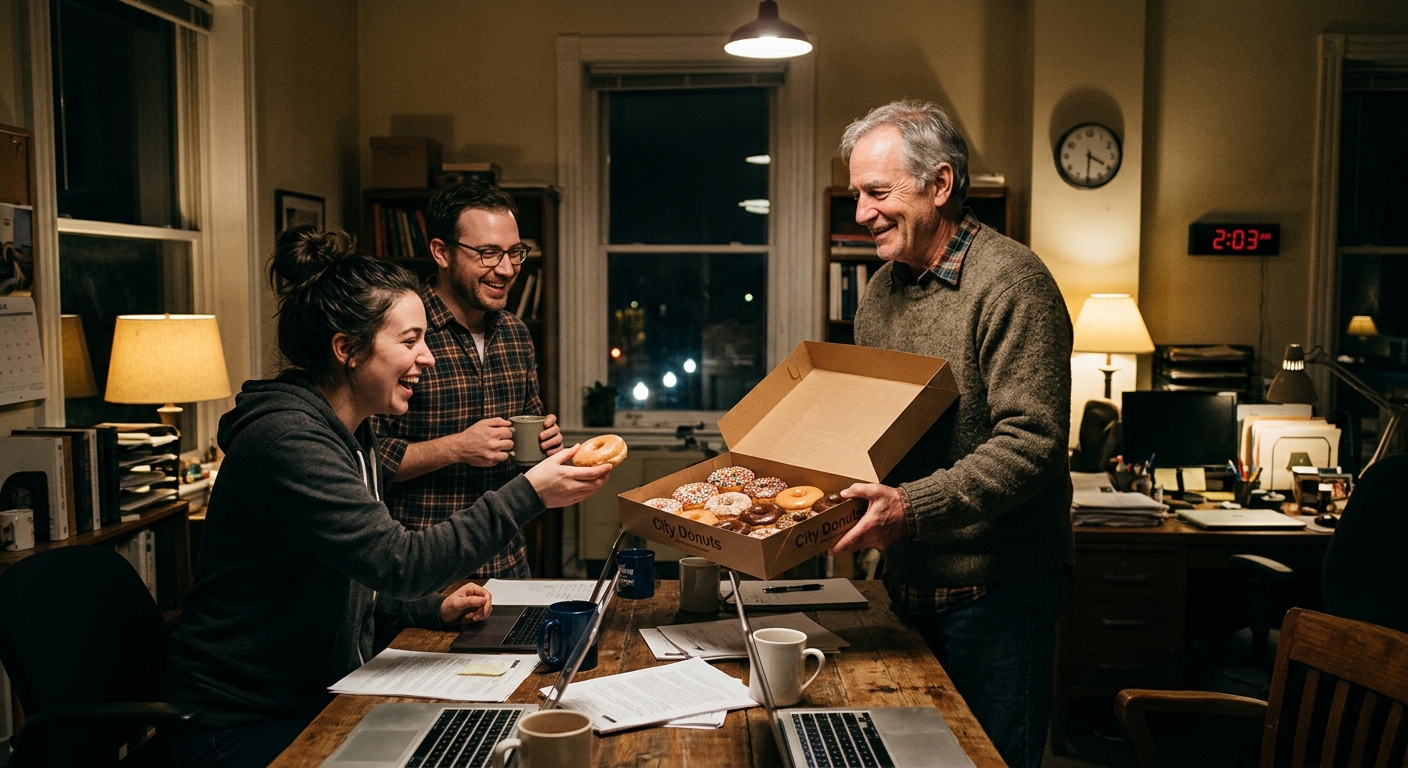
He does not call ahead. He does not wear a shirt with a logo. He does not post about it online. He simply shows up at the sliding glass doors, arms full, and says the same thing every time: “I brought donuts for the night shift.”
That’s it. That’s the whole plan.
How It Started: A Broken Leg and a Glazed Donut
David, 58, a retired logistics coordinator from Columbus, Ohio, did not set out to become anyone’s tradition. He traces the whole thing back to a single night in 2011, when he broke his leg slipping on ice in his driveway on Christmas Eve.
“I ended up in the ER at about midnight,” he recalls. “And I just remember looking around at all these nurses and techs and thinking, these people are here. On Christmas Eve. Taking care of strangers. And nobody had brought them anything.”
He was discharged early Christmas morning, and on his way home, still on crutches, he stopped at the only place open: a 24-hour donut shop. He bought four dozen, went back to the hospital, and handed them to the nurses’ station.
“The look on their faces,” he says, pausing. “I mean, it was just donuts. But it was also not just donuts. You know?”
He knew. And he went back the following Thanksgiving. And every holiday after that.
A Look at the Numbers (Because They Are Staggering)
What started as one hospital on one holiday has quietly expanded into something that requires real planning, a spreadsheet, and a trunk full of cardboard boxes. Here is what a typical holiday run looks like for David today:
- 6 to 8 hospitals visited in a single night, depending on the holiday
- 40 to 60 boxes of donuts purchased from local shops, which he now orders in advance
- Roughly 5 to 6 hours spent driving across the city in the early morning hours
- Zero social media posts made before, during, or after
- 13 years and counting without missing a single major holiday
He estimates he has spent somewhere between $18,000 and $22,000 of his own money over the years. He pays for all of it himself, though a few close friends have started slipping him cash around the holidays after word quietly got out.
What the Night Shift Actually Feels Like
To understand why a box of donuts hits differently at 3 a.m. on Christmas, you have to understand what working the holiday night shift actually feels like.
Maria Esteves, a registered nurse in the cardiac unit at a Columbus hospital, has received David’s donuts three times over the past four years. She did not know his name until recently.
“We just called him the Donut Man,” she says, laughing. “And then one Christmas he came in and one of the younger nurses asked him, she just asked him straight out, why do you do this? And he said, because you’re here when you don’t have to be, and I’m here because I want to be. That’s it.”
Maria gets quiet for a moment. “I cried. Like, full-on cried in the break room over a maple bar. Because it’s not really about the donut. It’s about being seen. On a night when you feel invisible, someone saw you.”
The Hospitals Have Started to Expect Him
Word travels slowly in the night shift world, but it travels. Several hospitals now have staff members who quietly watch for his Honda Accord in the parking lot. One charge nurse admitted she starts a pool every Thanksgiving about which floor he will visit first.
Nobody has ever organized a formal thank-you. Nobody has nominated him for an award (though this reporter suspects that may change after publication). David has turned down two local news interview requests over the years, agreeing to this one only on the condition that the focus stay on the workers, not on him.
“These people don’t need a story about me,” he says plainly. “They need a story that makes the person reading it want to do something. Anything. Even something small.”
7 Things David’s Story Teaches Us About Showing Up
- Consistency is its own form of love. Anyone can do something kind once. Doing it for 13 years without recognition is a different kind of commitment entirely.
- You don’t need a platform to make a difference. David has no Instagram, no foundation, no press team. He has a car and a credit card and a willingness to be awake at 2 a.m.
- The gesture matters less than the timing. A donut is ordinary. A donut delivered to someone working alone on Christmas morning is extraordinary.
- Being seen is a human need, not a luxury. Healthcare workers, overnight shift employees, and caregivers often feel forgotten. A small acknowledgment can shift an entire night.
- You don’t have to explain yourself. David does not deliver a speech or hand out business cards. He lets the gesture speak, and it speaks clearly.
- Local shops are part of the story too. David buys from small, local donut shops. His ritual has become a meaningful source of holiday income for at least three family-owned businesses in Columbus.
- Quiet kindness ripples outward. Multiple nurses interviewed for this piece said that after receiving his donuts, they went out of their way to do something kind for a patient or coworker that same shift. One act sets off a chain.
What He Does While He Drives
There is something worth imagining here: a man in his late fifties, alone in a car full of donut boxes, navigating an empty city in the deep middle of the night on Christmas. What does that feel like?
“Honestly? It’s my favorite night of the year,” David says. “The city is so quiet. I listen to old jazz, or sometimes nothing at all. And I think about the people I’m going to see. I think about the nurses and the paramedics and the cleaning staff and the security guards. I think about how they all went to work today instead of being wherever they would have rather been.”
He pauses again, and you can hear the sincerity settle in.
“I would have rather been at the hospital than at home alone, honestly. So maybe I’m doing this a little bit for me too.”
The Invitation He Leaves Behind
David has no plans to stop. He has no succession plan. He is not building an organization or writing a memoir. But he does leave something behind at each stop, tucked inside the top donut box: a small handwritten card that reads simply, “Thank you for being here. Happy holidays from a neighbor.”
No name. No phone number. Just those two sentences.
And somehow, that is enough. More than enough. It is, in fact, everything.
If you work the night shift at a hospital in Columbus, Ohio this holiday season, keep an eye on the parking lot around 2 a.m. There is a guy in a Honda Accord who wants you to know he sees you. He is bringing maple bars and glazed and maybe a few of the ones with sprinkles, and he is coming because you showed up, and he thinks that matters.
It does.