🎧 Listen to this story
Narrated by Vindemiatrix · 7,652 characters
A Corner That Feels Like Home
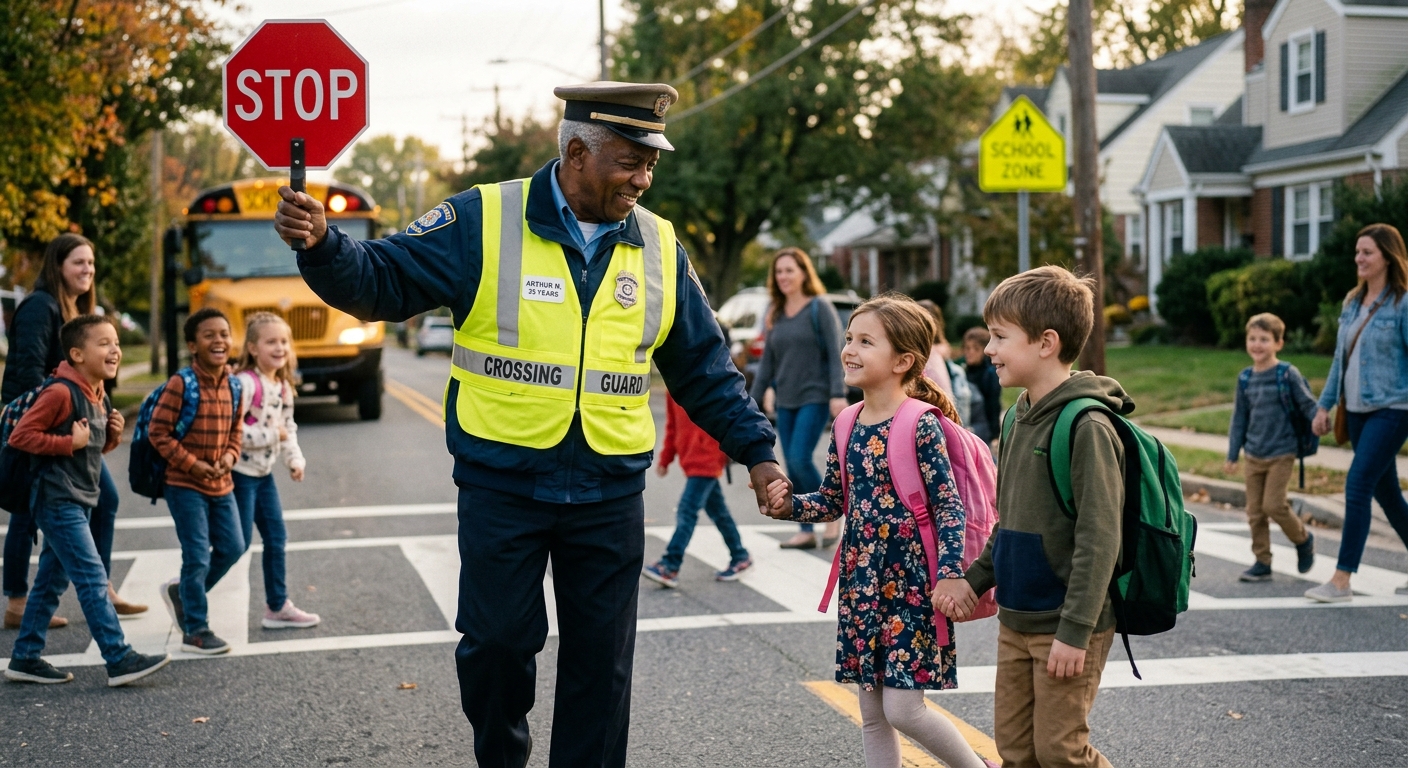
At the intersection of Maple and 5th, just outside Roosevelt Elementary School in Dayton, Ohio, there is a man who has stood in the same spot, rain or shine, for 35 years. His name is Walter Grimes, and he knows your name. He knew your older sister’s name. He knew your mother’s name when she was seven years old, clutching a lunchbox and nervous about her first day of second grade.
Walter is 71 years old. He wears the same bright orange vest every morning, the same weathered smile, and the same readiness to stop traffic with one hand while waving a child safely across the street with the other. But what sets Walter apart from every other crossing guard in the city, perhaps in the country, is something so simple it almost sounds impossible: in 35 years of service, he has never once failed to learn the name of every single child who has crossed his corner.
Every. Single. One.
How It Started: A Promise Made to Himself
Walter did not set out to become a legend. He took the job in 1989 after retiring early from a factory position due to a back injury. He needed something to do, something that felt useful. A neighbor mentioned the school district was hiring crossing guards, and Walter figured it would keep him moving in the mornings.
On his very first day, a little girl in pigtails walked up to him, looked him dead in the eye, and said, “What’s your name?” He told her. Then she asked, “Are you going to know MY name?” Walter laughed, learned her name on the spot, and made a quiet promise to himself right then and there: he would know every single child who crossed that street.
“It wasn’t a grand gesture,” Walter said in a conversation with a local reporter from the Dayton Daily News. “It was just a little girl who wanted to feel seen. Don’t we all?”
The Method Behind the Magic
People often assume Walter has some extraordinary memory, some superhuman gift. The truth is both more humble and more instructive. His system, if you can call it that, comes down to three things:
- He pays attention from day one. When a new school year begins, Walter positions himself to greet every child by name within the first two weeks. He studies the school’s roster when the principal allows it, and he associates each name with a detail: a backpack color, a laugh, a habit of skipping instead of walking.
- He repeats the name out loud, every time. Every morning, without exception, he greets each child by name. “Good morning, Marcus.” “Hey there, Priya, nice boots today.” The repetition is deliberate and consistent.
- He treats each child as someone worth remembering. This, Walter insists, is the real secret. “If you genuinely believe someone matters, your brain makes room for them. It’s that simple.”
What the Children Say
Over 35 years, thousands of children have crossed Walter’s corner. Many of them are now adults with children of their own, some of whom Walter is now guiding across the same intersection. The generational loop is not lost on him, and it is certainly not lost on the families.
Diane Castillo, now 38, remembers walking to Roosevelt Elementary as a child in the mid-1990s. “Mr. Walter was the first adult outside my family who made me feel like I was somebody important,” she said. “Not because he did anything huge. Just because he always said my name. Every single morning. Like he was glad I showed up.”
Her son, Mateo, now crosses that same corner. “He knew Mateo’s name by the third day of kindergarten,” Diane said, her voice catching slightly. “I cried on the way home. I’m not even embarrassed about that.”
Marcus Webb, now a high school basketball coach in Cincinnati, credits Walter with something he calls “the first lesson in dignity.” “There is a specific feeling you get when someone remembers your name,” Marcus said. “It tells you: you exist, you count, you are not invisible. Walter gave me that feeling every morning for six years. That stays with you.”
35 Years of Rain, Snow, and Showing Up
Walter has worked through blizzards, heatwaves, a broken wrist in 2007 that he wrapped himself and showed up the next morning anyway, and the quiet devastation of the pandemic years when the streets were empty and he still came, just in case.
“Two kids showed up during the first week of lockdown,” he recalled. “Their parents were essential workers and didn’t have childcare figured out yet. I was glad I was there. I walked them to the door myself.”
He has also grieved at that corner. In 2013, one of his children, a quiet sixth-grader named Leo Torres, was killed in a car accident two blocks away. Walter placed a single sunflower at the corner for a full year, one for every Monday morning. “Leo deserved to be remembered,” Walter said simply. “They all do.”
What We Can All Learn From Walter Grimes
In a world that moves faster every year, where interactions are increasingly digital and brief, Walter’s story reads almost like a fable. But it is real, and it carries lessons that reach far beyond a school crossing:
- A name is not a small thing. Remembering someone’s name is an act of respect. It tells them their presence registers, that they have made an impression simply by existing.
- Consistency is a form of love. Walter did not show up once or twice. He showed up 35 years in a row. That kind of reliability builds something in children that no single grand gesture ever could.
- You do not need a dramatic platform to change lives. Walter has no viral videos, no bestselling book, no TED talk. He has an orange vest and a corner. That has been enough.
- Attention is a gift. In an age of distraction, giving someone your full, unhurried attention is one of the rarest and most powerful things one human being can offer another.
- The ordinary can be extraordinary. Walter’s job is considered one of the most unremarkable in public service. He has transformed it into something people will tell their grandchildren about.
A Community That Finally Said Thank You
In the spring of 2024, Roosevelt Elementary organized what they called “Walter’s Morning,” a surprise gathering at the corner where former students, now adults, showed up alongside current students to honor him. They came from three states. Some brought their own children. The local mayor was there. A banner stretched across the intersection read: “He Knew Our Names. We’ll Never Forget His.”
Walter, characteristically, was more focused on the children than the ceremony. He was spotted during the event crouching down to speak with a shy kindergartner who had wandered to the edge of the crowd, asking her name, repeating it back to her, and telling her she had a strong name, a name worth remembering.
Someone captured the moment on a phone camera. It went quietly viral for a weekend, and then the world moved on. But at Maple and 5th, nothing has changed. Walter is still there, every morning, orange vest on, learning the names.
The Corner Will Not Always Have Walter
Walter has hinted, gently, that retirement may come within the next year or two. His knees, he admits, are not what they once were. The winters are harder now. But he is not ready to go yet, not while there are still names to learn.
“I’ll know when it’s time,” he said. “But right now, there’s a whole new class of kindergartners coming in September. I’ve got work to do.”
And somewhere in Dayton, a five-year-old who does not yet know it is about to be seen, truly seen, by a man in an orange vest at the corner of Maple and 5th. Their name will be spoken out loud, warmly and without hurry, and something in them will quietly settle into place.
That is the work of Walter Grimes. That is, it turns out, enough to change the world.