🎧 Listen to this story
Narrated by Sulafat · 8,273 characters
A Neighborhood on the Edge
Three years ago, the corner lot at the intersection of Maplewood and 5th Street in the Eastside district of Columbus, Ohio, was nothing more than a graveyard of broken glass, overgrown weeds, and forgotten furniture. Residents crossed to the other side of the street when passing it. Parents steered strollers away from it. It was the kind of place that whispered a neighborhood’s quiet despair back at itself.
Nobody expected a pile of dirt, a handful of volunteers, and a few hundred seed packets to change any of that.
But that is exactly what happened.
The Woman Who Started Digging
Renata Okafor, a retired school nurse and lifelong Eastside resident, had watched her neighborhood decline for over a decade. Families moved away. Small businesses shuttered. The community center closed due to budget cuts. What remained was a block of people who shared addresses but had stopped sharing lives.
“I kept thinking someone was going to do something about that lot,” Renata told us when we visited last spring. “And then one morning I woke up and realized I had been waiting for a ‘someone’ who was never going to come. So I became the someone.”
In April 2021, Renata showed up at the vacant lot with a shovel, a pair of gardening gloves, and her neighbor’s teenage son, Marcus, who she had bribed with the promise of homemade jerk chicken. They cleared debris for three weekends straight. Then Renata knocked on every door within two blocks and invited people to a meeting at her kitchen table.
Eight people showed up. By the end of that first conversation, they had a name: The Eastside Growing Collective.
What the Dirt Taught Them
The early days were far from poetic. Soil testing revealed heavy contamination from decades of industrial runoff, which meant raised beds, imported soil, and a steeper budget than anyone had planned for. A grant application to the city parks department was rejected twice. One of the founding eight members quit after a disagreement over plot allocation.
“We almost fell apart before anything even grew,” admits Darius Webb, a 34-year-old electrician who joined in the second month. “And honestly, looking back, I think that struggle was part of the point. You don’t build community in the good times. You build it in the frustrating, messy, nobody-knows-what-they’re-doing times.”
They eventually secured a $4,200 microgrant from a local nonprofit, and construction on the first twelve raised beds began in June of that year. Volunteers ranged in age from 9 to 78. Some spoke Spanish, some Somali, some only English. They used hand gestures, translation apps, and a lot of laughter to communicate across the language gaps.
The Harvest Was Never Just Food
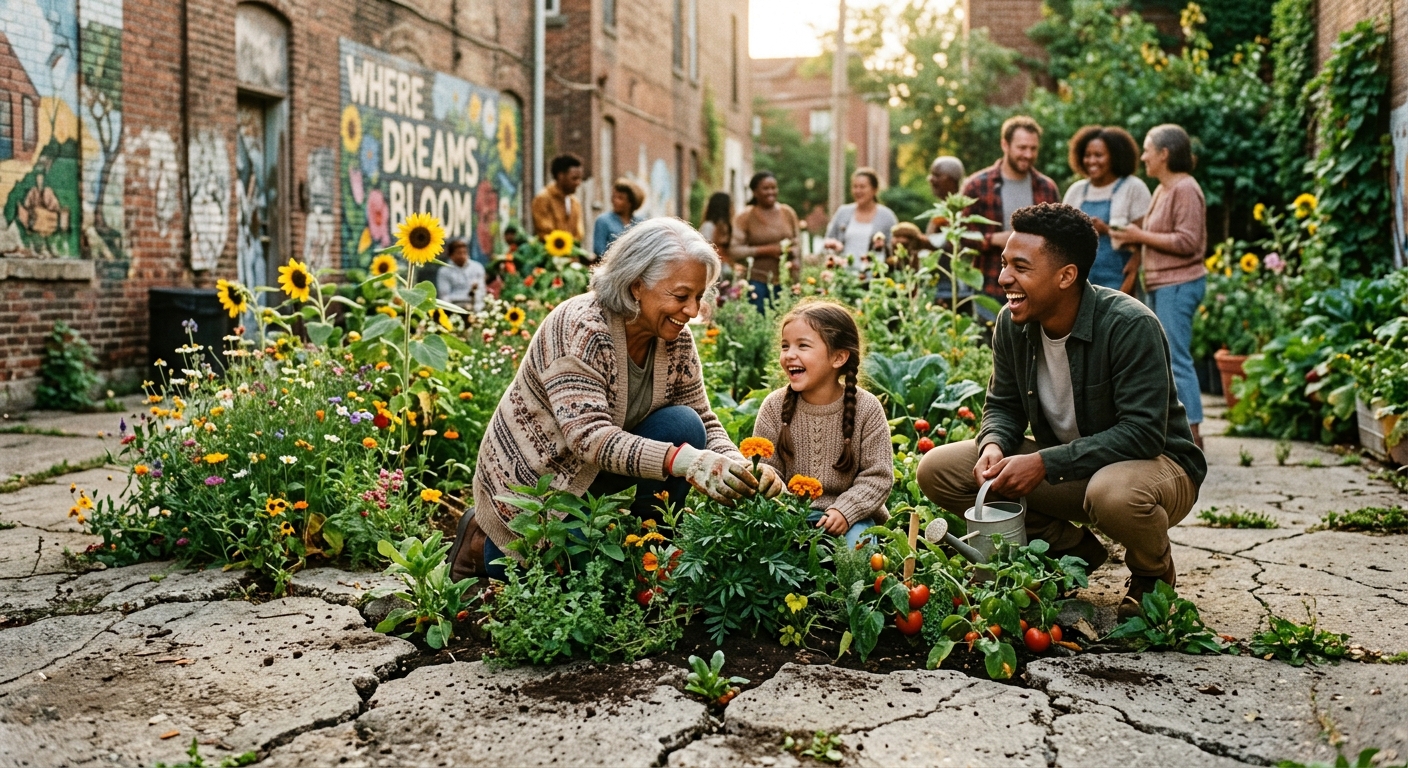
By late summer, the garden was producing tomatoes, collard greens, peppers, basil, okra, and a sprawling patch of sunflowers that had not been planned by anyone but had shown up anyway, seemingly on their own terms. Produce was shared freely among participants, with surplus donated to a nearby food pantry.
But the real harvest, as every member will tell you, was something harder to measure.
- Loneliness decreased: Three elderly residents who had been largely isolated during the pandemic became regular fixtures at the garden, coming daily, sometimes just to sit and watch.
- Youth engagement grew: Marcus, the teenager who had helped clear the lot for jerk chicken, went on to lead a youth gardening workshop the following spring. He is now studying environmental science at Ohio State.
- Conflict transformed: Two families on the block who had a longstanding dispute over a property line began speaking again, having spent enough shared hours in the soil to remember each other’s humanity.
- Mental health improved: Several participants reported reduced anxiety and depression symptoms, echoing a growing body of research that connects time in green spaces to improved psychological wellbeing.
- Cultural exchange deepened: A Somali-American family introduced the group to fenugreek; a Puerto Rican family brought recao, a herb rarely found in Columbus stores. Recipe swaps became a regular Saturday ritual.
What the Research Says
The transformation in Eastside is not an isolated miracle. It reflects a growing body of evidence about the profound social and psychological power of community green spaces. A 2019 study published in the journal Landscape and Urban Planning found that participants in community gardening programs reported significantly higher levels of social cohesion and a stronger sense of belonging than non-participants. Another study from the University of Colorado found that neighborhoods with community gardens experienced measurable reductions in crime rates over five-year periods.
Researchers call it “social infrastructure,” the physical spaces and recurring activities that bring people into contact with one another organically, without agendas or obligations. A garden, it turns out, is one of the most effective forms of social infrastructure ever invented.
“You can’t really be strangers for long when you’re arguing about whether the tomatoes need more water,” says Dr. Lena Marsh, a community psychologist at Ohio State who has studied the Eastside project. “There is something about working toward a shared living thing that bypasses so many of the walls people put up.”
The Garden Today
In 2024, the Eastside Growing Collective now manages 38 raised beds, a composting station, a small tool library, and a covered gathering space built by volunteers over one long weekend in October 2022. There is a waiting list for garden plots. A neighboring church donated an adjacent strip of land, doubling the available growing space.
The vacant lot that once made people cross the street is now the reason people walk an extra block out of their way. Children play near the sunflowers. Elders hold informal court under the shade canopy on weekday afternoons. On Saturday mornings, it is not unusual to find a dozen different conversations happening in four or five different languages, all centered around the same muddy, beautiful, improbable patch of earth.
Renata still comes every day, though she now describes herself as a “supporting character” rather than the lead. She is proud of that shift.
“When it was just me and Marcus with our shovels, it was my project,” she says, brushing soil off her gloves. “Now it belongs to everyone. That’s the whole point, isn’t it? You start something so that eventually it doesn’t need you anymore.”
What Your Neighborhood Could Learn From Eastside
The Eastside story is repeatable. It does not require a charismatic founder or a large budget. It requires a willingness to start imperfectly and a belief that the people around you are worth knowing. Here are a few principles the Collective wishes they had known from the beginning:
- Start smaller than you think you should. Four raised beds are enough to build momentum. You can always expand.
- Invite conflict in early. Disagreements about rules, space, and responsibility will happen. Face them directly rather than letting resentment quietly build.
- Let the project evolve beyond your original vision. The sunflowers nobody planted are often the best part.
- Celebrate small harvests loudly. The first ripe tomato deserves a party. Ritual and celebration build collective identity faster than almost anything else.
- Connect with existing resources. Local nonprofits, university extension programs, and city parks departments often have grants, soil resources, and expertise available for exactly this kind of project.
A Final Word From the Dirt
There is a version of this story that gets told as a feel-good headline and forgotten by Tuesday. But the people of Eastside will tell you this is not that kind of story. The garden did not fix everything. The neighborhood still has real challenges: underfunded schools, food insecurity, aging infrastructure. No amount of tomatoes erases systemic problems.
What the garden did was remind people that they are not alone in those problems. It gave them a reason to know each other’s names, to see each other’s faces, to trust each other just a little more than they did before. And from that small increase in trust, something larger began to grow.
Sometimes that is exactly enough to start with.