
🎧 Listen to this story
Narrated by Leda · 8,426 characters
The Day I Couldn’t Get Out of Bed
It was a Tuesday in late October when I realized something had gone terribly wrong. Not wrong in a dramatic, crisis-call kind of way, but wrong in the quiet, hollow sense that is somehow harder to explain. I had slept nine hours and still felt like I was carrying a boulder on my chest. My coffee went cold on the nightstand. My phone buzzed with emails I couldn’t bring myself to open. I had been a high-functioning marketing director for eleven years, and somewhere between the deadlines and the back-to-back Zoom calls and the relentless pressure to always be producing, I had simply run out of myself.
My doctor called it burnout. I called it failure. Looking back, we were both partially right, but neither of us had the full picture. What I needed wasn’t a new productivity system or a two-week vacation to a resort. What I needed was something far older and far simpler than anything modern medicine had on offer. I needed trees.
What Is Forest Bathing, Really?
Before I get into my story, let me clear something up, because I had the wrong idea entirely when a friend first mentioned it. Forest bathing is not hiking. It is not trail running. It is not ticking off a checklist of scenic overlooks while wearing a fitness tracker. The Japanese practice known as Shinrin-yoku, which translates literally to “taking in the forest atmosphere,” was developed in Japan in the 1980s as a response to a national health crisis driven by overwork and urban stress.
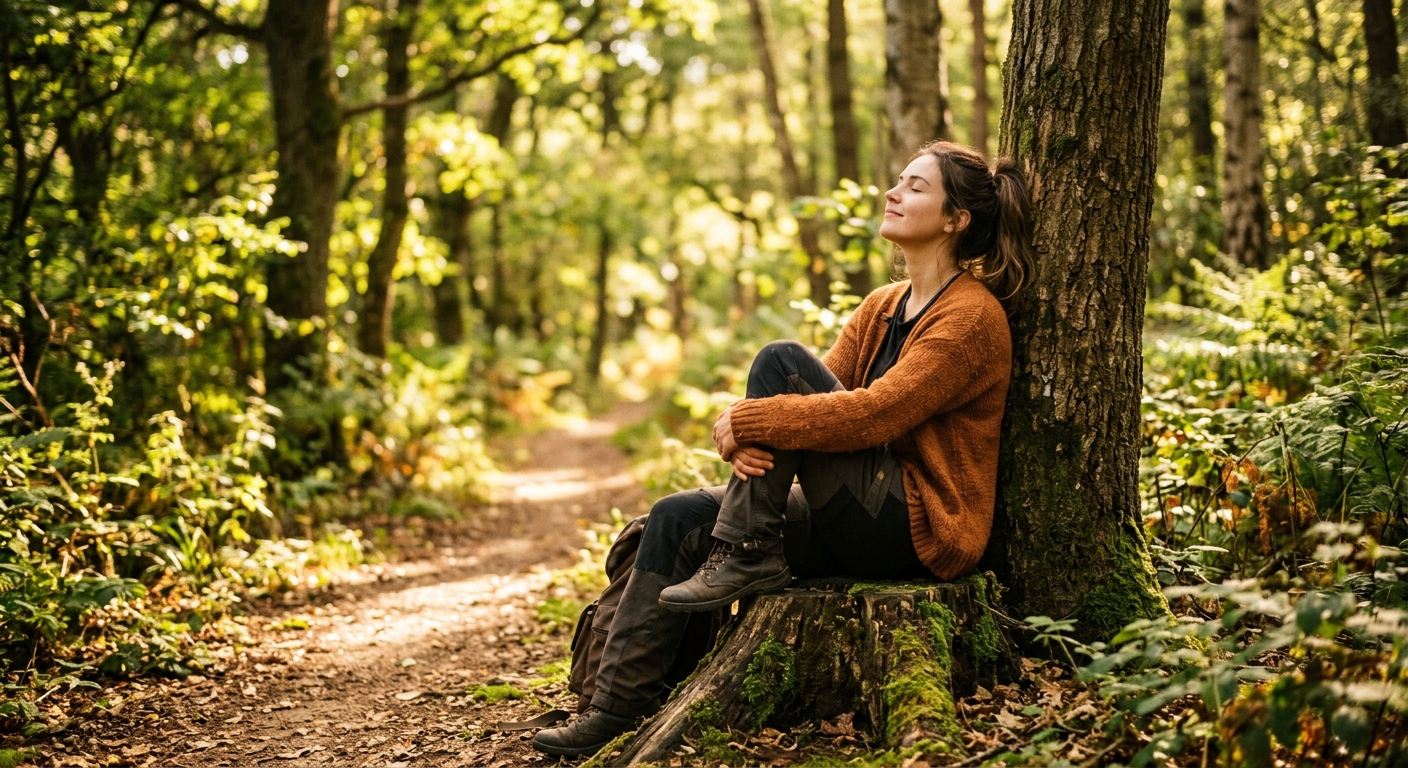
The practice is beautifully uncomplicated. You walk slowly through a natural wooded environment with no destination and no agenda. You engage your senses. You notice the texture of bark, the smell of damp earth, the way light filters through a canopy of leaves. You are not exercising. You are not meditating in any formal sense. You are simply being present inside a living ecosystem, and you let that ecosystem do its quiet, ancient work on your nervous system.
Research from Japanese scientists, including the pioneering work of Dr. Qing Li, has shown that spending time in forests measurably lowers cortisol levels, reduces blood pressure, boosts the activity of natural killer cells in the immune system, and significantly decreases feelings of anxiety and depression. These are not anecdotal wellness claims. These are peer-reviewed findings published in journals around the world.
My First Walk: Awkward, Slow, and Somehow Perfect
My first forest bathing session was deeply uncomfortable, and I say that with great affection for the experience. I drove forty minutes to a state forest near my home on a gray November morning, wearing the kind of hiking boots I had bought three years ago and worn twice. I had no guide. I had read a single article online and decided I was ready.
For the first twenty minutes, I felt ridiculous. I kept checking my phone. I kept calculating how long I had been walking and whether I was doing it correctly. My brain, trained by years of productivity culture, kept demanding output. What am I accomplishing? What is the point of this? I nearly turned back.
But then something happened that I still struggle to fully articulate. I stopped walking to look at a spider web strung between two branches, still holding the morning dew like a string of tiny pearls. I stood there for what must have been five full minutes. And in those five minutes, something inside my chest loosened, just slightly, like a knot that had been there so long I had forgotten it wasn’t supposed to be.
I kept walking. Slower this time.
What Changed Over the Following Months
I began going to that forest twice a week. Then three times. I started noticing things I had never noticed in my forty-one years on this planet. The way a stand of birch trees smells different after rain than before. The specific quality of silence that exists about a mile into dense woodland. The way your breathing naturally slows to match the pace of your footsteps when those footsteps have nowhere urgent to be.
Here is what shifted in my life over the six months that followed:
- My sleep improved dramatically. Within three weeks of regular forest bathing sessions, I was falling asleep without the white noise machine and the melatonin gummies I had relied on for two years.
- My relationship with my phone changed. I started leaving it in the car during my forest walks, and somehow that habit began bleeding into the rest of my day. I no longer felt the compulsive need to check it every eight minutes.
- I stopped glorifying busyness. This was the biggest shift. I had spent a decade treating exhaustion as a badge of honor, equating how tired I was with how important my work must be. The forest, in its extraordinary indifference to human productivity, taught me how absurd that equation really is.
- My creativity returned. Ideas started coming back, not the frantic, grasping ideas of a burned-out brain trying to perform, but genuine, curious ideas that arrived quietly, often mid-walk.
- I became a better listener. Spending time in an environment where everything communicates subtly, where you have to slow down and pay attention to understand what’s happening around you, turned out to be excellent training for human relationships.
The Science Behind Why This Works
One of the most fascinating aspects of forest bathing research involves phytoncides, the airborne chemical compounds that trees and plants emit as part of their natural defense systems. When we inhale these compounds, our bodies respond in measurable ways. Studies have shown that phytoncide exposure increases the production and activity of natural killer cells, which play a critical role in our immune response. This is why researchers sometimes describe forest air as literally medicinal.
Beyond phytoncides, there is the concept of Attention Restoration Theory, developed by environmental psychologists Rachel and Stephen Kaplan. Their research suggests that natural environments restore our capacity for directed attention, the kind of focused mental effort we rely on for work and decision-making, by engaging what they call “involuntary attention,” the soft, effortless noticing that happens when we watch clouds move or listen to water over rocks. Burnout, in many ways, is a depletion of directed attention. The forest replenishes it without asking anything in return.
How to Start Your Own Practice
You do not need to live near a national forest. You do not need special equipment or a certified guide, though guides can absolutely enhance the experience. You need a patch of trees, comfortable shoes, and a willingness to feel slightly purposeless for a little while.
A Few Principles to Begin With
- Leave your agenda at the trailhead. This is not exercise. There is no finish line. Give yourself a loose time frame, say 45 minutes to an hour, and let yourself wander within it.
- Engage all five senses intentionally. Touch the bark of a tree. Smell the soil. Listen for the layers of sound that exist when you stop making noise yourself.
- Put the phone away. This one is non-negotiable. The forest cannot compete with your notifications. Give it a fair chance.
- Go slowly enough to be bored. The boredom is the point. Push through the discomfort of having nothing to accomplish, and something remarkable often happens on the other side of it.
- Be consistent rather than intense. Two or three shorter sessions per week will do more for you than one long monthly hike.
A Practice That Became a Philosophy
Eighteen months after that first awkward walk, I no longer work as a marketing director. That is not entirely because of the forest, but the forest was certainly part of the conversation I started having with myself about what kind of life I actually wanted. I now consult part-time, write regularly, and spend a significant portion of each week outside.
I am not suggesting that forest bathing is a cure for burnout, or that walking among trees will solve systemic workplace problems, or that everyone can simply opt out of the grind that makes burnout so common in the first place. Those are real, structural issues that deserve serious attention.
What I am suggesting is this: the forest has been here far longer than the inbox, and it will be here long after it. There is wisdom in that patience, if you are willing to walk slowly enough to receive it.
Start small. Find your trees. Let yourself be still.
The rest has a way of sorting itself out.