
🎧 Listen to this story
Narrated by Schedar · 8,016 characters
The Day Everything Stopped
It was a Tuesday afternoon in late October when seventeen-year-old Maya Restrepo heard the words that would fracture her world more completely than the bones in her right leg ever could. She had been a competitive track and field athlete since the age of eleven, a sprinter with a natural gift that coaches described as “once in a generation.” She had college scouts calling. She had a future mapped out in lanes and finish lines and the smell of freshly cut grass on summer mornings.
Then came the accident.
During a regional qualifying meet, Maya landed awkwardly after a hurdle, her leg twisting beneath her at an angle that made everyone in the stadium go quiet. The compound fracture shattered not just her tibia and fibula, but also severely damaged the surrounding ligaments and nerve endings in ways that would take months to fully understand. The orthopedic surgeon was gentle but honest: the injury was extensive, the recovery uncertain, and the likelihood of returning to competitive sprinting was, in his professional estimation, very low.
“Very low” is a phrase that lives in a strange space. It is not impossible. But for a seventeen-year-old who had never known a version of herself that did not run, it felt like a door being quietly shut in her face.
The First Months: Learning to Be Still
What nobody tells you about recovering from a serious athletic injury is that the hardest part is not the physical pain. It is the silence. Maya had spent years filling every afternoon with practice, competition, travel, and the rhythm of a life built around motion. Suddenly, she was confined to a hospital bed, then a wheelchair, then crutches, with nothing but time and the creeping fear that she had already experienced the best version of herself.
“I cried every single day for the first two months,” Maya recalled in a conversation with her school’s athletic director, who later shared the story with her permission. “Not because of the pain. Because I didn’t know who I was without running.”
Her parents, both working multiple jobs to cover the mounting medical bills, did their best to keep spirits high. Her younger brother drew cartoons of her winning races and taped them to her bedroom wall. Her teammates visited on weekends, sometimes just sitting with her and watching movies, not always knowing what to say but showing up anyway.
It was during this period of enforced stillness that Maya began journaling, something she had never had time for before. She wrote about her fears, her frustrations, and slowly, tentatively, her goals. One entry, written about six weeks after surgery, simply read: “I am not done. I don’t know how I know that, but I do.”
The Long Road Back: What Recovery Actually Looks Like
Real recovery is rarely cinematic. It does not happen in a two-minute training montage set to an upbeat song. For Maya, it looked like this:
- Months one through three: Non-weight-bearing rest, wound management, and the painstaking early stages of physical therapy focused on reducing swelling and preventing muscle atrophy.
- Months four through six: Gradual reintroduction of weight-bearing exercises, pool therapy, and rebuilding basic mobility. Maya describes this phase as “learning to trust my own leg again.”
- Months seven through nine: Strength training, balance work, and the first tentative jogs on a treadmill. Her physical therapist, a no-nonsense woman named Dana Polachek, pushed her hard but also knew when to pull back.
- Months ten through twelve: Return to outdoor running, working with her original coach to rebuild her sprinting form from the ground up, accounting for subtle changes in her gait caused by the nerve damage.
There were setbacks. A minor re-injury in month five sent her back to square one for several weeks. There were days when she skipped therapy because she could not face it, and then felt guilty, and then went back. There were arguments with her parents about pushing too hard. There were conversations with a sports psychologist that she initially resisted and later called “the most important thing I did.”
The Role of Mental Health in Physical Recovery
This is something that often goes undiscussed in stories about athletic comebacks: the psychological dimension is just as demanding as the physical one. Maya’s sports psychologist, Dr. Irene Castillo, worked with her on managing performance anxiety, rebuilding confidence, and addressing what she describes as a quiet but persistent fear of re-injury that can derail even the most physically healed athletes.
“Athletes who have suffered serious injuries often develop a psychological pattern where they subconsciously protect the injured area, even after it has fully healed,” Dr. Castillo explained. “This can alter mechanics, slow reaction times, and actually increase the risk of future injury if it is not addressed directly.”
For Maya, this meant visualization exercises, gradual exposure to competitive settings, and honest conversations about what competing meant to her now, after everything she had been through. The answers surprised her.
A Different Kind of Athlete Emerges
When Maya returned to the track for the first time in a competitive capacity, thirteen months after her injury, something had shifted. She was not the same runner she had been before, and she had made a kind of peace with that. Her times were slower. Her form had adapted. But the coaches watching her that day noticed something else: a composure, a groundedness, a quality of presence that younger, untested athletes rarely possess.
“She runs like she knows something now,” her coach, Marcus Webb, said afterward. “She used to run with pure instinct. Now she runs with instinct and intention. That is a rare combination.”
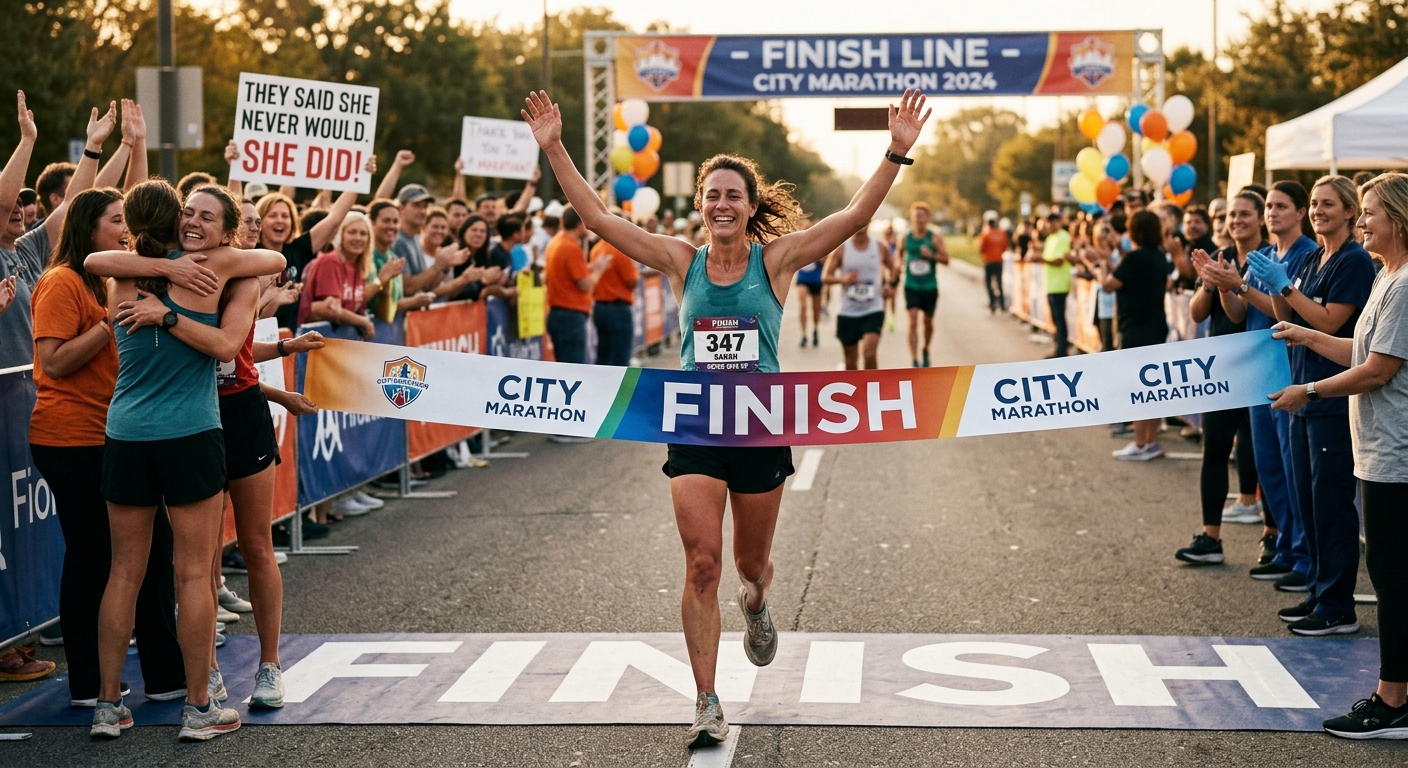
Maya did not win her first race back. She finished fourth. She cried in the infield afterward, and not from disappointment. She cried because she was there at all.
7 Things Maya’s Journey Teaches Us About Resilience
- Identity goes deeper than what we do. Losing a defining activity forces a reckoning with who we are beneath our roles and achievements. That reckoning, while painful, can be genuinely clarifying.
- Stillness is not wasted time. Maya’s months of enforced rest produced a self-awareness she might never have developed otherwise. Sometimes, stopping is where we start to understand.
- Asking for help is not weakness. From her physical therapist to her sports psychologist to her teammates who just showed up on weekends, Maya’s recovery was a collective effort.
- Setbacks within setbacks are normal. Recovery is not linear. Expecting it to be sets us up for unnecessary despair when inevitable bumps occur.
- Redefining success opens more doors than closing them. Maya had to release her old benchmarks and find new ones. That flexibility made her comeback possible.
- Mental health is physical health. Healing the mind and healing the body are not separate processes. They are the same process running on parallel tracks.
- Showing up, imperfectly, is enough. Fourth place, after a year of pain and doubt and quiet determination, was one of the greatest athletic achievements of Maya’s life so far.
Where She Is Now
Maya Restrepo is eighteen years old. She has since competed in six more meets, improving her times with each one. She has begun mentoring younger athletes at her school who are dealing with injuries of their own, sitting with them in the way her teammates once sat with her, not always knowing what to say, but showing up anyway.
She did receive a partial athletic scholarship offer from a mid-size university, not the Division I full ride she had dreamed of at fifteen, but an opportunity she says she values more because she understands now what it cost to get there.
And she still journals. On the first anniversary of her injury, she wrote one line: “It broke me open and I found more inside than I knew was there.”
That, perhaps, is the truest thing anyone can say about the long, unglamorous, quietly extraordinary work of coming back.