
🎧 Listen to this story
Narrated by Sadachbia · 7,912 characters
The Courtroom Nobody Expected Her to Enter
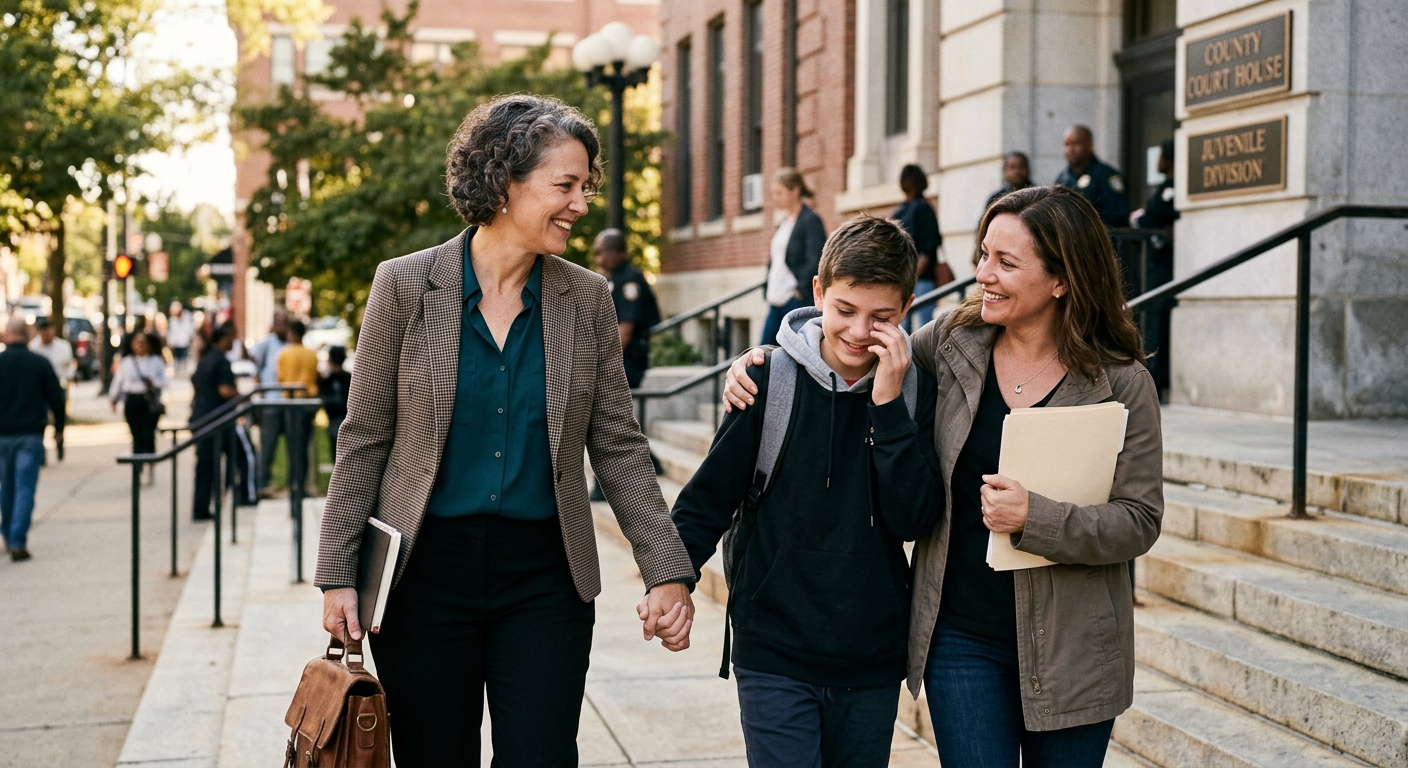
The first time Maria Delgado walked into a juvenile courtroom, she did not have to be there. Nobody had asked her to come. There was no policy requiring it, no overtime pay attached to it, and no line in her job description that said anything about wooden benches, fluorescent lighting, and the particular silence that falls over a room when a child’s fate is being decided by strangers in robes.
She came because a 14-year-old boy named Carlos sat at that defendant’s table with no family in the gallery behind him. She had heard about the hearing from a clerk she knew. She had driven 40 minutes after school. And when Carlos turned around and saw her face, he started to cry.
That was 15 years ago. Maria has not missed a single student’s court date since.
What ‘Showing Up’ Actually Means
Maria Delgado is a school counselor at Jefferson Middle School in a mid-sized city in the American Southwest. She works with roughly 280 students a year. A subset of those students, at any given time, are navigating the juvenile justice system for offenses ranging from truancy violations to more serious charges. For every single one of them, Maria finds out when their court date is scheduled, puts it on her personal calendar, arranges coverage for her school duties, and goes.
She sits in the gallery. She does not speak unless asked. She does not carry a sign or wear a shirt with a slogan. She brings nothing except her presence and, sometimes, a letter she has written to the judge describing the student’s progress, strengths, and circumstances at school.
“I am not there to fix the legal situation,” she says. “I am there so that child does not feel invisible. Because the moment a kid feels invisible in a system that is deciding their future, something breaks in them. And it is very hard to put back together.”
The Numbers Behind the Commitment
Over 15 years, Maria estimates she has attended more than 340 court appearances. She has driven as far as 90 miles for a single hearing. She has taken personal days, unpaid leave, and vacation time to make it work. She has sat in courtrooms during rainstorms, on holidays, and once, the week after she had knee surgery, arriving on crutches and finding a seat in the back row before the bailiff could suggest she leave.
She has never once been reimbursed for mileage.
She does not mention any of this to the students. She does not want them to feel like a burden. She simply appears. And in a world where many of these kids have learned that the adults around them will eventually disappear, her consistent appearance has become something close to a miracle.
What the Students Say
For a 2023 profile written by a local education reporter, several of Maria’s former students spoke about what it meant to see her in that courtroom. Their words are worth reading slowly.
“I thought I had dreamed it at first. I looked back and she was just sitting there in her work clothes with her little notebook. I remember thinking, she drove all the way here for me. I hadn’t done anything to deserve that. But she came anyway.” – Former student, now 22
“My mom couldn’t make it. My dad wasn’t around. I was sure I was going to walk in there completely alone. And then I saw her and I stood up a little straighter. I wanted to be worthy of the fact that she was there.” – Former student, now 19
“She never made a big deal out of it afterward. Never said ‘I was there for you.’ She just asked how I was doing and what I needed next. That’s when I understood what real support looks like.” – Former student, now 24, currently studying social work
The Letters That Changed Outcomes
Several juvenile court judges in the region have come to recognize Maria by sight. One judge, who spoke on background to protect the privacy of the cases involved, described the letters Maria submits as unlike anything else that crosses his bench.
“Most character letters are generic,” he said. “They say the child is good, that they had a hard life, that they deserve a chance. Maria’s letters are specific. She writes about the exact conversation she had with a student on a specific Tuesday. She references a moment in class when something shifted. She writes about who this child is as a person, not just as a defendant. Those letters carry weight.”
At least four families have told Maria that her letter was cited directly by the judge in the sentencing or diversion decision. In each case, the outcome was more favorable than initially expected.
How She Keeps Going
People ask Maria frequently whether 15 years of this work has worn her down. Whether the emotional weight of watching children face adult-sized consequences has cost her something she cannot get back. She thinks carefully before she answers.
“It has cost me something,” she admits. “But it has given me more back. Every time I see a kid who was in that courtroom come back to school and actually try, something fills back up in me. The cost is real. But so is the return.”
She also credits a strong support system: a partner who has never once complained about a rearranged weekend, two colleagues who cover her caseload without resentment, and a school principal who quietly approved her schedule flexibility years ago and has never withdrawn it.
“I could not do this alone,” she says. “Anyone who tells you that sustained compassion is a solo act is lying to you. It is a team sport.”
What Other Educators Can Learn From Maria
Maria is not asking every counselor, teacher, or administrator to start attending court dates. She knows that is not realistic or even always appropriate. What she does believe, and what she will say plainly if you ask her, is that there are versions of this kind of showing up available to every person who works with young people.
- Show up to the things nobody requires you to attend. The recital, the game, the ceremony at the community center. Presence is powerful precisely because it is chosen.
- Write the specific letter, not the generic one. When a student needs an advocate, be the person who takes the time to know them well enough to say something true and particular about them.
- Ask directly what a student needs, rather than assuming. Maria says the most important question she has ever learned to ask is simply: “What would help you most right now?”
- Let students see that your care has no conditions attached. Many at-risk youth are waiting for the moment when the adult in their life proves that their support was always transactional. Refuse to give them that moment.
- Build a support structure around your compassion. Sustainable care requires infrastructure. Ask for the schedule flexibility, the coverage, the institutional backing. You cannot pour from an empty cup and you should not have to.
A Quiet Kind of Legacy
Maria Delgado does not have a foundation named after her. She is not on any list of national honorees, though those who know her work think she should be. She has a small office with a cactus on the windowsill and a bulletin board covered in drawings from former students. One of those drawings, done in crayon by a kid who is now a firefighter, shows a courtroom. In the back row, there is a small figure with brown hair. Underneath it, in unsteady child’s handwriting, are the words: “She was there.”
That is the whole story, really. Three words that mean everything.
She was there. She is still there. And somewhere right now, a child at a defendant’s table is turning around and finding her face in the crowd, and something in them is deciding to try a little harder because of it.
Not because she is extraordinary, though she is. But because she made a decision 15 years ago to never let a student face a hard moment alone, and she has kept that promise every single time. That is not a superpower. That is a choice. And choices, made consistently over a long period of time, become something that outlasts us all.