🎧 Listen to this story
Narrated by Orus · 8,085 characters
The Fields That Fed Two Worlds
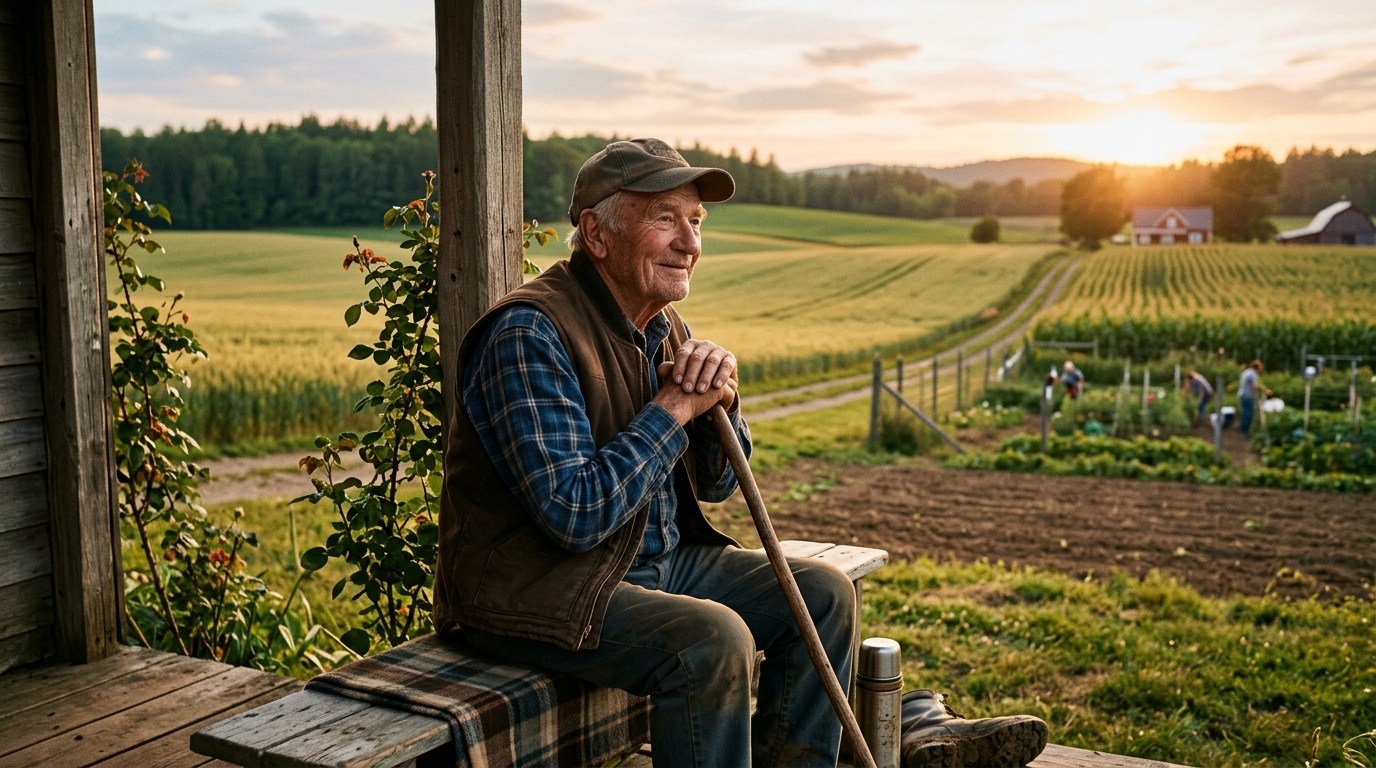
Every autumn, when the combine harvesters rolled across the flat, golden fields of central Nebraska, Earl Hutchins did something that made his neighbors shake their heads in quiet disbelief. He divided his harvest in two. One half went to market, to pay the bills, keep the lights on, and put fuel in the tractors. The other half went to strangers he would never meet, stacked in crates and loaded onto refrigerated trucks bound for food banks across three counties.
He did this for thirty years. Without fanfare. Without a press release. Without ever once asking for a thank-you.
This is his story, and it belongs to all of us.
Where It All Began: A Hungry Winter in 1993
Earl did not start out as a philanthropist. He started out as a struggling farmer in his early thirties, inheriting a property that was more debt than dirt. His father had passed unexpectedly, leaving Earl with 500 acres of farmland, two aging tractors, and a mortgage that felt like a stone tied around his neck.
The winter of 1993 was particularly brutal. A drought had cut yields across the region, and Earl found himself at a community meeting where local officials were discussing a food shortage crisis at three regional food banks. Shelves were running low. Families were going without. A church elder stood up at the meeting and said something that Earl has quoted in the years since:
“We are surrounded by farms and yet people here go to bed hungry. Something about that equation is broken.”
Earl went home that night and could not sleep. He walked out to his barn, looked at the surplus grain he had stored from a modest but decent season, and made a decision. He loaded up his truck and drove it to the food bank the next morning. He did not make a grand announcement. He just showed up.
That first donation was roughly a quarter of his surplus. By the following year, it was half. And it stayed that way for three decades.
How It Actually Worked: The Logistics of Generosity
People often assume that donating half a harvest is a simple act. It is not. It requires planning, coordination, and a willingness to absorb real financial cost.
Over the years, Earl developed a system that became remarkably efficient. Here is how it worked:
- Pre-harvest planning: Each spring, Earl would contact the regional food bank network to understand what was most needed, whether that was corn, soybeans, potatoes, or squash. He would adjust what he planted accordingly.
- Designated rows: Earl physically marked sections of his fields as “bank acres,” a term his farmhands adopted with genuine pride. These rows were harvested separately and never counted toward market projections.
- Cold storage partnerships: He worked with two neighboring farms to share refrigerated storage space, allowing perishable produce to be delivered in batches rather than all at once, reducing waste significantly.
- Volunteer harvest days: In the late 1990s, Earl began hosting annual volunteer days where local families could come out and help with the bank-acre harvest. At its peak, over 80 volunteers would show up on a single Saturday.
Over thirty years, conservative estimates suggest Earl donated the equivalent of over 2.4 million pounds of food. Food bank directors in the region describe his contributions as foundational, not supplemental.
“Didn’t It Cost You Everything?”
The most common question people ask Earl is whether the donations hurt him financially. It is a fair question, and he answers it honestly.
“Some years were tight,” he admits. “There were years where I wondered if I’d made the right call. My wife Dorothy, bless her, she never once told me to stop. She’d look at the numbers and say, ‘We’re fine, Earl. We’re fine.’ She kept the books and kept the faith at the same time.”
Dorothy passed away in 2018 after 44 years of marriage. Earl continued donating through his grief, perhaps because it was the one routine that kept him connected to the man they had built together. “The farm was always ours,” he says. “Even now, it still feels like ours.”
What Earl discovered, and what surprised even him, was that the act of giving seemed to generate its own kind of return. Not mystically, but practically. His reputation in the farming community attracted favorable supplier relationships. Volunteers who came to help on harvest days sometimes became long-term seasonal workers. Local media coverage, which he never sought, brought young agricultural students to apprentice on his land.
“I never gave to get,” he is careful to say. “But I want to be honest: giving did not ruin me. It rounded me out.”
What 30 Years of Generosity Looks Like From the Inside
To understand the full weight of what Earl built, consider a few moments that those around him describe as quietly extraordinary:
The Letter from a Stranger
In 2007, Earl received a handwritten letter from a woman named Patricia, who had been a single mother in 1995. She wrote to tell him that a food bank in Kearney, Nebraska had provided her family with corn and potatoes through an especially desperate winter. She had no way of knowing where the food came from, until a volunteer at the food bank told her about “the farmer who gives half.” She tracked down Earl’s address and wrote to say that her son, now grown, was studying agriculture at the University of Nebraska. “He wants to be a farmer,” she wrote. “I think because somewhere deep down, he remembers that farmers are the people who saved us.”
Earl keeps the letter in his desk drawer. He has read it more times than he can count.
The Year He Almost Stopped
In 2012, a combination of drought and equipment failure made it the hardest farming year of Earl’s life. He told his daughter that he was considering scaling back the donation that year, maybe dropping to a quarter rather than half. She listened, nodded, and then drove out to the field herself and started marking the bank acres. “She didn’t say a word,” Earl recalls. “She just picked up the flag stakes and started walking. What could I do? I followed her.”
The Community That Grew Around the Idea
By 2015, six other farms in Earl’s county had adopted a version of his model, donating anywhere from ten percent to thirty percent of their harvests to local food networks. None of them were prompted by an organization or a government initiative. They were inspired by watching one man do it, year after year, without needing recognition to continue.
What We Can Learn From Earl Hutchins
Earl’s story is not a call for everyone to give away half of what they earn. It is something more nuanced than that. Here are the lessons that seem to ripple outward from his thirty years of quiet commitment:
- Consistency outlasts inspiration. Earl was not always inspired. Some years felt like obligation. But he showed up anyway, and that consistency built something no single grand gesture ever could.
- You do not need permission to start. No one appointed Earl. No committee approved his plan. He saw a need, had a resource, and connected them.
- Generosity is a practice, not an event. Like any skill, it deepens with repetition. The Earl of 2023 gave with a different quality of intention than the Earl of 1993. The action looked the same, but the man had grown into it.
- The people around you will define your legacy. Dorothy’s quiet bookkeeping. His daughter’s silent flag-staking. The volunteers who showed up every harvest Saturday. Earl did not do this alone, and he will be the first to tell you so.
The Farm Today
Earl is now in his mid-sixties. His son James has taken over primary management of the farm, and the half-harvest donation continues. James grew up on bank-acre Saturdays and considers the practice as natural as crop rotation.
When asked if he plans to stop anytime soon, Earl laughs and says simply, “The fields are still producing. The shelves still need filling. So no. I don’t see any reason to stop.”
And somewhere across three counties, families who will never know his name will sit down to a meal that his fields made possible. That, Earl Hutchins would tell you, is more than enough.