
🎧 Listen to this story
Narrated by Aoede · 8,701 characters
The Experiment That Started With a Sticky Note
It began, as most strange ideas do, at 2 a.m. on a Tuesday. I was lying in bed scrolling through old photos when I stumbled across a picture of my college mentor, Dr. Patricia Wynn, at my graduation. She was beaming. I was in a cap and gown, holding a rolled-up diploma like I had just won something. And I realized, with a slow-sinking feeling in my chest, that I had never properly thanked her. Not once. Not in fifteen years.
That single realization spiraled into a question I could not shake loose: How many people had shaped my life without ever hearing me say thank you?
So I did what any sleep-deprived overthinker would do. I grabbed a notebook, started listing names, and by morning I had forty-three of them. Teachers. Neighbors. Coworkers. The nurse who held my hand during a procedure when no one else was there. My little brother, who once drove four hours in a snowstorm just because I asked him to. My college roommate who never once complained when I stress-cleaned the apartment at midnight.
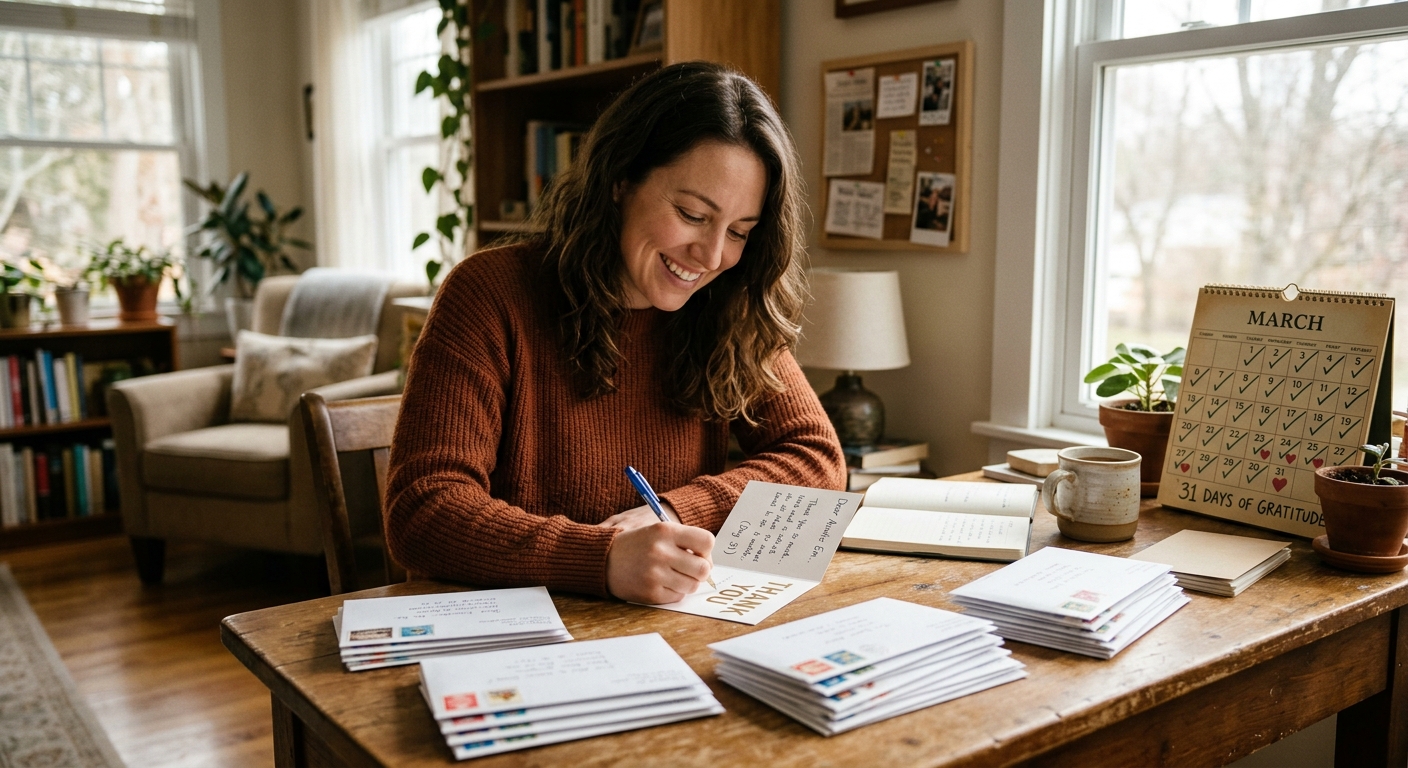
I decided to write a handwritten thank you note to as many of these people as I could, every single day for one month. No emails. No texts. Real paper, real pen, real stamps. And I decided to document what happened, not just for them, but for me.
Here is what I learned.
Lesson 1: Gratitude Has a Memory Problem
When I sat down on day one to write to Dr. Wynn, I assumed it would take ten minutes. It took forty-five. Not because I did not know what to say, but because once I started remembering, I could not stop. The afternoon she rewrote my entire thesis outline with me on a whiteboard. The time she emailed me at 11 p.m. to say she was proud of me. The recommendation letter she wrote that she never let me read.
We are surprisingly bad at holding onto gratitude over time. Life moves fast, and the people who help us fade into the background of our own story. We become the hero of our narrative, and quietly, the supporting cast disappears from the credits.
Writing these notes forced me to remember, and remembering was its own form of healing.
Lesson 2: The People Who Expected Nothing Are the Ones Who Did the Most
This one caught me off guard. As I moved through my list, I noticed a pattern. The people who had the most profound impact on my life were almost never people who were paid to care about me or who had any formal obligation to help. They were the ones who showed up anyway.
My neighbor growing up, Mrs. Callahan, who used to leave a plate of food on our porch during the weeks my mother was in the hospital. She never knocked. She never asked for thanks. She just left the food and walked back home. When I wrote to her, now in her eighties, she called me three days later and cried for most of the conversation. She said she had not thought about those years in a long time and was not sure anyone had ever noticed.
People who expect nothing in return are doing the purest kind of kindness. And they are often the most invisible.
Lesson 3: Writing It Down Changes the Way You Feel It
There is real science behind this. Researchers at the University of Pennsylvania found that writing a detailed gratitude letter and delivering it in person is one of the most effective interventions for boosting happiness, more so than almost any other positive psychology exercise. But even without the delivery, the act of writing alone activates something different in the brain than just thinking grateful thoughts.
When I typed things out, it felt efficient. When I wrote them by hand, it felt like I was building something. Each sentence required a choice. I had to decide what mattered most, what detail to include, which memory to anchor the whole thing around. It was slow and deliberate, and that deliberateness is exactly what made it powerful.
By week two, I noticed I was sleeping better. I was less irritable in traffic. I was kinder at the grocery store. I do not think that was a coincidence.
Lesson 4: Some Thank Yous Will Arrive Too Late, and That Is a Lesson Too
Three people on my list had passed away.
My high school English teacher, Mr. Brennan, who told me I was a writer before I believed it myself. My grandfather, who taught me to cook and to listen. And a childhood friend who died in his thirties and who had once, in middle school, defended me in front of a crowd when no one else would.
I wrote the letters anyway. I wrote to Mr. Brennan’s daughter, who found me on social media after I mailed the note to the school. She said her father had kept every card and letter from former students in a shoebox, and she wished she could add mine to it. She told me stories about him that I had never known, and by the end of our email exchange, I felt closer to a man who was gone than I had when he was alive.
The lesson: do not wait. Do not assume there will be a better time, a more appropriate occasion, a moment when it will feel less awkward or less vulnerable. There may not be one.
Lesson 5: Receiving Gratitude Is Its Own Kind of Hard
I did not expect this, but a handful of people on my list reached back out, and several of them told me that receiving the note was genuinely difficult. Not in a bad way, but in a disorienting way. One former coworker told me she had to read my letter three times because she kept dismissing what I was saying as exaggeration. Another person said they sat with it for a week before they could respond because they did not know how to accept that they had mattered that much.
We are not always good at being thanked. We deflect, we minimize, we say things like, oh, it was nothing, or anyone would have done that. But not anyone did. You did. And accepting that you were genuinely helpful to someone is a form of self-respect that many of us have not practiced enough.
Lesson 6: Gratitude Is Not a Feeling, It Is a Practice
Before this experiment, I thought of gratitude as something that happened to me, an emotion that arose when something good occurred. A warm fuzzy feeling at Thanksgiving, a brief swell of appreciation after good news. But writing a note every single day for a month taught me that gratitude is not passive. It is a skill you build.
Some days the notes flowed easily. Other days I sat at my desk for twenty minutes before I could begin. On those days, the act of starting, of putting pen to paper and committing to finding something specific and true and worth saying, was a kind of discipline. Like going to the gym when you are tired. You do not always feel like it. But you always feel better after.
What the Month Looked Like: A Quick Breakdown
- 31 notes written. I fell behind twice and wrote two in a day to catch up.
- 23 people responded, by phone, email, social media, or another letter.
- 4 relationships were meaningfully reconnected, people I had not spoken to in years and am now back in contact with.
- 3 notes went to people who had passed away, with at least one reaching a family member who treasured it.
- 2 people told me the note came at a moment they desperately needed it.
- 1 person told me it changed how they saw themselves.
How to Start Your Own Thank You Note Practice
You do not have to commit to a month. You do not have to do it every day. But if you are sitting with this and feeling that same slow-sinking recognition I felt at 2 a.m. looking at that old photo, here is how to begin.
Start with one name
Think of one person who helped you and never heard you say so. Just one. Write down their name and one specific thing they did.
Be specific
Vague gratitude feels like a form letter. Tell them the exact thing they did, the exact moment you remember, the exact way it affected you. Specificity is what makes a thank you land.
Send it the way that feels real
Handwritten is powerful, but an email sent is better than a handwritten note never mailed. The goal is for it to reach them, not to be perfect.
Do not expect anything back
Some people will not respond. That is okay. The note was true when you wrote it, regardless of what happens after.
Final Thoughts: The Month That Changed the Way I See My Own Life
I started this experiment because I felt guilty about not thanking one person. I ended it with a completely different understanding of my own story. Every single note reminded me that I had not gotten here alone. Every life is built, at least in part, by the quiet generosity of people who showed up at the right moment.
If you have a list of names floating in the back of your mind, people you mean to thank someday, I would gently suggest that someday should be today. Get out a piece of paper. Write one name at the top. And begin.
Because the people who helped you deserve to know. And honestly? So do you.