
🎧 Listen to this story
Narrated by Gacrux · 6,902 characters
A Routine Traffic Stop That Became Anything But Routine
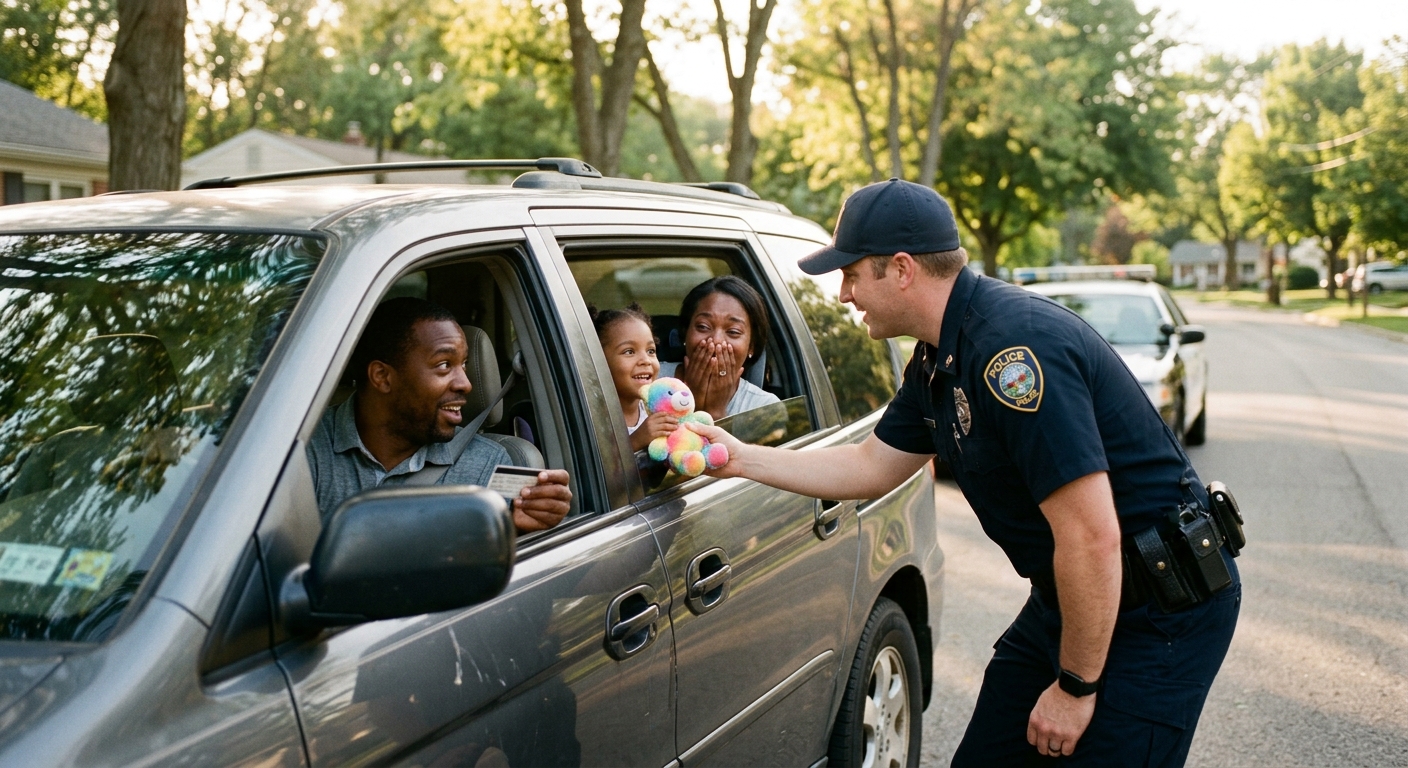
It started like hundreds of other calls on a Tuesday afternoon in a small town outside of Memphis, Tennessee. Officer Daniel Reeves was running plates on a stretch of road near the local Kroger when his scanner flagged a silver minivan with expired registration tags. Standard stuff. He flipped on his lights, the van pulled over, and Reeves walked up to the driver’s side window expecting the usual exchange: license, registration, explanation, ticket.
What he found instead stopped him cold.
Behind the wheel was a woman named Sandra Hollis, 34, her hands trembling slightly as she fumbled through her glove compartment. In the back seat sat three children under the age of eight, one of them quietly humming to herself while clutching a stuffed rabbit. On the passenger seat was a single canvas grocery bag, nearly empty, and a handwritten shopping list.
‘I knew right away something wasn’t right,’ Reeves later told a local news reporter. ‘Not dangerous, just… heavy. Like the weight in that car wasn’t coming from the kids.’
What She Told Him She Could Not Say Out Loud
Sandra explained that she had been aware of the expired tags for weeks. She knew she was risking a ticket every time she drove. But the registration fee, a little over $80, was the difference between renewing her tags and putting food on the table that week. Her husband had been laid off two months prior. They were waiting on an assistance application to process. The tags had to wait.
‘She wasn’t making excuses,’ Reeves said. ‘She was just telling me the truth. And I could see it. The kids were quiet, the kind of quiet that kids get when they sense something stressful is happening. And she just looked exhausted in a way that sleep doesn’t fix.’
Reeves asked her to stay put. He walked back to his cruiser. He sat there for a moment.
He did not write the ticket.
The Decision That Took About 30 Seconds
Instead, Officer Reeves drove Sandra and her kids to the Kroger they had been heading to. He grabbed a cart, told her to get what her family needed for the week, and paid for everything himself at the register. The total came to $167.43. He also slipped her a card with the number of a local nonprofit that helps families cover vehicle registration and utility costs in emergency situations.
He told her to drive carefully. He got back in his cruiser and finished his shift.
He did not post about it. He did not call the news. He did not tell his sergeant. Sandra, overwhelmed with gratitude, eventually shared the story on a community Facebook group and it spread from there, reaching regional news outlets within 48 hours.
Why This Story Hits Differently
Stories of police officers performing acts of kindness circulate regularly, and that is genuinely wonderful. But this particular story resonates for a few specific reasons that are worth unpacking.
1. He Used His Discretion Quietly
Reeves had every legal right to issue that ticket. He chose not to, and he did not make a show of it. There was no lecture, no ‘you’re lucky I’m letting you off.’ He simply assessed the full human picture in front of him and responded accordingly. That kind of discretion, exercised without ego, is rare and worth celebrating.
2. He Addressed the Actual Problem
A fine would have made Sandra’s situation measurably worse. Groceries made it measurably better. He didn’t just withhold a punishment, he provided something real. That is a meaningful distinction. It shows a kind of practical empathy, the ability to ask not just ‘what does the law allow me to do here?’ but ‘what does this person actually need right now?’
3. He Connected Her to Ongoing Help
The card he handed her was arguably the most important thing he did. One grocery run changes a week. A connection to a resource that helps families bridge financial gaps can change months. That detail reveals a level of thoughtfulness that goes well beyond a spontaneous generous gesture.
What Sandra Says Now
Sandra agreed to speak publicly after the story gained attention, though she was initially reluctant. ‘I was embarrassed at first,’ she admitted. ‘You don’t want people to know you can’t buy your own groceries. But then I thought, if someone else is sitting in a parking lot crying because they can’t make things stretch, and this story helps them feel less alone, then I’ll talk.’
Her husband found work within six weeks of that afternoon. The family’s registration is current. Sandra volunteers twice a month at the same nonprofit Reeves pointed her toward.
‘He gave us a week,’ she said. ‘But more than that, he gave me back a little bit of my dignity at a moment when I felt like I had none left. That’s not a small thing. That’s everything.’
The Ripple Effect in the Community
After the story circulated locally, something interesting happened. Three other families in the same county quietly contacted that nonprofit using the same referral language Reeves had used when he handed Sandra the card. Two of them specifically mentioned hearing about it from ‘the grocery story.’ The organization’s executive director, Patricia Wald, noted a 22 percent spike in first-time callers in the month following the news coverage.
‘People see a story like this and it gives them permission to ask for help,’ Wald said. ‘The shame around financial hardship is so powerful. When someone shows up and says, without judgment, here is a resource, here is a hand, it opens a door that pride usually keeps shut.’
What We Can All Take From This
You do not have to be a police officer to do what Daniel Reeves did. You do not need a badge or a cruiser or a uniform. What you need is the willingness to look at the full picture of another person’s life before deciding how to respond to them. You need to ask, even silently, what is actually going on here, and what can I actually do about it?
Sometimes that means paying for someone’s groceries. Sometimes it means not sending an angry email when someone misses a deadline. Sometimes it means asking a coworker if they’re okay instead of just noting that their work has slipped. The gesture changes. The instinct is the same.
- Look past the surface behavior to the circumstances underneath it.
- Use whatever authority or resources you have with generosity, not just by the rulebook.
- Connect people to ongoing support, not just a single act of relief.
- Do the kind thing without requiring recognition for it.
- Understand that dignity is sometimes the most valuable thing you can give someone.
A Final Note on Officer Reeves
When reporters asked Reeves how he felt about all the attention the story received, he was characteristically understated. ‘I just did what felt right in the moment,’ he said. ‘I hope people aren’t making it bigger than it is. It was groceries. Anyone could have done it.’
Maybe. But not everyone did. He did. And that, in the end, is the whole point.