🎧 Listen to this story
Narrated by Orus · 8,655 characters
One Pair of Needles. One Mission. Ten Thousand Lives Touched.
When Margaret Ellison retired from her job as a school librarian in 2009, most people assumed she would slow down. Take up gardening, maybe. Travel a little. Read the stacks of novels she had been putting off for decades. Nobody, least of all Margaret herself, predicted that her next chapter would involve yarn, knitting needles, and the tiniest, most fragile humans imaginable.
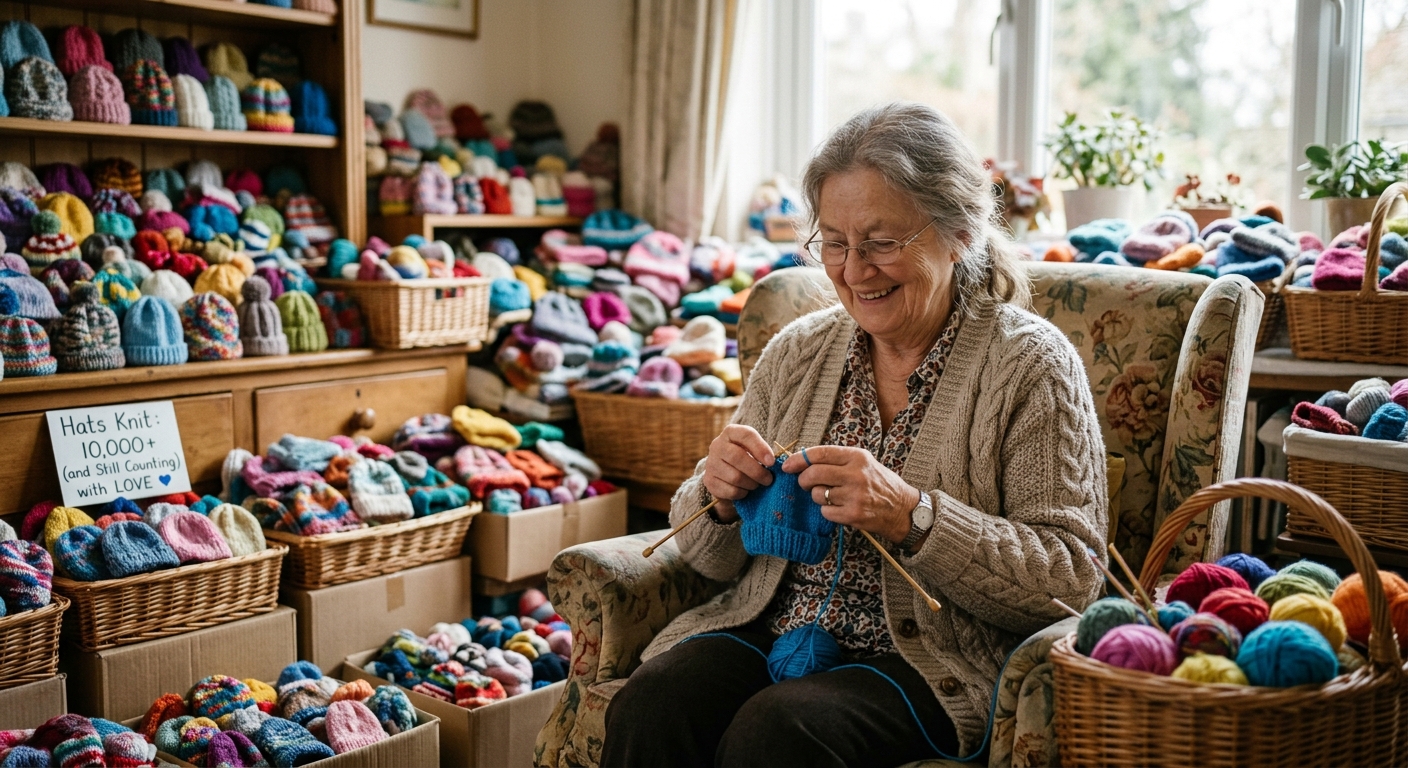
To date, Margaret has hand-knitted more than 10,000 hats for premature babies in neonatal intensive care units across the United States. That number is not a typo. Ten thousand. Each one carefully crafted, each one delivered with a handwritten note, and each one placed on the head of a baby fighting hard to survive outside the womb before the world was quite ready for them.
This is her story, told in her own words and through the eyes of the nurses, parents, and hospital volunteers who have watched her work change lives, one tiny hat at a time.
How It All Started: A Premature Grandson and a Grandmother’s Helplessness
“I remember sitting in that waiting room and feeling completely useless,” Margaret told us during a visit to her home in Asheville, North Carolina, where three large baskets overflowing with soft yarn sat beside her favorite armchair. “My grandson Eli was born at 28 weeks. He weighed one pound, fourteen ounces. The doctors were wonderful, the nurses were incredible, but I was just this grandmother standing outside a glass window with nothing to offer.”
A nurse suggested that the NICU accepted hand-knitted hats. Premature babies struggle to regulate their own body temperature, and something as simple as a well-fitted, soft hat can make a measurable difference in keeping them warm. The hats also carry something harder to measure: the sense that someone, somewhere, cared enough to make something by hand just for them.
Margaret had not knitted since her own children were young. She dug out her old needles that same evening.
“I made Eli’s first hat in about three hours. It was a little lopsided. The yarn was this soft yellow I had found in the back of a drawer. I cried the entire time I made it.” She pauses here, smiling at the memory. “But when they put it on him, I stopped crying. He looked so real. So present. Like a whole person who had decided to stick around.”
Eli is now fourteen years old and plays on his middle school soccer team.
From One Hat to a Movement: The Logistics of Love
After Eli came home, Margaret assumed her knitting days were finished. But the NICU nurse who had first suggested the hats reached out a few weeks later. They were running low on donations. Could Margaret make a few more?
She could. She did. And she has not stopped since.
By 2012, she was producing roughly 40 hats per month. By 2015, she had connected with a network of other volunteer knitters who she coordinates through a simple email list she calls “The Warmth Circle.” Today, the circle includes over 60 volunteers across 11 states, but Margaret remains the anchor, personally knitting between 20 and 30 hats every single week.
Her process is organized with the precision of someone who spent decades managing a library catalog.
- Yarn selection: Only 100% cotton or merino wool is used. No synthetic blends, which can irritate a premature baby’s skin.
- Sizing: Hats are knitted in five sizes, ranging from micro-preemie (for babies under two pounds) to standard NICU size.
- Quality check: Every hat is inspected for loose ends or uneven stitches before it leaves her hands.
- The notes: Each hat comes with a small card that reads, simply: “Made with love. You are stronger than you know.”
- Distribution: Hats are delivered monthly to seven hospital NICUs in North Carolina, Tennessee, and Virginia, with additional shipments sent to partner hospitals by Warmth Circle volunteers.
What the Nurses Say
We spoke with Diane Kowalski, a NICU charge nurse at a regional hospital in Charlotte who has been receiving Margaret’s hats for six years. Her perspective cuts through any sentimentality and gets straight to the practical reality.
“People sometimes think of donated items as a nice extra. These hats are not a nice extra. They serve a genuine clinical and emotional purpose. Temperature regulation in a micro-preemie is a serious concern. A properly fitted, soft hat is part of how we keep these babies stable,” Diane explains. “But beyond the physical benefit, I have watched parents walk into the NICU for the first time, completely overwhelmed and terrified, and when they see their baby wearing this little hand-knitted hat, something shifts. They see their child as a person, not just a patient. That is powerful medicine.”
She adds that the handwritten notes are, in her words, “surprisingly impactful.” “Parents keep those cards. I have had parents come back to visit us years later and they still have the card. One mom laminated hers.”
A Day in Margaret’s World
On a Tuesday morning in March, Margaret settles into her chair at 7:15 a.m. with a cup of black coffee and a skein of pale green merino wool. The television is off. The house is quiet. Her cat, a large orange tabby named Biscuit, arranges himself across her feet.
She begins knitting at 7:22 a.m. By 9:45 a.m., a hat is finished. She holds it up, a small soft dome no bigger than a tennis ball, and turns it slowly in the light to check the stitches.
“People ask me if it gets boring,” she says, setting it down and reaching for more yarn. “It never gets boring. Every single hat, I think about the baby who is going to wear it. I think about the parents. I think about Eli. And then I just knit.”
She allows herself one small ritual each time she finishes a hat. She holds it in both hands for a moment, closes her eyes, and sends, as she describes it, “whatever warmth I have left in me into it.” It is a simple, private gesture that nobody asks her to do and nobody would know if she skipped. She never skips it.
The Ripple Effect: What One Person’s Commitment Can Inspire
Margaret is quick to redirect any praise toward the Warmth Circle volunteers and the NICU staff. But the numbers tell a story that belongs to her.
In 2022 alone, Margaret and her network delivered 2,847 hats to NICUs. She keeps a running tally in a notebook she bought at a dollar store, logging each hat with the date it was completed and which hospital it was destined for. When she reached hat number 10,000 in January of this year, she noted it in the book, had a small piece of chocolate cake that her neighbor brought over, and then started hat number 10,001.
“I do not have any grand plans to stop,” she says simply. “My hands still work. The babies still need hats. That is the whole equation.”
How You Can Get Involved
Margaret’s story is remarkable in its scale, but the truth she embodies is accessible to everyone. You do not need to knit 10,000 hats. You need to start with one. Here are a few ways to contribute to efforts like hers:
- Learn to knit or crochet: Many libraries and community centers offer free beginner classes, and countless free NICU hat patterns are available online.
- Donate yarn: Local NICUs and volunteer organizations often accept donations of soft, natural-fiber yarn.
- Contact your local NICU directly: Many hospitals have wish lists and welcome community volunteers.
- Join or start a knitting circle: Even a group of three or four people working together can produce dozens of hats each month.
- Spread the word: Share stories like Margaret’s. Inspiration is contagious, and one person hearing this story might become the next Margaret Ellison.
The Stitch That Connects Us
There is something quietly radical about Margaret Ellison’s work. In a world that rewards scale, speed, and visibility, she has spent fifteen years doing something slow, repetitive, and deeply personal. She is not building an app. She is not running a nonprofit with a staff and a budget. She is an older woman in a comfortable chair in Asheville, North Carolina, turning yarn into warmth, one stitch at a time, for babies she will never meet.
And somehow, that is exactly what makes it extraordinary.
“I think about what I am leaving behind sometimes,” Margaret says near the end of our conversation, scratching Biscuit behind the ears. “I have no idea where all those hats are now. Most of them have probably been outgrown and moved on. But for a little while, in the hardest moment of some family’s life, something I made with my own hands was keeping their baby warm. That is enough. That is more than enough.”
Hat number 10,247 is halfway finished. The yarn is a soft, heathered blue. Somewhere, a baby is waiting for it.