🎧 Listen to this story
Narrated by Sulafat · 7,539 characters
A Life Fully Lived, and Then Some
Evelyn Marsh spent seventy-four years getting by without ever reading a single page of a book on her own. She raised five children, buried a husband, tended a garden that was the envy of her entire street in rural Tennessee, and made the best peach cobbler anyone in a thirty-mile radius had ever tasted. By most measures, she had lived a full and meaningful life.
But there was always something missing. A quiet gap she rarely spoke about, a door she had never been able to open.
Then, in the autumn of her seventy-fourth year, Evelyn sat down with a volunteer literacy tutor named Donna Reyes at her local library and sounded out her very first word on her own. It was the word light.
“I cried,” Evelyn says simply. “Not because it was sad. Because it was the most beautiful thing I had ever done for myself.”
How a Secret Becomes a Weight
Illiteracy is one of the most quietly carried burdens in the United States. According to the National Center for Education Statistics, approximately 21 percent of American adults read below a sixth-grade level, and millions more have never learned to read at all. For many of them, the secret becomes a full-time job, a constant performance of competence designed to hide a gap they were taught, directly or indirectly, to be ashamed of.
Evelyn grew up in a sharecropping family in the 1950s. School was not always an option, and when it was, the quality was poor and the hours limited. By the time her family settled into something resembling stability, Evelyn was already a teenager, and the window for formal education had, in her mind, permanently closed.
“You learn to cope,” she explains. “You memorize things. You recognize shapes on signs. You ask people questions in a way that doesn’t let them know you can’t read the answer yourself. You get creative. And then one day you realize you’ve spent your whole life working around something instead of through it.”
For decades, Evelyn’s children did not know. Her late husband, Earl, knew and quietly helped her without ever making her feel small for it. When he passed away in 2019, she lost not only her partner of fifty-one years but also her primary support system for navigating a reading world.
The Moment Everything Changed
It was Evelyn’s youngest daughter, Patricia, who finally connected her mother with the county library’s adult literacy program. Patricia had stumbled across a flyer while picking up books for her own kids and, on impulse, brought it home.
“I left it on the kitchen table without saying anything,” Patricia recalls. “I didn’t want Mama to feel like I was pushing. But the next morning it was gone, and a week later she told me she had made an appointment.”
Evelyn walked into the library that first Tuesday morning with her purse held in front of her like a shield. She was, she admits, absolutely terrified. The waiting room had two other adult learners, both decades younger than her. She almost turned around.
“But then Donna came out and shook my hand and said, ‘I’m so glad you came,’ and she meant it. You can tell when someone means something. And I thought, well, I’ve been brave before. I can be brave again.”
Learning to Read at 74: What It Actually Looks Like
The process was not a fairy tale of overnight transformation. Evelyn and Donna met twice a week for nearly eight months. Progress was slow and then suddenly, unexpectedly fast. There were frustrating plateaus and small, electric breakthroughs that Evelyn still describes with the kind of joy usually reserved for births and weddings.
What the Journey Taught Her
- Patience is a skill, not a personality trait. Evelyn says she had to learn to sit with not-knowing in a way that was entirely new for someone who had spent a lifetime masking uncertainty with confidence.
- The brain does not have an expiration date. Her progress surprised even her tutor, who noted that Evelyn’s pattern recognition and contextual reasoning were extraordinarily strong, skills built over a lifetime of observing and adapting.
- Shame shrinks in the light. Once Evelyn started telling people she was learning, she discovered that several friends and neighbors had similar stories. “I thought I was the only one. I was not the only one.”
- Reading is not just functional, it is emotional. Evelyn had not anticipated how deeply books would affect her. The first full novel she finished on her own, a slim paperback copy of The Secret Life of Bees by Sue Monk Kidd, left her weeping at the kitchen table in the best possible way.
- It is never too late to want something for yourself. This, she says, is the lesson she most wants other people to hear.
“I Talk to Books Now Like They Are Old Friends”
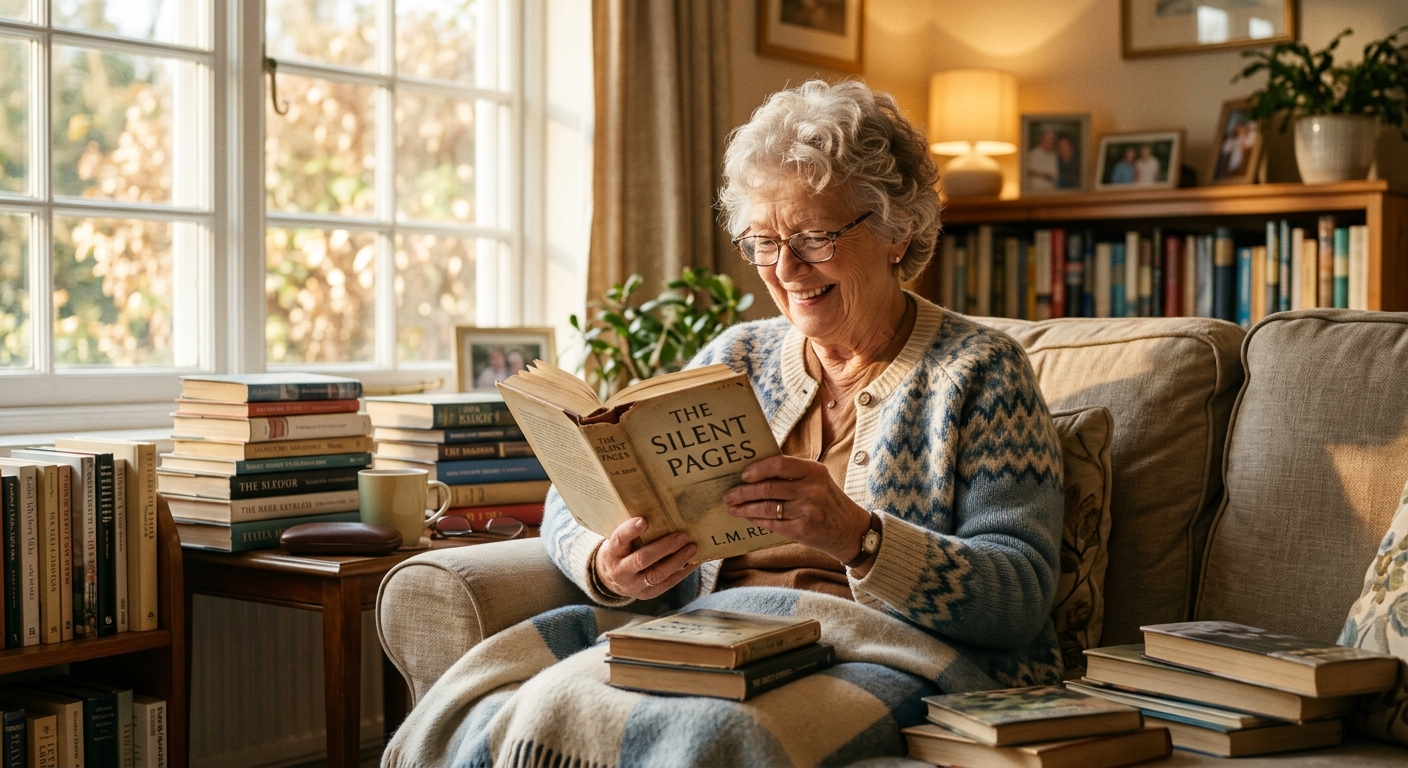
Eighteen months after that first session with Donna, Evelyn Marsh reads every single day. She has a library card that she describes as her most prized possession. She keeps a running list in a spiral notebook of every book she has finished, and as of this writing, that list has forty-one titles on it.
Her tastes have turned out to be wonderfully specific. She loves stories about women who survive things. She loves anything set in the American South. She has a complicated relationship with mysteries (“they stress me out, but I can’t stop”). She recently started a biography of Harriet Tubman and told her daughter it was the most important thing she had ever read.
She also joined a book club at the library, the same library where she first learned to read. She is the oldest member by about fifteen years and, according to the club’s organizer, one of the most vocal and passionate participants.
“Miss Evelyn does not hold back,” the organizer says with a laugh. “If she didn’t like a character’s choices, she will tell you exactly why. She brings things to the discussion that the rest of us don’t think to bring, because she’s lived more than most of us have.”
What Her Story Means for the Rest of Us
Evelyn’s story is not just about literacy. It is about the courage it takes to be a beginner at any age. It is about the particular bravery required to admit a vulnerability you have spent decades hiding. It is about what becomes possible when one person, in this case Donna Reyes and the quiet infrastructure of a public library, simply refuses to make someone feel less than.
It is also a reminder that the things we tell ourselves are permanent, the closed doors, the missed chances, the seasons that have passed, are sometimes more negotiable than we think.
Evelyn Marsh did not get to read bedtime stories to her children. But she reads them to her grandchildren now, with expression and enthusiasm and her finger tracing each line, and she says those are some of the best hours of her life.
“I wasted a lot of time being ashamed,” she says, settling back in the chair on her porch, a book face-down in her lap. “But I don’t think about that too much anymore. I’ve got too many books left to read.”
Resources for Adult Literacy
If you or someone you know is interested in adult literacy programs, the following organizations offer free support:
- ProLiteracy (proliteracy.org): the largest adult literacy organization in the United States
- Your local public library: most counties offer free adult literacy tutoring programs
- LiteracyDirectory.org: a searchable database of literacy programs by location
- 800-228-8813: the national literacy hotline, confidential and free
Everyone deserves the light that comes from a first word read alone. Sometimes it just arrives a little later than expected, and it is no less bright for it.