
🎧 Listen to this story
Narrated by Aoede · 9,891 characters
A Different Kind of Rich
In a world where loneliness has been declared a public health epidemic, where doctors in countries like the United Kingdom now prescribe social activities alongside medications, and where studies consistently show that isolation shortens lives as effectively as smoking fifteen cigarettes a day, there are places that seem to have quietly solved the problem.
They are not utopias. They are not wealthy enclaves with perfect weather and endless leisure time. Some of them are modest fishing villages. Some are tight-knit urban neighborhoods in the middle of crowded, chaotic cities. Some are intentional communities built by people who simply got tired of being alone together.
What they share is not geography or income or architecture. What they share is a set of deeply held habits, values, and daily rhythms that make connection not just possible, but inevitable.
Researchers, sociologists, and public health experts have spent years studying these communities. What they found challenges almost everything modern society treats as normal.
The Japanese Villages That Live Forever Together
Japan’s Okinawa prefecture is famous for its unusually high number of centenarians. Researchers studying longevity there kept bumping into a concept called moai, a word that roughly translates to “meeting for a common purpose.” In practice, a moai is a small group of five or so people who come together in childhood or early adulthood and commit to supporting one another for life.
These are not casual friend groups. Moai members contribute to a shared financial pool. They show up when someone is sick. They celebrate each other’s milestones and grieve each other’s losses. The relationship has a structure, a rhythm, and a weight that makes it difficult to simply drift away from.
Dr. Craig Willcox, a gerontologist who has studied Okinawan longevity extensively, noted that the social accountability built into moai creates a kind of invisible safety net. “People know they are expected,” he explained. “There is always somewhere you are supposed to be, and someone who will notice if you are not there.”
That last part, someone noticing your absence, turns out to be one of the most protective forces against loneliness that researchers have identified.
Denmark’s Cohousing Revolution
Denmark consistently ranks among the happiest countries in the world, and while many factors contribute to that, one under-discussed element is the country’s long tradition of cohousing communities, known locally as bofaellesskaber.
Cohousing communities are designed with a specific intention: neighbors should have reasons to interact. Private homes are smaller than average, intentionally so, because the community provides common spaces that residents genuinely want to use. Shared kitchens host communal dinners several nights a week. Shared workshops, gardens, and laundry spaces create organic opportunities for conversation.
Critically, participation is structured but not forced. Residents rotate through cooking duties, maintenance responsibilities, and community decisions. This means that even introverts, people who would never spontaneously knock on a neighbor’s door, end up spending time together in ways that feel purposeful rather than performative.
Junior Freiband, an American architect who spent months studying Danish cohousing communities, described what he saw as a design solution to a social problem. “In a typical suburb, there is no reason to see your neighbor unless you make a deliberate effort,” he said. “In cohousing, avoiding your neighbor takes effort. The default is connection.”
The Italian Villages That Refuse to Let People Disappear
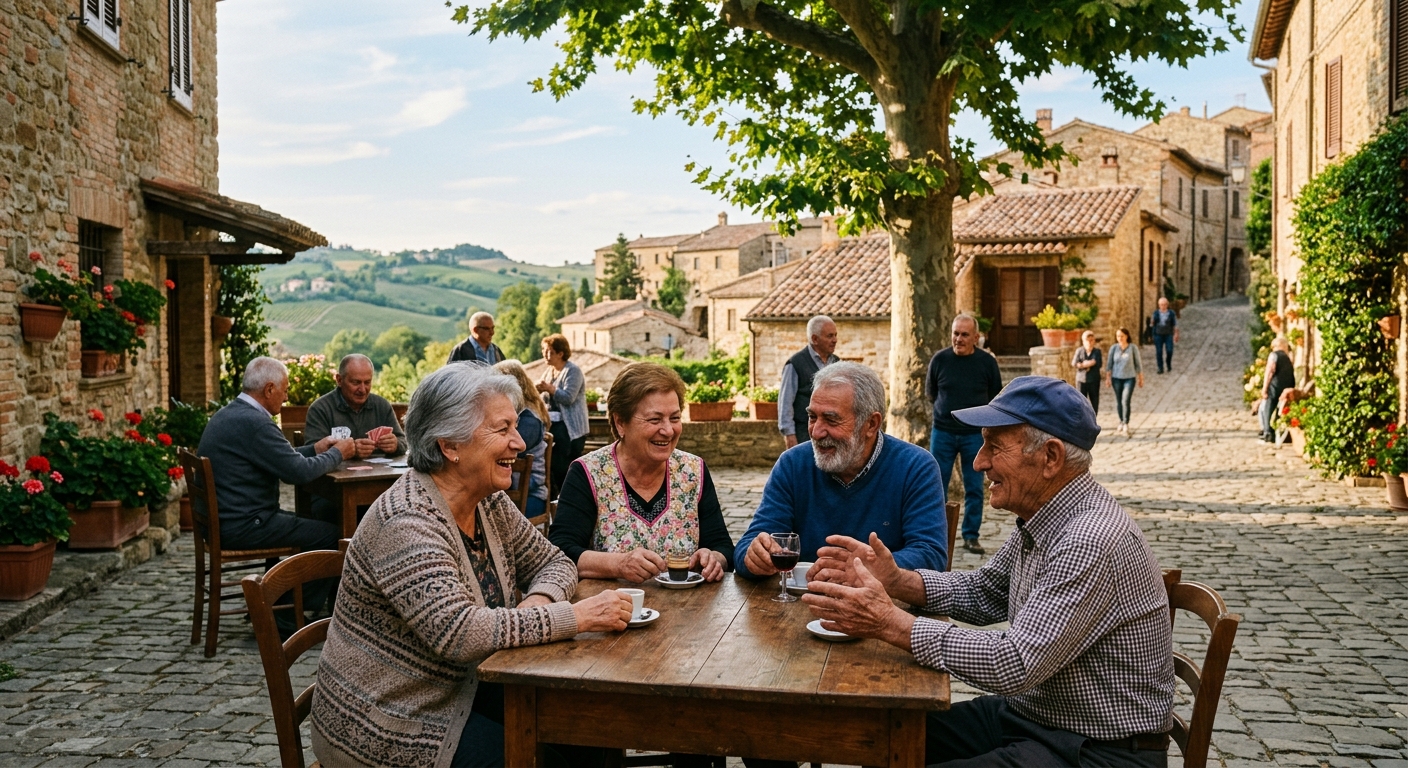
In several small towns across Sardinia and southern Italy, researchers studying another cluster of centenarians found a cultural norm so simple it almost seemed too obvious to be remarkable: nobody eats alone.
In these communities, a person seen eating alone, especially an elderly person, is not treated as someone who simply prefers solitude. They are treated as someone who needs help. Neighbors knock. Family members check in. The village priest makes note. There is a collective assumption that isolation is a problem to be solved, not a preference to be respected without question.
This stands in sharp contrast to Western urban culture, where respecting someone’s privacy often means leaving them entirely alone, even when that aloneness has curdled into something painful and dangerous.
Valter Longo, a biogerontologist at the University of Southern California who has studied these Sardinian communities in depth, pointed to what he called “positive social pressure.” “There is an understanding that you belong to the community and the community belongs to you,” he explained. “Disappearing is not really an option.”
What These Communities Do Differently: A Closer Look
After examining communities across Japan, Denmark, Italy, the Netherlands, and several indigenous communities in North America, researchers began to identify consistent patterns. These are not accidental. They are practiced, inherited, and in many cases, consciously protected.
1. They Make Connection Structural, Not Aspirational
In most modern societies, connection is something we are told we should pursue. We are encouraged to reach out, join clubs, attend events, download apps. The responsibility sits entirely with the individual. In communities with low rates of loneliness, connection is baked into the architecture of daily life. You do not have to try to see people. You simply live in a way that makes seeing people the natural outcome.
2. They Maintain Intergenerational Contact
One of the most striking features of low-loneliness communities is the degree to which old and young people actually spend time together. In Okinawa, elders are present in schools and markets. In Sardinian villages, children play near the tables where grandparents sit and talk. In many indigenous North American communities, the transmission of knowledge between generations is a daily, living practice rather than a historical memory.
Research consistently shows that intergenerational contact benefits both groups. Children who spend time with older adults develop stronger empathy and longer attention spans. Older adults who spend time with children report dramatically lower rates of depression and cognitive decline.
3. They Have Rituals That Require Showing Up
Whether it is the moai’s regular meeting, the cohousing community’s shared dinner, or the Sardinian village’s Sunday gathering, these communities have recurring rituals that create consistent, predictable opportunities for connection. The key word is requiring. Not demanding or coercing, but gently structuring life so that showing up is the norm and absence is noticed.
4. They Value Uselessness in the Best Way
Many low-loneliness communities have a deep cultural comfort with unstructured time spent together. Sitting without a purpose. Talking without an agenda. Wandering through a market without needing to buy anything. In productivity-obsessed modern cultures, this kind of time is often dismissed as wasted. In communities where people rarely feel alone, it is considered one of the most important things a person can do.
5. They Treat Loneliness as a Community Problem, Not a Personal Failure
Perhaps the most significant difference is this: in these communities, if someone is lonely, it is understood to be everyone’s problem. Not in a pitying way. Not in a way that strips the lonely person of dignity. But in the fundamental belief that a neighbor’s isolation is a signal that the community has somehow failed to do its job. That reframing changes everything about how people respond to those around them who are struggling.
Can Any of This Be Transplanted?
It would be easy to look at these communities and conclude that their success is cultural, historical, or simply too rooted in a specific place and time to be replicated anywhere else. That conclusion would be both understandable and wrong.
Across the United States, Canada, the UK, and Australia, people are actively building cohousing communities modeled on the Danish example. Many are succeeding. Researchers working in urban environments have found that even small architectural and policy changes, adding benches to streets, designing building lobbies as gathering spaces, creating shared gardens in apartment complexes, can measurably increase the number of social interactions residents have per week.
The Village Movement, which began in Boston in 2001, has since spread to over 300 communities across the United States. It operates on a simple principle borrowed directly from the cultures described above: neighbors take responsibility for one another, especially as they age. Members check in on each other, share rides, and show up when someone is sick. The results in terms of mental health, physical health, and reported happiness have been significant.
The Lesson Hiding in Plain Sight
The communities that have nearly eliminated loneliness are not doing anything magical. They are not offering something that requires enormous wealth or perfect circumstances. They are simply doing what humans did for most of our existence, living in ways that make isolation structurally difficult and connection structurally easy.
The loneliness epidemic is not a mystery. It is the predictable outcome of designing lives and cities and cultures around individual convenience rather than collective belonging. And the antidote, as these communities quietly demonstrate every single day, is equally unsurprising.
Show up. Make it easy for others to show up. Notice when someone is missing. Build your life so that other people are woven into the fabric of it, not tucked away like optional accessories.
That is not a secret. But in a world that has nearly forgotten it, it might as well be.