🎧 Listen to this story
Narrated by Leda · 8,188 characters
One Cold Night That Changed Everything
It was a Tuesday evening in late November when Marcus Webb first noticed the man huddled beneath a bus shelter on the corner of Fifth and Main. The temperature had dropped to 19 degrees Fahrenheit. The man had no coat, no gloves, and no shoes that could reasonably be called shoes. Marcus drove past. Then he stopped. Then he sat in his car for a long moment before pulling a jacket from his back seat and walking over.
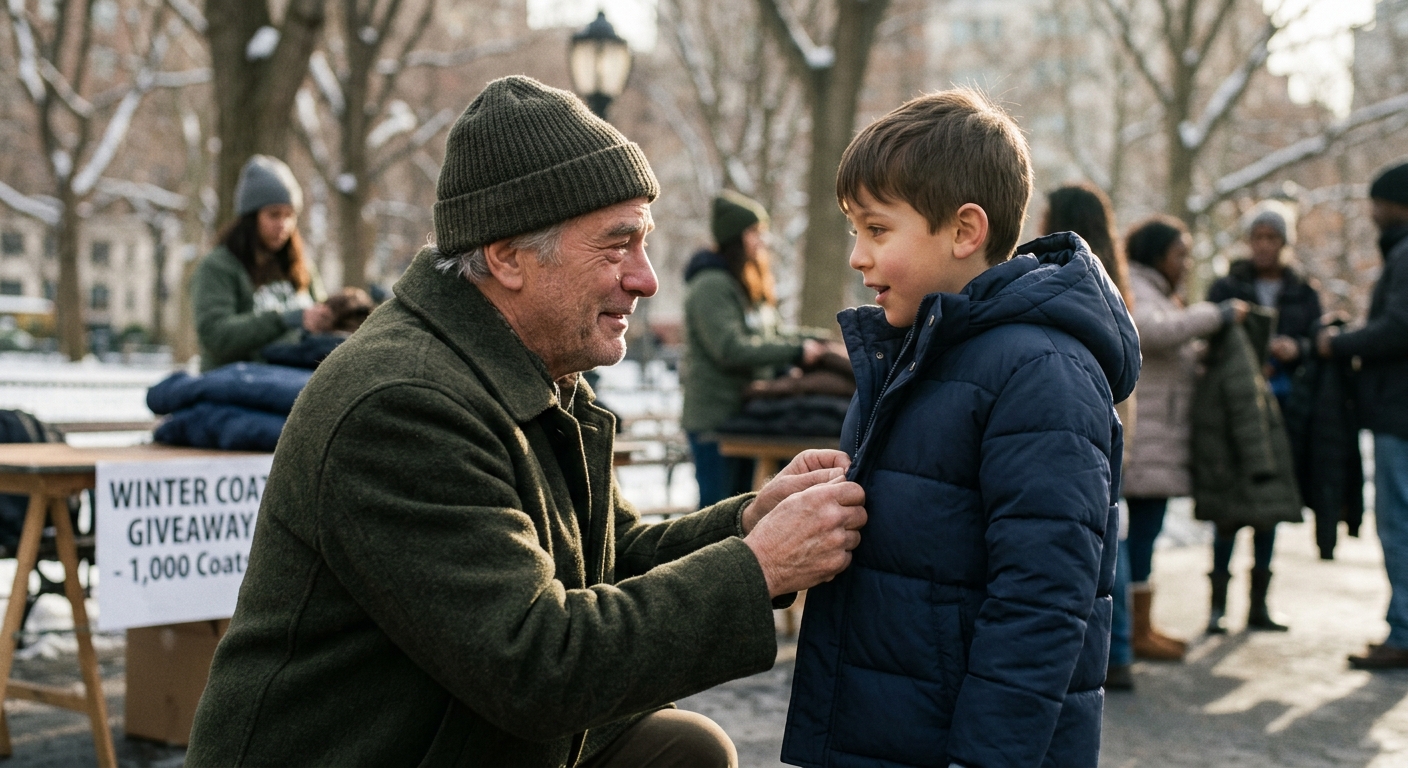
That single interaction, lasting less than three minutes, became the seed of something neither Marcus nor anyone around him could have predicted. Twelve years later, Marcus Webb has personally distributed over 1,000 coats to homeless individuals across his city each winter, a number that continues to grow with every season.
This is not a story about a millionaire writing a check. This is a story about a middle school science teacher who decided that discomfort was not a reason to look away.
How a Classroom Teacher Became a One-Man Relief Operation
Marcus, now 51, teaches seventh-grade earth science in Columbus, Ohio. He is not wealthy by conventional standards. He drives a 2009 Honda Civic, clips grocery coupons, and brings his lunch to work in a reusable container his students have nicknamed “the brick” because of its thick insulated walls.
After his encounter at the bus shelter that November night in 2012, Marcus went home and felt what he describes as “a specific kind of guilt that you cannot argue your way out of.” He had a coat. The man at the bus shelter did not. The math, as Marcus tells it, was painfully simple.
“I teach kids about systems,” he said in a recent conversation at his kitchen table. “Weather systems, ecosystems, how everything connects to everything else. And I realized I was living in a system where people froze on sidewalks three blocks from heated shopping malls. I just couldn’t un-see that.”
The next morning, he posted a handwritten flyer at his school asking colleagues to donate any gently used coats they had at home. He collected eleven coats that first week. He delivered them himself, driving through neighborhoods where he knew unhoused people sheltered, stopping to ask each person directly what size they needed and whether they preferred something longer or shorter.
That detail matters more than it might seem.
The Dignity Factor: Why How You Give Is Just as Important as What You Give
What separates Marcus Webb’s coat drives from a simple donation bin is the deliberate, almost stubborn insistence on personal connection. He does not drop coats at a facility. He does not hand them through a car window. He parks, gets out, introduces himself, and asks each person their name.
“People who are unhoused are often treated like they’re invisible,” Marcus explains. “They get handed things without eye contact. They get talked about in the third person while they’re standing right there. When I walk up and say, ‘Hi, I’m Marcus, what’s your name, and what size do you usually wear,’ sometimes people look genuinely surprised. Like they weren’t expecting to be asked a question that assumed they had preferences.”
Former recipient Darlene T., who has since transitioned into stable housing and now volunteers with Marcus’s drives, describes the experience vividly: “He looked at me. He actually looked at me. That sounds like such a small thing, but when you’ve been on the street for a while, being seen feels enormous.”
The Numbers Behind the Warmth
What began with eleven coats in 2012 has grown into a community-wide effort that Marcus organizes almost entirely outside of work hours. Here is a look at how the operation has evolved:
- Year 1 (2012): 11 coats collected and distributed personally
- Year 3 (2014): 87 coats, supported by a small network of teacher colleagues
- Year 5 (2016): 230 coats, with local church groups joining the effort
- Year 8 (2019): 610 coats, a formal coat drive launched with three collection sites
- Year 10 (2021): 940 coats, partnerships formed with two local businesses
- Year 12 (2023): Over 1,100 coats distributed across a single winter season
He keeps a handwritten ledger. Not a spreadsheet, not a database. A composition notebook, the same kind he hands his students on the first day of school.
Where Do All the Coats Come From?
Funding and sourcing have always been the most logistically complex part of the operation. Marcus uses a combination of community donations, end-of-season retail discounts, and a modest annual fundraiser his students help organize each October.
For the past four years, his seventh-grade class has hosted what they call “The Big Coat Push,” a two-week campaign that includes a school assembly, a coat collection contest between homerooms, and a student-designed social media campaign. In 2023, the class raised enough through the campaign to purchase 200 brand-new coats at cost from a local sporting goods store that partnered with them at reduced prices.
“These kids get it immediately,” Marcus says, the pride in his voice unmistakable. “I don’t have to convince them. I just have to give them the context and get out of their way. They end up teaching me things about urgency that I thought I already knew.”
What Critics Get Wrong About This Kind of Work
Not everyone has been entirely supportive. Over the years, Marcus has encountered skepticism from people who argue that individual charity work like his “doesn’t address the root causes” of homelessness or that it provides a feel-good substitute for systemic change.
He does not dismiss those criticisms.
“I teach systems thinking. I know that a coat is not a housing policy. I know it’s not job training or mental health infrastructure or addiction recovery services,” he says carefully. “But I also know that people die of hypothermia while we’re debating policy. A coat keeps someone alive tonight. Staying alive tonight is what makes tomorrow possible.”
He pauses, then adds: “And I’ll tell you something else. Several of the people I’ve given coats to over the years have come back and gotten involved. They’ve become volunteers. One of them is now pursuing a social work degree. The coat didn’t solve everything. But it started a relationship. And relationships change things in ways that policies alone cannot.”
Lessons From Twelve Winters on the Street
After more than a decade of this work, Marcus has gathered insights that go far beyond coat distribution. Asked what he has learned, he offers these reflections:
- Consistency builds trust. People who are unhoused have often been let down repeatedly. Showing up year after year, in the same places, with the same respectful approach, matters enormously.
- Ask, don’t assume. Some people want wool. Some are allergic. Some need XXL. Some prefer bright colors because it makes them feel less invisible. Asking respects individuality.
- Small acts normalize generosity. When Marcus’s students participate, they carry that orientation toward others into the rest of their lives. He has heard from former students, now in their twenties, who credit the coat drives with shaping how they engage with their own communities.
- The giver receives something too. Marcus is honest about this. “I leave every coat drive feeling more human. More connected. More like the world makes sense than it did when I woke up that morning.”
What You Can Do Right Now
Marcus is not asking everyone to run a coat drive. He is simply asking people to notice. To stop at the bus shelter. To take the jacket off their back seat and walk it over.
“There are things in your closet right now that you haven’t touched in two years,” he says with a smile. “Someone two miles from you is cold. The distance between those two facts is about forty-five minutes of your Saturday.”
He is right. And perhaps that is the most powerful thing about Marcus Webb’s story. It does not require a foundation, a nonprofit status, a viral campaign, or a celebrity endorsement. It requires only the willingness to see another person and to act on what you see.
Twelve winters. Over 1,000 coats. One Tuesday night at a bus shelter where a middle school teacher from Columbus decided he could not drive past.
Some decisions ripple outward forever.