
🎧 Listen to this story
Narrated by Aoede · 8,782 characters
A Simple Touch That Changed Everything
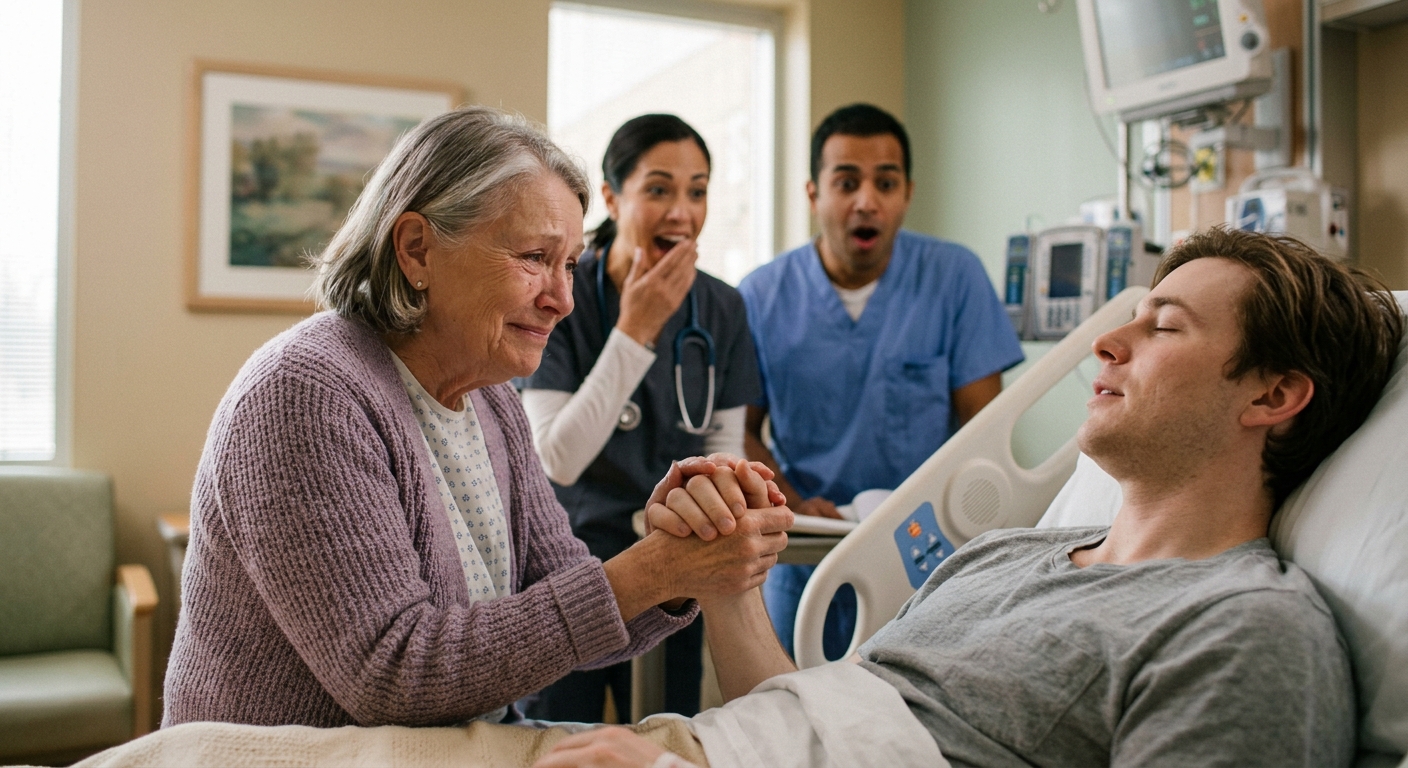
It did not start with a groundbreaking study or a million-dollar research grant. It started with a nurse named Margaret Eliott, a 34-year-old ICU nurse at a regional hospital in Ohio, who sat beside a patient during a particularly brutal overnight shift and did the only thing she could think to do: she held his hand.
The patient, a 67-year-old man named Gerald, had been admitted following emergency bypass surgery. His pain levels were spiking, his blood pressure was climbing, and the medication was not working fast enough. Margaret had already called the attending physician. She had adjusted the drip. She had done everything by the book. And then, almost instinctively, she pulled her chair close, wrapped her gloved hand around his, and said quietly, “I’m right here. You’re not alone.”
Within minutes, Gerald’s breathing slowed. His grip on the bed rail loosened. His monitored pain score, which he had rated a 9 out of 10 just moments before, dropped to a 6, then a 5. Margaret noted it in her log, almost as an afterthought. But she could not stop thinking about it.
What the Science Actually Says
Margaret’s experience is not an isolated anecdote. Over the past two decades, a growing body of research has confirmed what many nurses and caregivers have long suspected: human touch, specifically the act of holding hands, has a measurable, physiological effect on pain.
A landmark study published in the Proceedings of the National Academy of Sciences found that when romantic partners held hands during a painful experience, the brain activity of both individuals began to synchronize. More remarkably, the person experiencing pain showed reduced neural responses in areas associated with pain processing. In other words, their brain literally registered less pain.
Dr. Pavel Goldstein, a pain researcher at the University of Haifa and lead author of that study, described the effect as “interpersonal synchronization,” a kind of neurological harmony that occurs between two people in close physical contact. His team measured brainwave patterns using EEG and found that the greater the empathy expressed by the person offering comfort, the stronger the synchronization and the greater the pain relief.
The Biology Behind the Comfort
To understand why this works, it helps to look at what happens inside the body during a moment of connection. When you hold someone’s hand with genuine warmth and intention, several things occur simultaneously:
- Oxytocin is released: Often called the “bonding hormone,” oxytocin reduces stress responses and has been linked to pain modulation in multiple studies.
- Cortisol levels drop: The stress hormone cortisol can amplify the perception of pain. Physical comfort helps suppress its release.
- Heart rate slows: A calmer cardiovascular state is associated with reduced pain sensitivity.
- The nervous system shifts: Touch activates the parasympathetic nervous system, pulling the body away from “fight or flight” and toward a state of rest and recovery.
- Attention is redirected: The brain is a notoriously poor multitasker. Focusing on a warm, steady human presence can literally crowd out some of the neural bandwidth devoted to pain signals.
None of this requires a prescription. None of it costs money. And yet, as Margaret discovered, it works.
“I Started Paying Attention Differently”
After that night with Gerald, Margaret began keeping informal notes. Over the following months, she paid closer attention to patients who received extended physical contact from family members or nursing staff, comparing their reported pain levels and medication usage to those who did not.
“I am not a researcher,” she says, laughing gently. “I want to be very clear about that. I was just a nurse who noticed things.” What she noticed was a consistent pattern: patients who were regularly touched, spoken to gently, and whose hands were held during painful procedures consistently reported lower pain levels and, in several cases, required less supplemental pain medication.
She brought her observations to the hospital’s nursing director, who encouraged her to collaborate with the hospital’s clinical research team. That collaboration eventually contributed to a revised patient comfort protocol at her facility, one that now formally includes “therapeutic touch and presence” as a recommended component of pain management for post-surgical patients.
Not Just for Hospitals
The implications of this research stretch far beyond ICUs and operating rooms. Think about the moments in everyday life when someone you love is hurting. A child with a fever. A friend receiving devastating news. An elderly parent navigating a difficult diagnosis. The instinct to reach out and hold their hand is not sentimental weakness. It is, it turns out, one of the most effective things you can do.
Studies have shown similar benefits in the following contexts:
- Dental procedures: Patients who held a nurse’s hand during dental work reported significantly less anxiety and pain than those who did not.
- Childbirth: Continuous physical support from a doula or partner during labor has been shown to reduce the need for pain medication and shorten labor duration.
- Chronic pain management: Regular affectionate touch from a partner has been associated with lower reported pain levels in people living with fibromyalgia and arthritis.
- Pediatric care: Children undergoing blood draws or injections showed lower cortisol levels and reported less pain when a parent held their hand throughout the procedure.
The Loneliness Factor
There is a darker side to this story, and it deserves to be told honestly. If human touch reduces pain, then the absence of it amplifies suffering. And in a world where loneliness has reached epidemic proportions, that is a public health crisis hiding in plain sight.
Research from the University of Chicago found that lonely individuals have heightened pain sensitivity compared to those with strong social connections. A separate study found that social isolation activates the same neural pathways as physical pain. We are not just emotionally hurt by loneliness. We are physically hurt by it.
For patients in hospitals without family nearby, for elderly people living alone, for anyone who goes days or weeks without meaningful physical contact, the pain they carry is not just emotional. It has a measurable biological signature. It lives in the body.
This is part of why Margaret’s story matters so much. Because what she stumbled upon in that overnight ICU shift was not just a technique. It was a reminder of something our species has always known but keeps forgetting: we are wired for connection, and when that connection is present, we are more resilient, more capable, and less alone in our pain.
What You Can Do Starting Today
You do not need a medical degree or a research grant to apply any of this. Here are a few practical ways to bring the healing power of touch into your relationships and community:
- Be intentional with physical greetings: A genuine hug or warm handshake communicates safety and care at a neurological level.
- Sit close during difficult conversations: Physical proximity, even without direct touch, activates many of the same calming responses.
- Hold hands during medical procedures: If you are accompanying someone to a doctor’s appointment or procedure, ask if you can stay and hold their hand. Many facilities will allow it.
- Check in on elderly neighbors or relatives: A visit that includes a hug or a held hand can have lasting effects on pain tolerance and emotional wellbeing.
- Do not rush comfort: When someone is hurting, resist the urge to immediately fix or advise. Sometimes the most powerful thing is to simply stay, be present, and offer your hand.
Gerald’s Recovery
Gerald spent eleven days in the hospital following his bypass surgery. He was discharged on a Tuesday morning, walking slowly but steadily, his daughter at his side. Before he left, he asked a nurse to find Margaret.
When she found him by the elevator, he did not say much. He was not that kind of man, his daughter explained later. But he took Margaret’s hand in both of his, held it for a long moment, and said: “You stayed.”
She said she nearly cried in the hallway.
“That’s the thing about this work,” Margaret said. “You give something small, something that costs you almost nothing, and somehow it ends up being exactly what someone needed most.”
Science is still catching up to what nurses like Margaret have always known. The human hand, offered freely and held with care, is one of the most powerful healing tools we have ever had access to. It has no side effects. It requires no insurance pre-authorization. And it has been available to us, always, at the end of our own arms.