🎧 Listen to this story
Narrated by Sulafat · 8,006 characters
The Bell Rings, and the Magic Begins
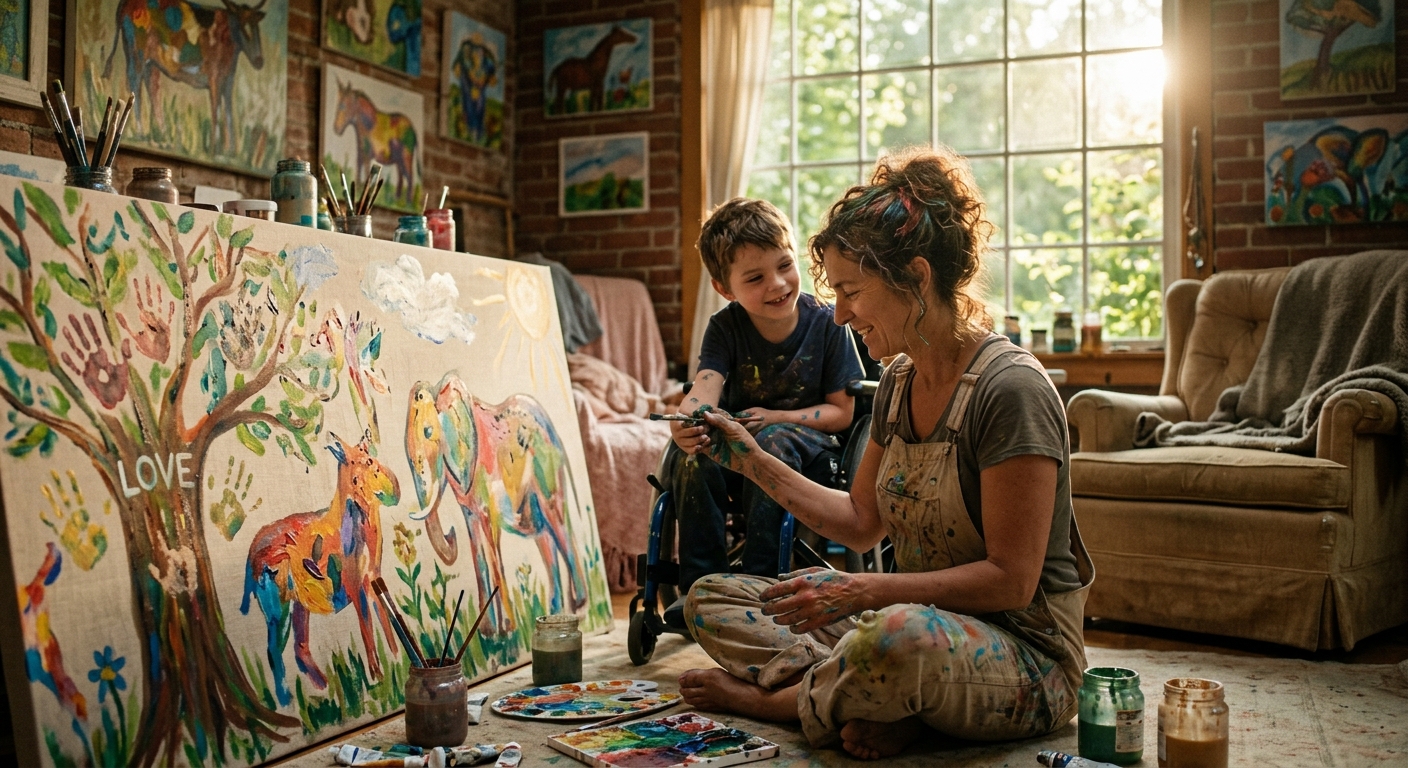
At 3:15 every weekday afternoon, something remarkable happens in a converted garage on the east side of Tucson, Arizona. Eighty children, ranging in age from six to sixteen, pour through a set of mismatched wooden doors painted every color of the rainbow. They drop their backpacks, grab an apron, and get to work. There are no entry fees, no waitlists for the right families, and no judgment about talent level. There is only paint, clay, canvas, charcoal, and the woman who made all of it possible: 58-year-old retired art teacher Marlena Vasquez.
What Marlena has built here, largely with her own savings and a growing network of community donors, is called The Open Palette. Since its founding in 2019, the program has served hundreds of children across the Tucson Unified School District’s most underserved zip codes. Every single session is completely free.
“I kept hearing that the arts were being cut from schools,” Marlena says, her hands still faintly stained with cadmium yellow from the morning’s supply prep. “And I thought, if the schools won’t do it, then I will.”
What Inspired Her to Start
Marlena spent 27 years teaching visual art in public schools before retiring in 2018. She had watched, with growing frustration, as budget cuts quietly strangled arts programming across the district. Music teachers were let go. Drama departments dissolved. Art classes were reduced from five days a week to one, and then, in some schools, eliminated entirely.
“Art saved my life when I was a kid,” she says plainly. “I grew up in a house with a lot of chaos. When I painted, everything went quiet inside. I can’t imagine who I would have become without it.”
After retiring, she spent about six months feeling restless. She traveled a little, visited her grandchildren in New Mexico, and tried taking up gardening. But she kept coming back to a single thought: there were kids in her city who had no creative outlet, no space to process their emotions, no one handing them a brush and saying, “Show me what’s inside.”
So she converted her two-car garage into a studio. She bought tables and stools secondhand. She reached out to local schools, put up flyers, and told parents it was free, genuinely and permanently free. The first week, eleven kids showed up. Within two months, she had a waiting list.
A Typical Day at The Open Palette
Walking into the studio on a Tuesday afternoon is a sensory experience. The smell of acrylic paint mingles with something earthy, probably the air-dry clay being shaped at the back table. Music plays softly, usually jazz or something instrumental. The noise level is a productive hum, punctuated by bursts of laughter and the occasional passionate debate about whether blue-green counts as teal.
Marlena does not run the program alone. She has recruited three volunteer instructors, all local artists, who each come in two or three days a week. There is also a rotating crew of high school students who earn community service hours by helping younger children. The structure is intentionally loose.
- Monday and Wednesday: Painting and mixed media exploration
- Tuesday and Thursday: Sculpture, ceramics, and three-dimensional work
- Friday: Free choice, plus a short group share where kids can talk about what they made and why
That Friday share session, Marlena says, is her favorite part of the week. “You hear things that break your heart open in the best way. A ten-year-old will hold up a painting and say, ‘This is what my grandma’s voice looks like.’ I mean, how do you not cry?”
The Children Who Come Back, and Why
For many of the kids, The Open Palette is more than an art class. It is an anchor. Parents in the neighborhood have described it as the reason their child started talking more, the reason their teenager stopped spending every afternoon on their phone, the reason their anxious kid finally found something they were confident about.
One mother, Rosa, whose two sons have attended since the program’s first year, puts it this way: “Before this, my older one, Mateo, was struggling in school. He was frustrated all the time. He started coming here and something shifted. His teacher even noticed. She said he seemed calmer, more focused. I believe it is because he finally had somewhere to put his feelings.”
Mateo, now fourteen, has won two regional youth art competitions. He is quietly considering a career in graphic design. He credits Marlena with showing him that his way of seeing the world had value.
How She Keeps It Running
The Open Palette operates on a combination of personal investment, small grants, and community generosity. Marlena applied for and received a $4,000 grant from a local arts foundation in her second year. A nearby art supply store donates overstocked materials quarterly. A parent who works in construction helped reinforce the garage and added proper ventilation at no charge.
But the reality is that most months, Marlena dips into her own retirement savings to cover the gaps. She does not say this with bitterness. She says it matter-of-factly, the way someone describes watering a garden.
“Is it sustainable long-term? I think about that,” she admits. “But I also think about those eighty kids showing up tomorrow. That is what keeps me moving.”
She has recently partnered with a local university’s education department, which is exploring ways to provide both funding and student-teacher volunteers who can earn practicum hours at the studio. It is a hopeful development, one that could help The Open Palette expand its reach and stabilize its finances.
What the Art World Can Learn From a Tucson Garage
There is a larger conversation happening in education circles right now about the role of creative learning in child development. Research consistently shows that arts education improves academic performance, emotional regulation, and social skills. A 2019 study from Rice University found that students with access to arts education showed significantly better outcomes in school engagement, compassion, and school climate scores compared to peers without that access.
Marlena did not need a research paper to tell her this. She learned it in her own classroom, over nearly three decades of watching children transform when given a creative outlet. But she is glad the research exists, because it helps her make the case to potential donors and partners.
“I want people to understand this is not a hobby,” she says firmly. “This is mental health support. This is academic support. This is community building. It just happens to involve paintbrushes.”
What She Hopes For
Ask Marlena about the future and she gets quiet for a moment, looking around the studio at the finished pieces drying on a wire rack, at the clay handprints pressed onto cardstock, at the self-portraits lined up along the far wall.
“I want every kid in this city who needs a place like this to have one,” she says finally. “I want to train other people to do what I do, in other neighborhoods, in other cities. I want the model to outlive me.”
She pauses, then smiles. “But first, I want to get through tomorrow’s session. We are starting oil pastels. It is going to be beautiful and absolutely chaotic.”
How You Can Support Programs Like This
If Marlena’s story moved you, consider taking one of these steps in your own community:
- Donate unused art supplies to local schools or community centers
- Volunteer your creative skills to an after-school program
- Research whether your employer offers community grant programs and nominate a local initiative
- Share stories like this one, because visibility matters and community support follows awareness
- Ask your local school board about arts education funding at the next public meeting
Eighty children walk through those painted doors every afternoon because one woman refused to accept that beauty and creativity were luxuries. She decided they were necessities, and then she acted on it. That is the whole story, and it is enough to change everything.