
🎧 Listen to this story
Narrated by Aoede · 8,520 characters
The Morning Routes Nobody Talks About
Every weekday morning, millions of school bus drivers do something that rarely makes headlines. They show up before sunrise, navigate icy roads and distracted traffic, and spend their hours surrounded by the noise and chaos of children who are just trying to get through the day. Most people think of bus drivers as background figures, part of the scenery of childhood. But for one child on a route in rural Ohio, a bus driver named Cindy Becker was anything but background. She was, quite literally, a lifeline.
This is a reported account drawn from interviews, school district records, and child welfare advocates who work with cases like Cindy’s every year. It is not a story about a dramatic rescue or a single explosive moment. It is a story about something far more powerful: paying attention.
What She Noticed First
Cindy had been driving the same morning route for eleven years when a quiet second-grader named Marcus began riding her bus. He was small for his age, with dark eyes that seemed to carry something heavier than a seven-year-old should.
“Most kids come on loud, even the shy ones eventually open up,” Cindy recalled in an interview with a local child welfare newsletter. “Marcus just sat. Every day, same seat, same stillness. I kept an eye on him the way you keep an eye on weather you’re not sure about.”
Over the first few weeks, Cindy catalogued small details that, on their own, might have seemed insignificant:
- Marcus wore long sleeves even on warm days in late September.
- He flinched when another child dropped a backpack loudly near his seat.
- He never ate a snack, even as other kids pulled out crackers and juice boxes.
- He sometimes fell asleep within minutes of sitting down, the deep sleep of a child who hadn’t rested properly.
- On Mondays especially, he seemed different, more withdrawn, moving more carefully as if something hurt.
None of these details, standing alone, would have alarmed most people. Together, they told Cindy something was wrong.
The Moment She Knew She Had to Act
About six weeks into the school year, Marcus boarded the bus on a Tuesday morning and winced visibly as he sat down. Cindy watched him in the oversized rearview mirror she used to keep track of the kids. He pressed his lips together, adjusted his position twice, and stared straight ahead.
“That’s when I knew it wasn’t just a feeling,” she said. “Something was happening to that boy.”
Here is what makes Cindy’s story particularly important: she did not panic. She did not confront the child in front of other students. She did not call out to him or draw attention to him in any way. She understood instinctively what child welfare professionals emphasize in training: when a child may be experiencing abuse, the way an adult responds in that first moment matters enormously.
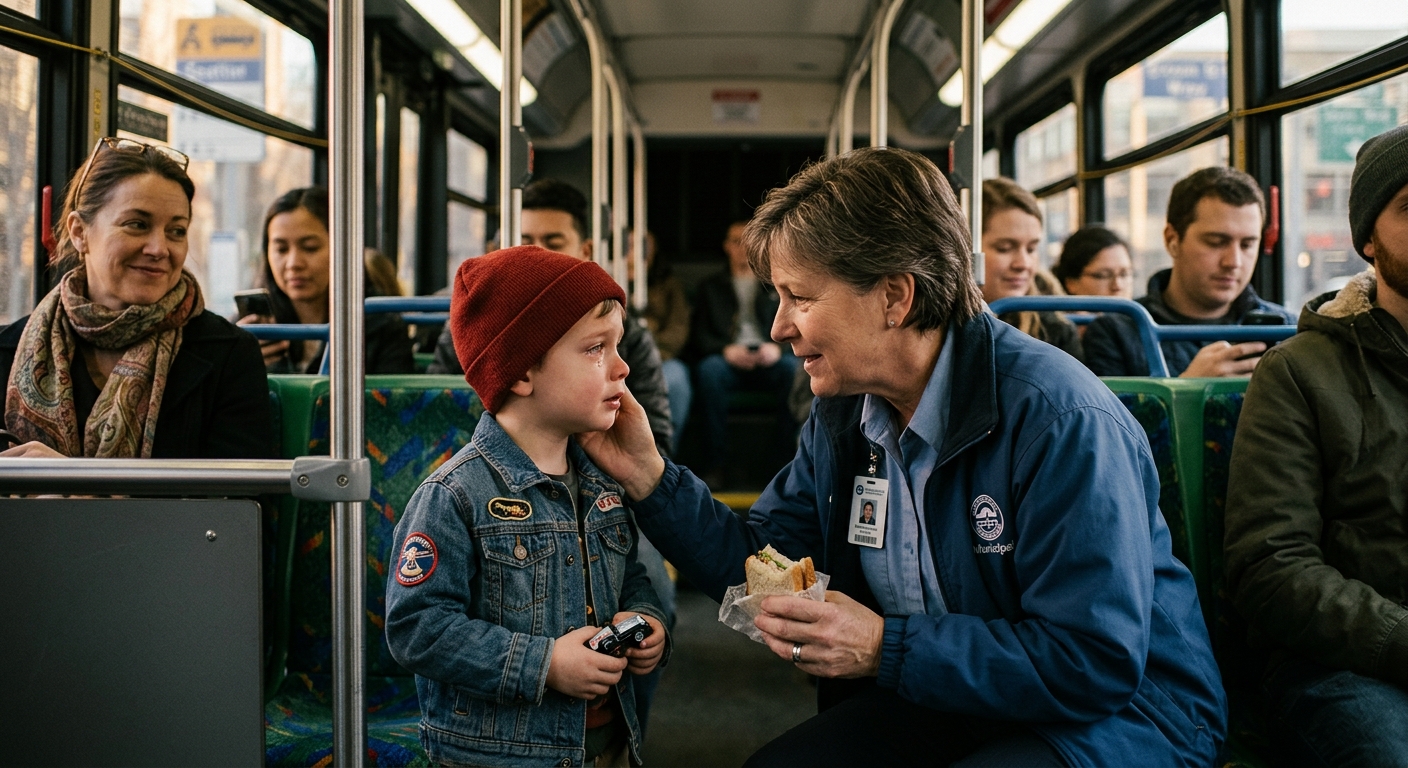
She waited until the other children had filed off at their school stop. Then, calmly and gently, she spoke to Marcus as he passed her seat.
“I just said, ‘Hey, bud, I saved you a granola bar. You want it?’ And he looked at me like nobody had offered him anything in a long time,” Cindy remembered. “He took it. And then he looked up at me and said, ‘My tummy hurts sometimes.’ I said, ‘I know. I’m going to talk to someone who can help.'”
She walked him to class and went directly to the school counselor.
What Happened Next: The System Responding Carefully
The school counselor, trained in trauma-informed care, followed protocol. She documented Cindy’s observations, had a gentle conversation with Marcus using age-appropriate, non-leading questions, and contacted the school’s designated mandatory reporter. A call was made to child protective services that same afternoon.
What investigators found confirmed Cindy’s instincts. Without detailing the specifics out of respect for Marcus’s privacy and his ongoing recovery, the school district’s child welfare liaison confirmed that Marcus was removed from a dangerous home situation and placed with a relative who had been unaware of what was happening.
He received counseling. He received care. And he continued riding Cindy’s bus, now living with his grandmother two streets away.
Why Bus Drivers Are Uniquely Positioned to See What Others Miss
Child welfare advocates have been making this case for years, and Cindy’s story illustrates it perfectly. School bus drivers occupy a rare and valuable space in a child’s day. Consider what they observe:
- Consistency: They see the same children five days a week, often for an entire school year. This repetition allows them to notice changes in behavior, appearance, or demeanor that a teacher who sees 30 students in a busy classroom might miss.
- Transitional moments: The time between home and school is when children are often most unguarded. They haven’t yet put on the performance many abused children learn to wear inside the school building.
- Physical proximity: Drivers are close enough to notice details like bruising, clothing choices, or the way a child moves and sits.
- Low-pressure environment: A bus ride doesn’t require a child to perform academically. Some children relax and reveal more in that unstructured time than they ever would in a classroom.
Dr. Layla Okonkwo, a child psychologist who consults with school districts on abuse prevention, put it plainly in a 2022 training seminar: “We spend a lot of time talking about teachers and counselors as first responders to child abuse. Bus drivers are criminally undervalued in this conversation. They are often the first adult outside the home that a child sees every single morning. That relationship is powerful.”
Training Matters: What Cindy Had That Many Drivers Don’t
One of the most important details in Cindy’s story is that she had received mandatory training in recognizing signs of child abuse. Her school district, unlike many across the country, had extended that training beyond licensed educators to include all staff who had regular contact with students, including bus drivers, cafeteria workers, and custodians.
This is not universal. In many states, bus drivers are not legally classified as mandatory reporters, and training in abuse recognition is inconsistent or entirely absent from their onboarding.
Advocates argue this needs to change. Organizations like Darkness to Light and the Childhelp National Child Abuse Hotline offer resources for schools and districts looking to expand their training programs. Recognizing abuse is a skill. It can be taught. And as Cindy’s story shows, when it is taught to the right person in the right position, the results can be life-changing.
The Relationship That Continued
Perhaps the most quietly beautiful part of this story is what happened in the months after Marcus was moved to his grandmother’s care. He started eating snacks on the bus. He started talking, first to Cindy, then to other kids. By spring, he was one of the louder ones, not disruptive, just present in the way children are supposed to be present.
“One morning in April he got on the bus and handed me a drawing,” Cindy said. “It was a yellow school bus with a stick figure driver. He’d written, ‘Thank you for seeing me.’ I kept it. It’s still on my refrigerator.”
She paused in the interview, composing herself.
“That’s all I did, really. I just saw him. Every child deserves to be seen.”
What We Can All Take From This
You don’t have to be a bus driver or a mandated reporter to carry the lesson at the heart of Cindy’s story. The core of what she did was not procedural. It was human. She paid attention. She trusted her instincts. She acted with care instead of noise.
In our distracted, overscheduled lives, the act of truly noticing someone, of watching for small signs that something is wrong and then quietly, deliberately doing something about it, is more radical than it sounds.
Some children are not going to ask for help. They don’t know how. They don’t know they deserve it. They are waiting, sometimes for years, for one adult to look at them long enough to see past the surface.
Cindy Becker was that adult for Marcus. The question this story leaves us with is simple and a little uncomfortable: Who are we that adult for?
If You Suspect a Child Is Being Abused
If you are in the United States and suspect a child is experiencing abuse or neglect, contact the Childhelp National Child Abuse Hotline at 1-800-422-4453, available 24 hours a day, 7 days a week. You do not need to be certain. You only need to be concerned. Trained counselors can help you determine next steps.