🎧 Listen to this story
Narrated by Kore · 6,984 characters
There is a particular hour, somewhere between the last of the dinner dishes and the first stirrings of tomorrow, when a town seems to exhale. The streetlights hum. The traffic thins to a trickle. And on the corner of a quiet road, a neon sign still glows in a window, promising coffee to anyone who needs it.
This is a story about that window, and about the woman who has kept the light on behind it for nearly twenty years. It is told in the order the night unfolds, because that is how the people who know the place tell it: one hour at a time.
9:00 PM: The Dinner Rush Fades
By nine, the families have gone home and the booths have gone soft and quiet. Marguerite, the owner, wipes down the counter in slow, practiced circles. She is in her sixties, with reading glasses pushed up into silver hair and a dish towel permanently draped over one shoulder.
She opened the diner in her late forties after a long career in hospital administration. She had no grand plan to change the world. She wanted a place where the food was honest and the coffee was hot. The tradition that now defines the diner began by accident.
One winter night, just as she was about to lock up, a man knocked on the glass. He was holding a plastic bag with everything he owned inside it. He did not ask for food. He asked if he could sit somewhere warm for a few minutes. She let him in, and then she did what felt obvious: she turned the grill back on.
“I told myself it was one plate,” she says, smiling. “That was in 2006.”
10:30 PM: The Quiet Regulars
As the night deepens, a different crowd settles in. The late shift is made up of people the daytime world rarely notices:
- Nurses coming off long hospital shifts, still in their scrubs
- Night-shift warehouse workers on a short break
- Taxi and rideshare drivers waiting out the slow hours
- College students cramming for morning exams
- Neighbors who simply cannot sleep and want company
Marguerite knows most of them by name, and she knows how each takes their eggs. But she also knows that the people who most need the diner at night are often the ones who never walk through the door unless someone makes it easy.
So she made it easy. There is a hand-lettered card taped beside the register that reads: If you are still hungry when the kitchen closes, tell us. No questions. No bill.
11:45 PM: The Quiet Rule
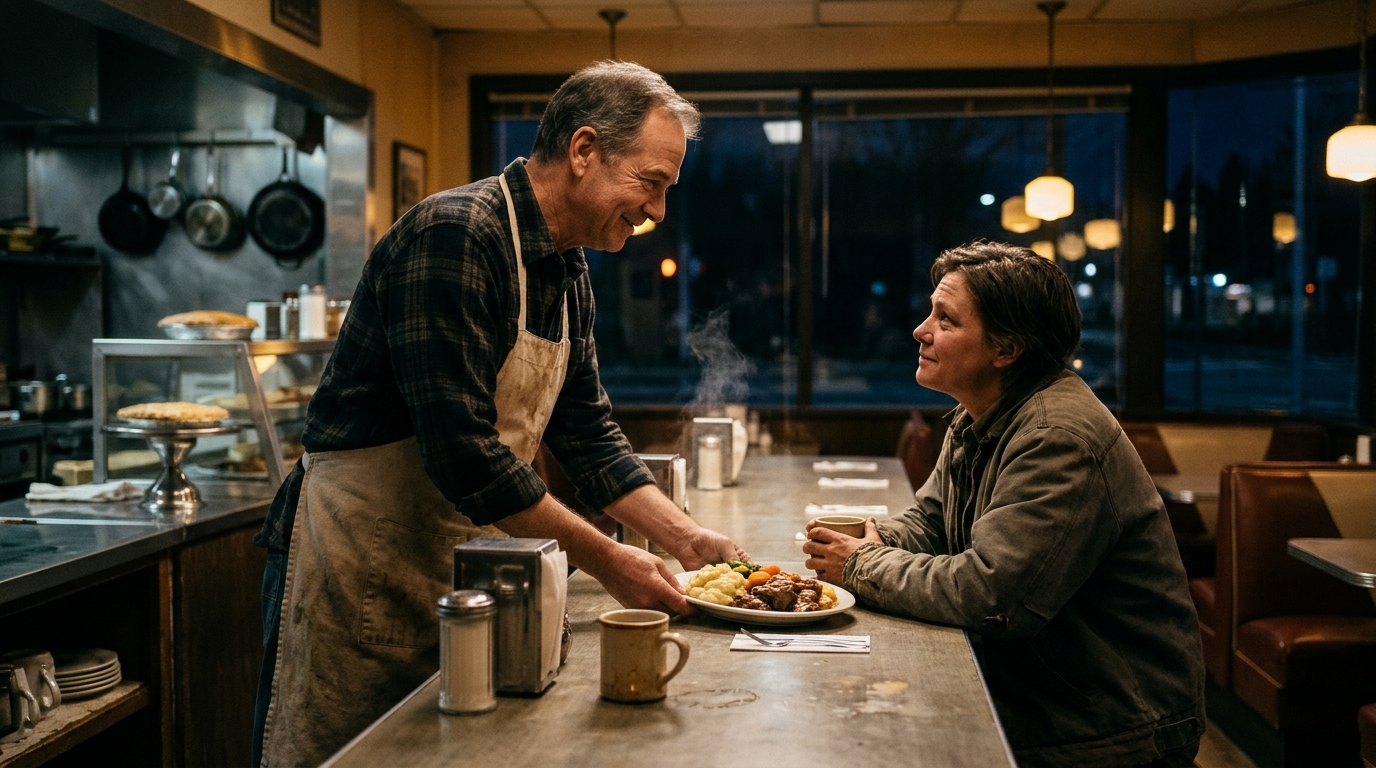
The rule is simple, and it is applied with care. When the clock nears midnight and the last orders are placed, anyone who is still hungry can ask for a meal and receive one. They do not have to prove anything. They do not have to explain. They do not have to sit near the window where the world can see them.
Marguerite and her small crew have learned that dignity is as important as the food. A few of the choices they have made over the years:
The back booth is always available
One corner booth, tucked away from the front windows, is never given to a paying customer after eleven. It is quietly held for anyone who might not want to be seen eating alone.
The plate looks like every other plate
No one is handed a different kind of meal. The free dinner is the same hot, generous plate that anyone else would pay for, served on the same dishes.
Nobody counts
There is no ledger of who ate and who did not. The staff do not track it, and they do not discuss it afterward.
Midnight: The Kitchen Closes, the Door Stays Unlocked
At midnight the grill is scraped down and the fryers are switched off, but the real work of the evening is just beginning. This is the hour when the diner becomes something closer to a lighthouse.
A young cook named Dani, who has worked the night shift for six years, remembers the first time she understood what the place was. A boy of about sixteen came in alone, hovering near the door. He ordered a glass of water and nothing else. Dani brought him a grilled cheese she had made “by mistake,” and told him the kitchen always overmade at closing.
“He ate it so slowly,” she says. “Like he was afraid it would disappear.” He came back every Thursday for the next month. Eventually he told Marguerite he had been sleeping at a friend’s place and the friend’s family could not afford another mouth. A week later, one of the regulars, a retired electrician, quietly helped him find a room and a part-time job at a hardware store.
“That is how it works here,” Marguerite says. “I feed them. Somebody else always seems to know what to do next.”
What the Stillness Teaches
There is something about the late hour that strips away pretense. In daylight, we are busy being who we are supposed to be. At midnight, with the streets empty and the sky wide and dark, people are more honest. They let their guard down. They say the true thing.
Marguerite has heard a great many true things over the years. Confessions, griefs, small triumphs, and plain exhaustion. She does not try to fix any of it. She pours the coffee and listens.
“People think kindness has to be big,” she says, folding napkins at the counter long after the last customer has gone. “Most of the time it is just staying open a little longer than you have to. It is leaving the light on.”
Why This Kind of Kindness Matters
It would be easy to read a story like this and admire it from a distance. But the lesson is not about one diner. It is about how ordinary this kind of generosity can be, and how little it asks of us.
Here are a few small ways to carry the same spirit into your own evenings:
- Notice who is still awake. The tired, the lonely, and the hungry are often most visible after dark. A simple hello can mean more than we realize.
- Make accepting help easy. The kindest offers do not come with questions or conditions. They come quietly, so no one has to feel small.
- Leave a light on. Whether it is a porch light, an open door, or a standing invitation, let people know there is somewhere safe to land.
- Share what you made too much of. Extra soup, extra dessert, an extra seat at the table. Overflow is a gift waiting to be given.
1:00 AM: Turning Out the Lights
When the last guest has gone and the chairs are stacked, Marguerite makes her final walk through the dining room. She straightens the salt shakers. She checks the back booth, where sometimes a half-finished cup of coffee remains, still warm.
She does not lock the door right away. She stands at the window for a moment, looking out at the empty road and the soft glow of the streetlight, and listens to the building settle around her. It is her favorite part of the day.
Then she flips the sign to closed, but she leaves the neon lit, just a little longer, just in case.
Tomorrow night, the grill will heat up again. Someone will knock on the glass. And somewhere in the quiet, a plate will be set down in front of a person who did not have to ask twice.
That is the thing about a kitchen that never turns anyone away. It teaches us that the day is never truly over for the people who need us. And that the best way to end an evening is to make sure someone else is not ending theirs alone.