🎧 Listen to this story
Narrated by Kore · 7,527 characters
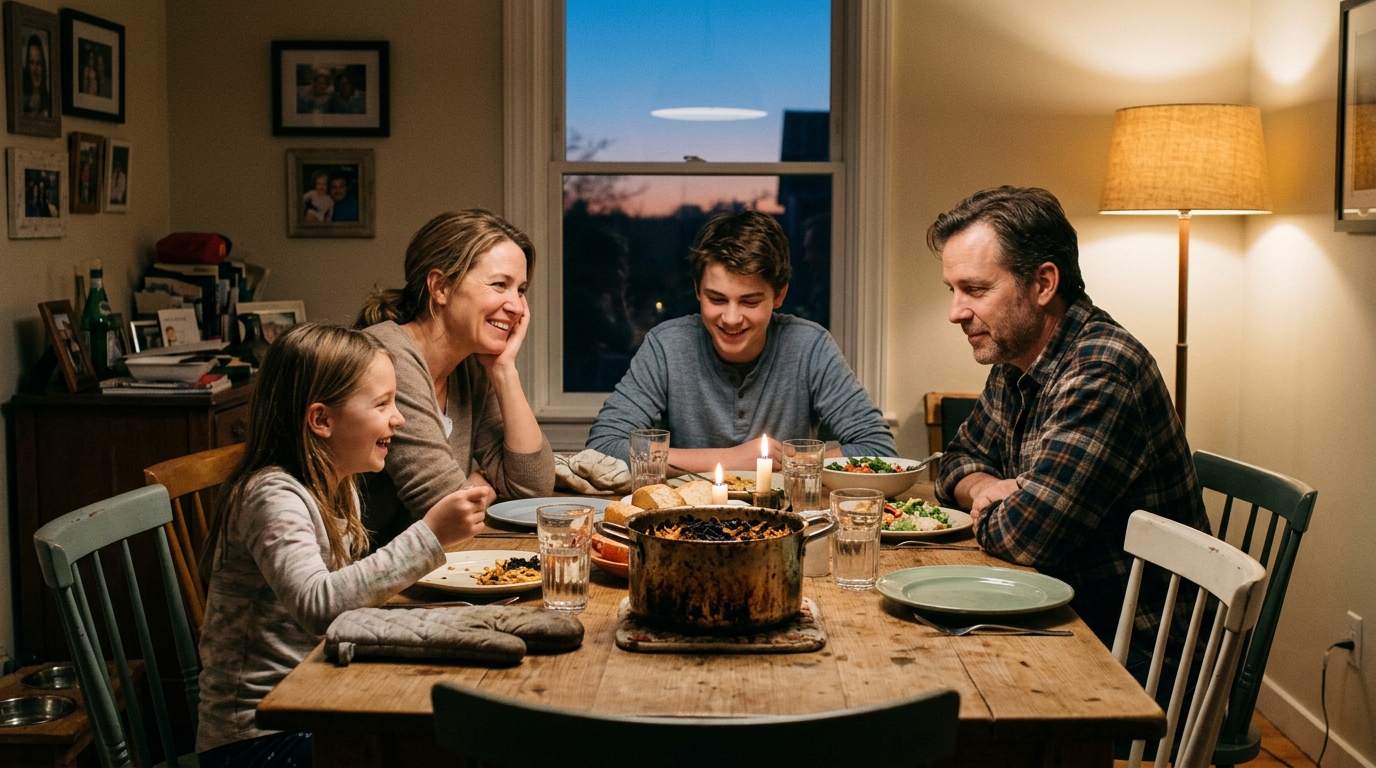
The kitchen light in the Marlowe house stays on later than most. Not because of homework or dishes, though there are plenty of both. It stays on because that is where the day gets put to rest, one plate at a time, around a scratched oak table that Daniel Marlowe found at a yard sale for forty dollars and refinished by hand.
This is a story about that table, and about the winter a man with nothing left decided to set it.
The Quiet After Everything Fell Apart
Eighteen months before the table, there was a different kind of silence. Daniel had lost his job at a distribution warehouse in the same month his marriage ended. His wife moved two states away for work and a fresh start, and the custody arrangement that followed left him with their two kids, nine-year-old Josie and thirteen-year-old Caleb, nearly full time.
He remembers those first months as a blur of cereal for dinner, eaten in front of a television that nobody was really watching. The kids retreated into their screens and their rooms. Daniel retreated into the garage, where he sat in his parked truck with the engine off, doing nothing, thinking nothing, just trying to hold together the pieces of a man he no longer recognized.
“I was ashamed,” he told me, on a call that ran long after the sun had gone down on his end. “I was physically in the house, but I wasn’t there. My kids were basically raising themselves, and I knew it. I just did not know how to start.”
The Night of the Burned Pasta
The turning point was not dramatic. It did not arrive with a speech or a miracle. It arrived on a gray Tuesday in February, when Josie came home from school and quietly asked if they could have a real dinner, the kind their grandmother used to make on Sundays.
She was not complaining. That was what undid him. She asked the way a child asks for something she has already stopped expecting.
Daniel said yes before he had any idea how. He boiled a pot of spaghetti, lost track of time while staring out the window, and returned to find the bottom scorched black and the whole kitchen thick with smoke. The smoke alarm screamed. Caleb came thundering down the stairs. Josie covered her ears and, to everyone’s surprise, started laughing.
They ate toast and jarred sauce at the counter that night, windows thrown open to the cold, all three of them coughing and smiling. It was a terrible meal. It was also the first time in months that the family had been in the same room for the same reason.
Rebuilding the Ritual, One Small Rule at a Time
Daniel did not try to fix everything. He tried to fix one hour. He decided that every evening at six, no matter what, the three of them would sit down together. He kept the rules deliberately small, because he knew a man in his position could not afford to promise something he could not keep.
Here is what the Marlowe dinner ritual looked like in those early weeks:
- Phones in a basket by the door. Not a punishment, just a pause. Daniel put his own in first.
- One cooked thing, however simple. Scrambled eggs counted. Grilled cheese counted. The point was the effort, not the menu.
- Everyone has a job. Josie set the table. Caleb cleared. Daniel cooked. Nobody was exempt.
- One question each. Before anyone could leave the table, everyone shared one thing from the day, good or bad.
- No fixing, only listening. Daniel made a rule for himself: when the kids spoke, he would not lecture or solve. He would just hear them.
It was clumsy at first. Caleb answered with single words. Daniel’s cooking was, by his own admission, “a crime scene.” But he showed up at six o’clock every single night, and slowly the consistency did what no apology could have done on its own. It rebuilt trust.
What Winds Down at the End of the Day
Something about the evening hour matters here, and Daniel has thought about it a great deal. By the time dinner comes, the day has already done its worst. The meetings are over, the job hunting is done, the small humiliations of being a struggling parent have already been absorbed. What is left at the table is just the three of them, tired and honest.
“Mornings are about getting out the door,” he said. “Nobody opens up in the morning. But at night, when the light goes soft and everything slows down, that is when people tell you the truth. I did not plan that. I just noticed it.”
It was at the table, around week six, that Caleb finally mentioned he had been eating lunch alone at school for months. It was at the table that Josie admitted she had been scared to ask her father for anything because he always seemed so tired. Those were not conversations Daniel could have forced. They came out because the room had become safe, and because the clock had finally slowed down enough to let them.
The Table Itself
By spring, Daniel had picked up part-time work and was slowly building toward something steadier. With a few spare dollars and a lot of spare evenings, he bought that old oak table and spent three weekends sanding it down. Josie helped, getting more stain on her hands than on the wood. Caleb, who had barely spoken to him in the early months, held the flashlight while Daniel worked on the legs.
When it was finished, they ate their first meal on it together. Nothing fancy: roasted chicken, rice, a bag of green beans. Daniel says he nearly cried when Josie ran her fingers across the smooth surface and announced, very seriously, “This is the best table in the whole world.”
Small Things That Changed
The shift did not happen all at once, but over the following year, the signs piled up quietly:
- Caleb started staying at the table after the meal ended, just to talk.
- Josie’s teacher called to say she seemed lighter, more willing to speak up in class.
- Daniel found steady work as a facilities coordinator, with hours that let him be home by five thirty.
- The kids began inviting friends over, because the house finally felt like a place worth coming to.
- Daniel stopped sitting in the truck.
Lessons That Settle In Once the Noise Fades
When I asked Daniel what he would tell another parent standing where he once stood, he took a long pause. Somewhere behind him, I could hear dishes clinking and Josie singing off-key.
“Do not try to rebuild your whole life,” he said. “That is too big. Rebuild one hour. Pick a small thing you can actually do every single day, and then do it, even when you are tired, even when it is bad. Especially when it is bad. The kids are not looking for a perfect dad. They are looking for a dad who keeps showing up.”
There is a gentle truth in that, one worth carrying into the quiet of your own evening. We tend to imagine that recovery requires something grand: a new job, a fresh start, a dramatic reversal. But so often it begins with something as plain as a pot on the stove and a place set for everyone you love.
A Thought to Take Into Tonight
As the day winds down where you are, consider the small rituals that might be waiting to be rebuilt. Maybe it is a shared meal. Maybe it is a walk after dinner, or a bedtime story, or just ten unhurried minutes of sitting with someone and asking how their day really was.
You do not need a perfect table or a perfect meal. You only need to show up, set the places, and let the evening do its quiet work.
The Marlowe kitchen light is still on as I write this, I am told. Dinner is long finished. The dishes are drying. And somewhere in that warm room, a father and his two kids are sitting a little longer than they have to, because for the first time in a long while, nobody wants to be anywhere else.