🎧 Listen to this story
Narrated by Kore · 7,561 characters
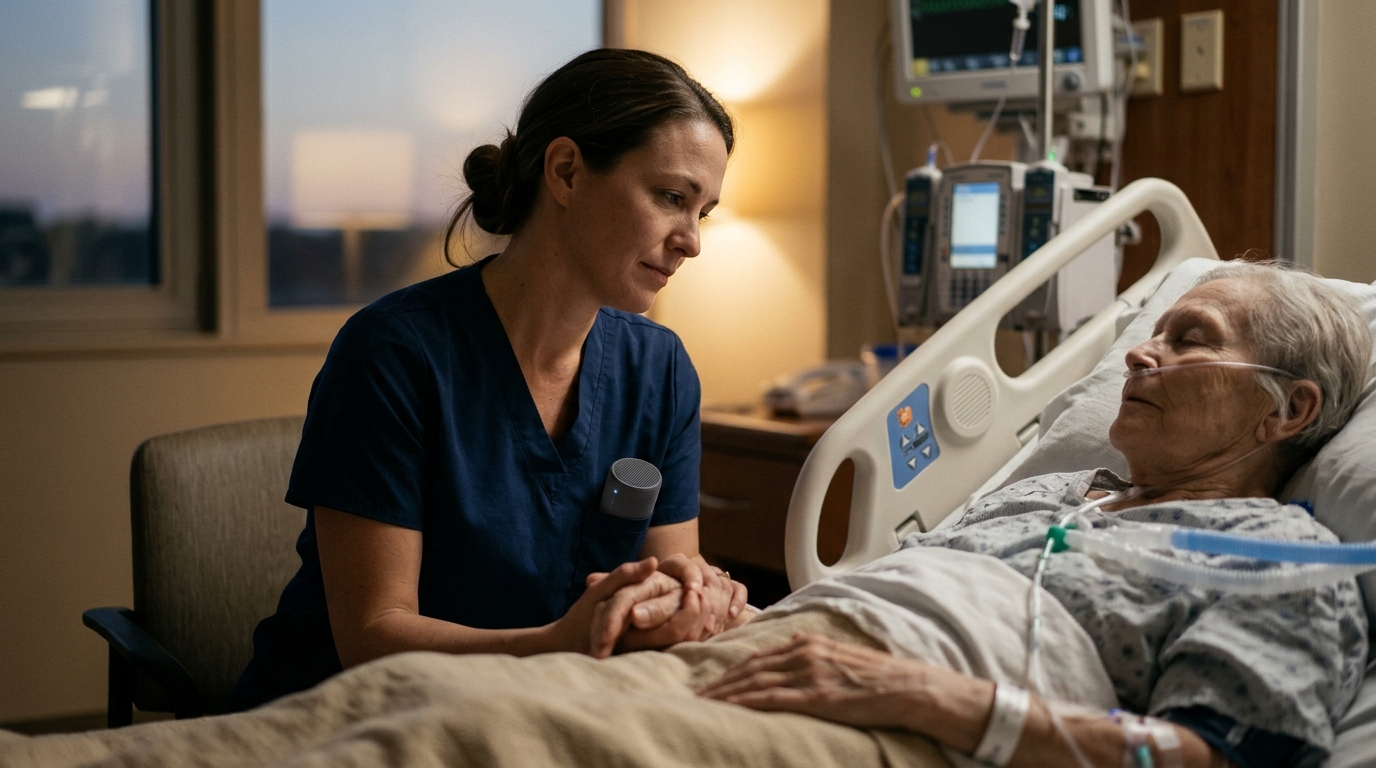
Somewhere around seven in the evening, when the visitors have gone home and the hallway lights dim to their night setting, the fourth floor of the intensive care unit begins to change. The monitors still chirp. The ventilators still sigh. But beneath it all, if you stand very still, you might hear something else: a faint piano, a cello, a lullaby played so softly it seems to come from the walls themselves.
That sound belongs to a nurse we will call Marguerite, a name she chose herself because she prefers that the story be about the music and not about her. She has worked the evening-to-night shift in a hospital ICU for nineteen years. And for most of those years, she has done one small thing that almost nobody asked her to do.
When a patient is dying, she plays them music.
How It Started
Marguerite remembers the night exactly, though she did not plan any of it. Early in her career, she was caring for an elderly man whose family lived three states away. His condition had turned quickly. There was no one at the bedside. The room was full of machines and empty of people, and she realized, with a feeling she still struggles to describe, that the loudest thing in the room was the sound of equipment keeping time.
She had a small phone speaker in her scrubs pocket that she used to listen to music on her breaks. On impulse, she pulled it out, found a quiet instrumental playlist, and set it on the windowsill. She sat with him for the last forty minutes of his life.
“I just couldn’t stand the thought of the last thing he heard being an alarm,” she says. “Everyone deserves better than a beep.”
She went home that night and did not sleep well. But she also knew, in the way you know things at the end of a long day, that she would do it again.
What the Evening Teaches
There is a particular quality to the hours after dark in a hospital. The rush of morning rounds is long gone. The doctors have made their decisions. The families, often, have been sent home to rest, or have not yet arrived. What remains is a kind of held breath.
Marguerite has come to believe that this is when the most important work gets done. Not the procedures or the charting, but the sitting. The staying. The quiet company of another human being while the world outside the window goes blue and then black.
“Days are for fixing,” she says. “Evenings are for accompanying. When there is nothing left to fix, the only thing left is to not let someone be alone.”
Her Simple Evening Ritual
Over the years, Marguerite has refined what she does into a small, gentle routine. She never makes a show of it, and she never imposes it. These are the quiet steps she follows:
- She dims the room. She lowers the overhead lights and, where possible, turns off the harshest monitor alerts so the space feels less like a machine and more like a room.
- She asks the family first. When relatives are present, she asks what kind of music their loved one enjoyed. A hymn, a jazz standard, an old country song, a lullaby sung in a language she does not speak.
- She keeps the volume barely there. The music is meant to be felt more than heard, a warmth in the background.
- She stays when she can. If no family is there, she pulls up a chair, even if only for a few minutes between her other duties.
- She holds a hand. Sometimes the music is only the beginning, and the real comfort is a steady, human touch.
The Science Behind the Softness
It would be easy to dismiss this as sentiment, but researchers who study end-of-life care have long noted that hearing is believed to be among the last senses to fade. Many palliative care professionals encourage families to keep speaking, reading, and playing familiar sounds, because there is reason to think a person may still perceive them even when they can no longer respond.
Marguerite does not claim to know exactly what her patients experience. She is a nurse, not a mystic. But she has noticed small things over the years: a furrowed brow that smooths, a restless hand that goes still, a breathing pattern that slows into something gentler. She cannot prove the music caused any of it. She only knows she would rather try than stand in silence.
The Night a Daughter Thanked Her
One evening stays with her more than most. A woman in her fifties had flown in too late to say goodbye to her father while he was awake. She arrived at the ICU shaking, apologizing to everyone, apologizing to the room itself.
Marguerite sat beside her and asked, softly, what her father had loved. The daughter laughed through her tears and said he used to hum old big band songs while he did the dishes. So Marguerite found a playlist of them, set the speaker on the bedside table, and turned it down low.
For the next hour, the daughter held her father’s hand and hummed along, off key, crying and smiling at the same time. When he passed, quietly, somewhere between one song and the next, the room did not feel empty. It felt full of something tender.
“She told me later that she had been terrified of the silence,” Marguerite recalls. “She said the music gave her something to do with her grief. It gave her a way to be with him.”
What She Carries Home
People often ask Marguerite how she does this work year after year without being swallowed by it. Her answer is unglamorous and honest. She does not always manage it. There are nights she drives home in silence, hands tight on the steering wheel, and lets herself cry in the parking lot before she goes inside.
But she has also built her own small evening ritual to set the day down. She makes tea. She sits on the back step if the weather allows. She says the names of the people she cared for that day, quietly, one by one, the way you might light small candles.
“I don’t want to forget them,” she says. “They were someone’s whole world. Even if I only knew them for a few hours.”
Why It Matters
Hospitals are built to save lives, and they do it magnificently. But they are not always built for the moment when saving is no longer possible. Those moments belong to the people who happen to be in the room: the nurses, the aides, the chaplains, the families. What they choose to do with that time can shape how a person leaves the world.
Marguerite has never asked for recognition. Her colleagues, though, have started to notice. A few have begun carrying small speakers of their own. A newer nurse on her unit recently told her, shyly, that she had played a lullaby for a patient the week before, and that it had felt like the most meaningful thing she had done all month.
That is how a small kindness travels. Not through policy or program, but from one tired, tender pair of hands to the next.
A Few Quiet Takeaways for Your Own Evening
- Presence is a gift. You do not need the right words. Sometimes you only need to stay.
- Small gestures carry weight. A song, a held hand, a dimmed light can matter more than any grand act.
- Dignity lives in the details. How we treat people at the very end says something about who we are.
- Remember the ones you cared for. Honoring someone does not require a monument, only a moment.
A Thought to Carry Into the Night
As the evening settles around you tonight, take a moment to think about the people in your life who do quiet, unseen work while the rest of the world winds down. The nurses on the late shift. The caregivers who sit up with the sick. The friends who answer the phone at midnight.
Somewhere right now, in a dim room on a quiet floor, a small speaker is playing a soft song. Someone is holding a hand. And no one, not tonight, is leaving the world in silence.